
Add Fazzaco to desktop

Add Fazzaco to desktop

Access Fazzaco from desktop next time

Add now
English

Bridge Technology and What It Brings to Us

Source: Fazzaco
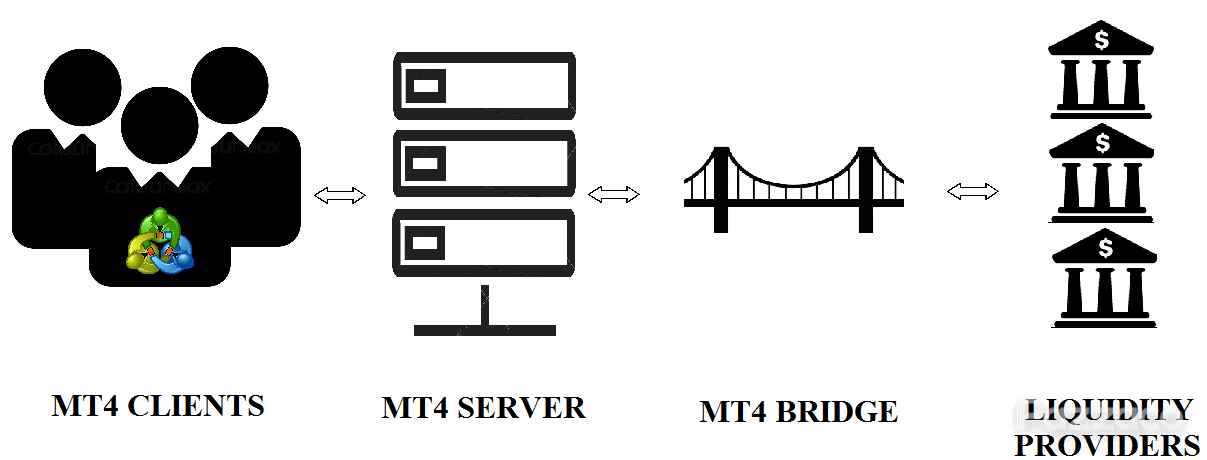
In the retail forex market, liquidity is one of the most important factors for investors to make profits. Higher profits encourage faster trades. Nevertheless, if you want your trading orders to be sent to the global forex market, then you may need a “bridge”.
To understand what a bridge is, we need to start with retail forex brokers. It is known that retail forex brokers fall into two categories, dealing desk (DD), where the brokers become the counterparts of the investors and execute orders and keep the position in an inner liquidity pool, and non-dealing desk (NDD), where the brokers simply pass the order to the interbank foreign exchange market. 
The MetaTrader4 trading platform is designed for dealing desk brokers and allow trading between a broker and its clients and so does not provide for passing orders through to the wholesale forex market, but the popularity of the trading platform means that retail forex traders as well as brokers want to provide a way to trade directly on the interbank foreign exchange market via MT4. Therefore, forex brokers have to choose a bridge technology solution to link to liquidity providers.
Bridge connects MT4 servers and liquidity providers, thus integrating forex brokers, orders, and liquidity (in the interbank forex market). An order can be sent from a forex broker to liquidity provider through a bridge.

​Through bridge technology, forex brokers are able to:
1. Improve customer loyalty
Through bridge technology, retail forex brokers can improve customer loyalty and deal with orders more efficiently, which is the largest advantage of the bridge solution.
​2. Keep the trading platform stable
The key to the stable performance of a trading platform is the extensibility and reliability of the bridge solution. Any bridge that may delay more than 1 millisecond is unacceptable. A bridge technology provider must know a thing or two about the trading platform. Usually, an MT4 bridge need to be tested for more than a month before it can actually go live.
​3. Defuse Risks
Retail forex brokers may vary in their ways of executing orders. There are two main types of bridge technology which effects the way orders are processed: the STP and ECN models. The bridge technology does not set any limitations for brokers in choosing the models, but as an increasing number of investors have turned to algorithmic trading with , many brokers feel reluctant to bear the risk of being a counterpart in a trade. To lower the risks, many brokers start to provide STP or ECN trading models.
Insiders suggest that the bridge technology provides higher transparency for brokers, exposing them to more effective information and enabling them to keep making favorable decisions. Existing bridge technology can support various operating and executing models of forex brokers and help them reduce risks.
4. Increase Profits
Bridge technology is characterized by low-delay STP, flexible order path, advanced client information, extended administration and operating capability, and liquidity management and operation, thus significantly reducing brokers’ time in operation and risk management. Some bridge technology can even monitor slippages and trading on a real-time basis, thus maximizing a broker’s profit.
Although MetaQuotes tries to replace MT4, which doesn’t have any bridging function, with MT5, which has a built-in bridge, most of retail forex brokers are strong advocates of the former and prefer to pass clients’ orders to the real forex market. ​​
​​​​
For other bridge-related passages, please refer to:​
How to Choose A Bridge Vendor?
An Introduction to MT5 Gateway
​
Create Company Page