When foreign exchange dealers such as forex brokers establish their own retail business, one of the first things they do is find liquidity providers (LPs). LPs are typically firms or institutions that provide currency pair pricing and then participate in the trade as either a buyer or seller.
For the foreign exchange market, the major global banks are the main sources of liquidity. Additional sources of liquidity include market players such as central banks, hedge funds, foreign exchange investment managers, retail forex brokers, and high net worth individuals.
Brokers can obtain liquidity from these or any LP in the interbank foreign exchange market. This enables brokers to offer and provide liquidity to their own clients for ordinary trading.
Liquidity providers’roles
Foreign exchange LPs provide liquidity services for non-bank market participants, including:
Integrate various market quotations, obtain best price and forward to downstream retail forex brokers and investors
Clear customer orders to recipients in the global markets
Provide liquidity data services, liquidity technology development, and support for forex brokers.
Liquidity Providers’ Work Model
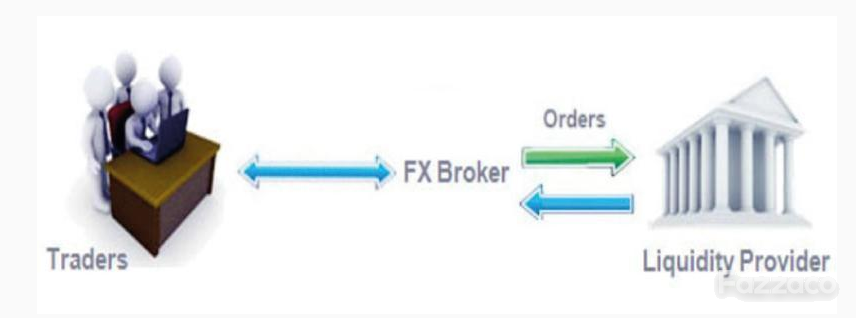
Practically, a Forex liquidity provider will provide Forex prices that are streamed through your online trading broker’s platform for instance Metatrader 4 or Ctrader. The online trading broker will add onto the spread offered by the liquidity provider as well as decide the commission to charge before passing the price quotes onto the traders so as to make a profit. This way, your broker just passes on the exchange risk to the liquidity provider.
In short; the liquidity provider offers liquidity to your Forex broker; who in turns passes on this liquidity to you as a trader with a mark-up on the spread. In this model, the liquidity provider will either be taking the opposite side of the positions taken by the online brokers’ traders or in turn pass the exchange rate risk to a bigger liquidity provider (tier one liquidity provider).
Tier one liquidity providers are usually large banks/investment banks and are not available to retail traders due to the higher amounts of trading volume required in order to deal with them. For this reason, retail traders have to use online trading brokers to perform their transactions.
(source: allfxbrokers, fortex)




 Subscribe Now