


How Was Elon Musk's First Day as Twitter's Owner? Apparently There's A Lot to "Sink In"
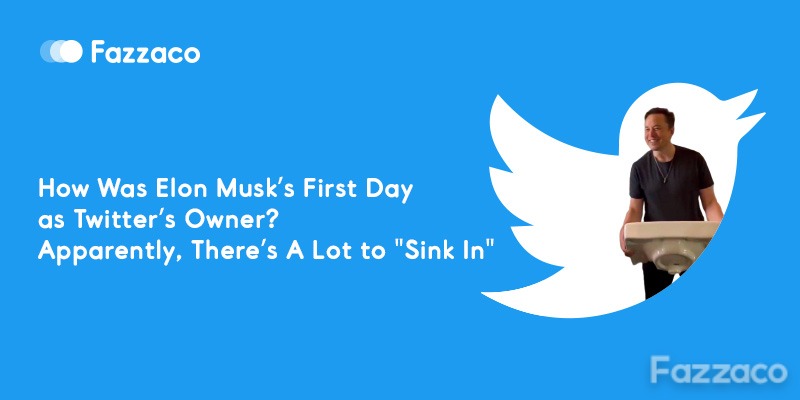
It was all just a regular Wednesday in San Francisco, California, until Elon Musk, the South African billionaire who owns Tesla and SpaceX, and now the official owner of Twitter, walked into the HQ building lugging a sink. Another Musk's dad joke, yeah, he literally tweeted "let that sink in".
Following on his first day as the social media giant's new owner, however, it looks like what Elon Musk did was more than a splashy entry.
Acquisition of Twitter: A Monthslong Saga
Elon Musk's purchase of Twitter started on April 14, 2022. The entrepreneur made the initial offer to buy Twitter for $43 billion, having already paid $2.64 billion for 9.1% of the company's stock to become its largest stakeholder. Musk first accepted Twitter's invitation to join its board of directors, but then declined. The following day, Twitter revealed a "poison pill" plan to stave off an invasion. On April 25, the board of directors of Twitter unanimously agreed to take the company private after accepting Musk's $44 billion takeover offer. Musk said he intended to expand the platform's functionality, make its algorithms open source, stop spambot accounts, and advance free expression.
Musk, however, declared his desire to end the contract in July, claiming that Twitter had broken the terms by refusing to take action against spambot accounts. Soon later, the business filed a case in the Delaware Court of Chancery against Musk, and the trial is scheduled to start on October 17. On October 4, however, Musk declared that he was going forward with the transaction.
Then on Thursday (Oct 27), the day after Musk made a presence at Twitter's HQ with a sink, announced that the deal with the Twitter was officially closed.
That Man Swaggered His Way In. Three Top Executives Got Escorted Out
If only we were watching the opening episode of the seventh season of Silicon Valley, and this obviously is gonna be one hell of Emmy Awards-winning drama.
In addition to the sink pun, Musk's first action as the owner of the social networking site was to fire Parag Agrawal, the CEO, Ned Segal, the CFO, Sean Edgett, the general counsel, and Vijaya Gadde, the head of legal policy, trust, and safety.
The executive team at Twitter, as a matter of fact, has seen quite some reshuffling since Agrawal replaced Dorsey. Agrawal began working for the company in 2011 as the CTO before becoming the CEO. The Chief Design Officer of Twitter, Dantley Davis, who joined the firm in 2019, and the Head of Engineering, Michael Montano, who started the company in 2011, both left within a few weeks as a result of Agrawal's restructuring. Rinki Sethi, the chief information security officer, and Peiter Zatko, the head of security, left Twitter shortly after. Following Agrawal's request for him to resign, Twitter's GM of Consumer, Keyvon Beykpour, revealed in May that he would be departing the business after seven years there. Bruce Falck, the leader of the revenue product for Twitter, also departed the organization at the same time.
And all of that, folks, is just the beginning.
Twitter Cannot Become A "Free-for-All" Hellscape
Elon Musk sent a message to the social media platform's advertisers on Thursday that "Twitter obviously cannot become a free-for-all hellscape", which is being accused of backtracking his previous promise to make Twitter a community with 100% freedom of speech.
In a statement, Musk explained his attempt to promote freedom of speech does not suggest that “anything can be said with no consequences!”
Musk's statement hints that he might still put bans on hate speech, threats of violence and COVID-19 disinformation on the platform.
As the message triggered online public outcry, many comments are saying that what Elon Musk is doing will not only sabotage the online democracy, but will also backfire, and when that happens, his little "let that sink in" show would become a jinx to himself, predicting that "Twitter is sinking".
Some people think otherwise. For instance, some believe that Twitter is largely a product of who you follow. If you follow a lot of professionals in a certain field, Twitter is quite helpful and occasionally entertaining. It will be hell for you if you follow a bunch of garbage politicians or super-online jerks who spew the most ludicrous crap.
Some others believe that it is simply crazy trying to moderate a website on a global scale. Say, if you put a ban on A type of content, easy-peasy, just remove them all. But what you don't know is that another community might jump out and point it out to you that certain A content under particular circumstances should be treated differently. At the end of the day, everyone's pissed, and nobody is happy.
Conclusion
The change to Twitter's ownership is a big thing which will ultimately impose effect on every aspect of our life, and financial industry will not be an exception. As what is mentioned earlier, all of this is just the beginning of a big drama, and we still have no idea that whether fintechs, brokerages, crypto exchanges, will be the audience, or part of the show.
 Subscribe Now