


Credit Suisse Turmoil Resurfaces: Uncovering the UBS and Credit Suisse Merger
In this February, Credit Suisse released its 2022 financial report, showing a sharp decline in net income from CHF 22.7 billion in the 2021 fiscal year to CHF 14.9 billion, a decrease of 34%. In the article "Will Credit Suisse Survive Out 2023?" by Fazzaco, it was pointed out that although Credit Suisse has taken measures to deal with the worsening situation and its chain of scandals, many insiders are not optimistic about the effectiveness of these measures given the huge loss reported.
Swiss Government Stepping In
To address the trust crisis of confidence in the market, the Swiss government stepped in and facilitated a full stock acquisition of Credit Suisse by UBS Group on March 19, with a total acquisition amount of $3.25 billion. In addition, the government provided potential loss guarantees of CHF 9 billion for the merger. As one of Switzerland's two largest banks, UBS stated that after this historic merger, it will still focus on growth in the Americas and Asia-Pacific regions, while reducing the investment banking arm of Credit Suisse.
Karin Keller-Sutter, the Swiss Financial Minister suggested that the payment transactions with Credit Suisse in Switzerland would have been significantly disrupted if the government hadn’t stepped in. “Credit Suisse would not have survived Monday (March 20), without a solution,” she added.
A Controversial Rescue Operation
Widespread anxiety and uncertainty has been shown in the Swiss public after one week into the merger. The fact that their government activated emergency laws to endorse UBS taking over Credit Suisse has led to discussions on the absence of democratic debate.
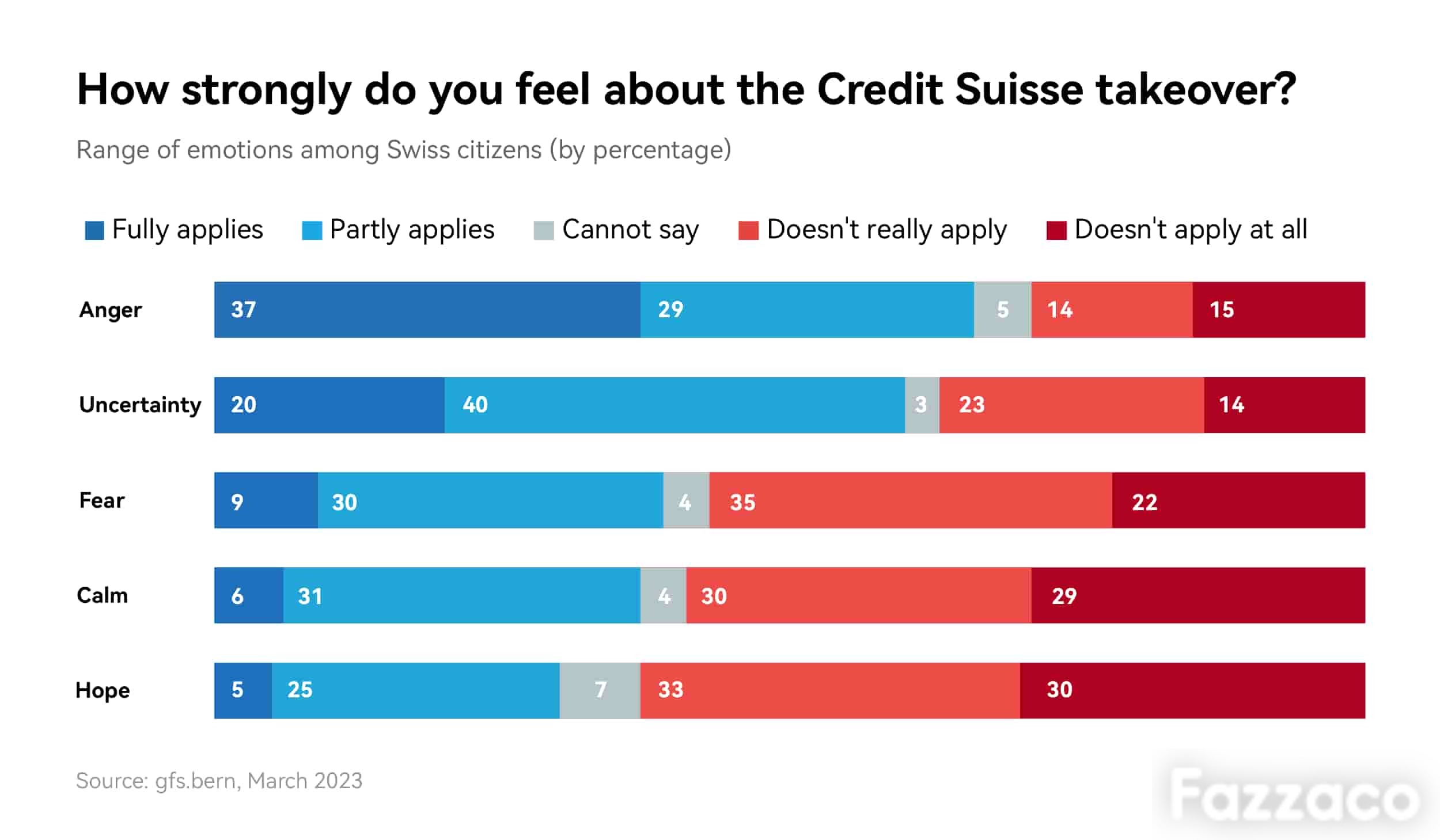
A survey conducted by the gfs.bern, a Swiss practical social research organization, showed that 66% of Swiss citizens are angry about this so-called "rescue", and 60% feel insecure. While voters of left-wing parties expressed the highest level of dissatisfaction, the feelings of unease and anger are widespread, almost covering all political inclinations among respondents. Against this backdrop, the Swiss political landscape is under immense pressure to find a solution that the public will accept.
Octavio Marenzi, CEO at Opimas, a renowned consultancy firm, believed that "Switzerland's standing as a financial center is shattered. The country will now be viewed as a financial banana republic." In Marenzi's opinion, this tragic failure of Credit Suisse will have a serious impact on other Swiss financial institutions, and the country's image, which has long been known for its prudent financial management and sound regulatory supervision, will no longer exist.
Is This the Best Way Out of Trouble?
Although FINMA, the Swiss regulator, has not officially responded to the public's dissatisfaction, as the main promoter of the merger, Karin Keller-Sutter, the Financial Minister, insists that there is no better solution. She believes that if Credit Suisse is allowed to go bankrupt, it will have a serious impact on the Swiss economy, so the government must take action to maintain market stability.
Many politicians pledged never to bail out banks again after the 2008 financial crisis, but the Rescue of Credit Suisse, orchestrated with public money, is telling us that banks are still so vulnerable that they might collapse the next day, and adverse impact may quickly be seen in the national economy.
Politics and Economics, Two Sides of A Coin
The Swiss Federal Council denied allegations that they were pressured by the United States to intervene. Some believed that US Treasury Secretary Janet Yellen had pressured them to take action after the recent events such as Silicon Valley Bank and Signature Bank in the United States that have already caused a crisis of trust in Americans’ backyard, and the US does not want to see Credit Suisse's bankruptcy and liquidation continue to cause turbulence in the international financial market.
The Credit Suisse crisis undoubtedly also stirred the nerves of all political parties in Switzerland. On October 22 of this year, the alpine state will hold federal elections, and new members of the National Council and the Council of States of Switzerland will be elected. The Social Democratic Party was the loudest opponent of the merger and called for a reassessment. Therefore, the party gained a lot of support from the public, with 37% of citizens expressing support for its standing. It can be foreseen that this bank crisis, following the US SVB incident, may change the political balance in Switzerland.
 Subscribe Now