


Fazzaco AI Forum: Voices from Brokerages and Fintech Leaders - When Finance Meets ChatGPT
Have you ever imagined having an intelligent robot to help you with your financial issues, give you professional advice, and even chat with you? This plot, seemingly from a sci-fi novel by Isaac Asimov, is becoming a reality today.
In recent years, there has been a tremendous advance in conversational AI. In particular, the release of OpenAI's Generative Pre-trained Transformer (ChatGPT), an AI behemoth with 1.3 billion parameters, has shocked the world. It is a language model-based AI that can not only generate poetry, prose, and news reports, but also write decent novels.
The financial and technology sectors have always been rich with innovative intersections and collaborations. The proliferation of generative AI like ChatGPT has naturally attracted the interest and attention of financial institutions. But just as many sci-fi novels have portrayed, an overly advanced AI always leads to disastrous consequences for humans. As this technology gradually takes shape in reality, people inevitably begin to worry: are we heading towards a brighter utopian future of AI, or are we falling into a damp and gloomy nightmare of "high-tech, low-life" cyberpunk?
Welcome to "Fazzaco AI Forum"! Today, we have invited leading brokers and fintechs across the forex market to join us in discussing the challenges and opportunities that generative AI technologies, represented by ChatGPT, bring to the financial industry, and the speculation and controversy they have sparked.
The Popularity of ChatGPT and the Dilemma It Presents in the Information Overloaded Mobile Era
We live in a mobile era dominated by hot trends, memes, short videos, and live streams. People are constantly bombarded with massive amounts of information, and the sudden rise of ChatGPT's popularity is just another example of what this is all about. This technology quickly became the talk of the town and swept through all industries, with some in the financial sector embracing it while others remained cautious.
When ChatGPT first became popular, it was the GPT-3.5 Turbo version. By March 2023, OpenAI had launched an API based on the 3.5 Turbo version, allowing third-party developers to integrate ChatGPT into their own services for creating chats. Devexperts, a fintech that provides technical solutions for the forex market, cryptocurrency, and traditional exchanges, was one of the first companies to jump on the bandwagon. Shortly after OpenAI released the API in March, the company announced the integration of ChatGPT into their charting tool DXCharts.
"Traditionally, our industry is conservative, and though we can read that multiple companies already use ChatGPT in their business, we don't hear that much from the fintech companies yet," Andrey Shuvlenov, the DXcharts Product Manager, said to Fazzaco, "We decided to start with something simple, yet useful...With the power of AI, we're able to provide an encyclopedia integrated right into the UI for the end-users to learn the basics of tech analysis for financial markets."

(Andrey Shuvlenov, Product Manager of DXCharts, Devexperts)
"Just imagine—you type something like: 'ChatGPT, find the best entry level based on MACD and RSI for TSLA stock'. And it's there, on your chart," Andrey visualized a wonderful scene in which the product can be used.
On a positive note, Viktor Karpinsky, the Chief Product Officer at AximTrade, an ASIC-regulated online brokerage, maintains an optimistic outlook and commented that "we strongly believe in a nice combination between AI technology and human." Viktor was one of the guests inrterviewed on site during Fazzaco's Dubai Expo last year. However, he also pointed out that we may never stop thinking just because the technologies are doing the job, using Google Maps as an example, "we can't imagine life without it. But if you always use Google Maps, this is way much harder for you to navigate in the city yourself without your phone. You are not training your mind to navigate and learn the road, as you always have Google Maps with you."

(Viktor Karpinsky, CPO at AximTrade)
Indeed, while ChatGPT has risen rapidly and taken the world by storm, it has also created a regulatory void. Recently, thousands of tech leaders and researchers, including Elon Musk, have called for a halt to the development of advanced AI systems and warned of the profound risks they pose to society and humanity in a letter. In the financial industry, since the beginning of 2023, Wall Street giants such as Bank of America, Citigroup, and Goldman Sachs have issued ChatGPT bans to their employees, and JPMorgan Chase has also restricted its use due to compliance concerns.
The prevailing view in the industry is that these institutions have issued the bans out of concern for information leakage and security issues. Samuel Hertz, the Chief Operating Officer of EBC Group, expressed that he understands the bans, and confessed to Fazzaco that the way they do things at EBC are a bit old school and cautious, which is exactly why AI-assisted tools are not gonna be rolled out "until we feel 100% confident that these services would add value to our clients and stakeholders."

(Samuel Hertz, Chief Operating Officer at EBC Group)
Raouf Boussaoui, the Content Manager at CPT Global, held a similar view, "while ChatGPT is a fascinating development, we are still evaluating its potential use in our trading processes. Introducing any AI tool, even in the well-established field of robotic trading, involves careful consideration of its merits and potential impact on our business." He gave Fazzaco a few examples: Lately, Italy imposed restrictions on ChatGPT and launched an investigation over privacy concerns; Wall Street, too, faced over $2 billion in fines resulting from a probe into the failure of global financial firms to monitor employees' communications on unauthorized messaging apps like WhatsApp. Therefore, he believes that in a highly regulated industry such as finance, brokers may be reluctant to adopt AI due to similar concerns.

(Raouf Boussaoui, Content Manager at CPT Global)
What Benefits Will Generative AI Bring to Brokers and Fintechs?
While many interviewees have expressed concerns about AI like ChatGPT, most people still believe that technological advancements bring positive benefits. Among them, Nadhir Ninouh, the Marketing Director at XTB, a UK FCA-regulated broker, listed some of the advantages that AI can bring to their business as follows:
· Market analysis
· Customer service
· Trade execution
· Compliance

(Nadhir Ninouh, Marketing Director at XTB)
Samuel Herts at EBC added details to Trade execution and Compliance: "(First), AI technologies can help brokers execute trades more quickly and efficiently while minimizing human error. (Second), AI technologies can assist brokers in complying with regulatory requirements by automating compliance monitoring and reporting."
This makes it clear that automation is the most prominent edge of AI, especially when it comes to automating repetitive tasks. Antonis Kountouretis, the Chief Technology Officer at GBE Brokers made an excellent conclusion as follows: "Artificial intelligence is an incredibly valuable tool, capable of enhancing our efficiency and elevating the quality of services we provide. By streamlining various tasks, it allows us to accomplish them in a shorter time-frame. However, it is essential to recognize that AI cannot substitute the training, expertise, or personal touch offered by a skilled professional. As it currently lacks critical thinking abilities, AI remains a complementary tool rather than a replacement for human expertise."

(Antonis Kountouretis, CTO at GBE Brokers)
Evgeny Sorokin, the Business Development VP at Devexperts, made his point that if we were considering generative AI in general, not ChatGPT in particular, the technology has already been extensively used in areas such as routine automation for end users, customer support and content creation.
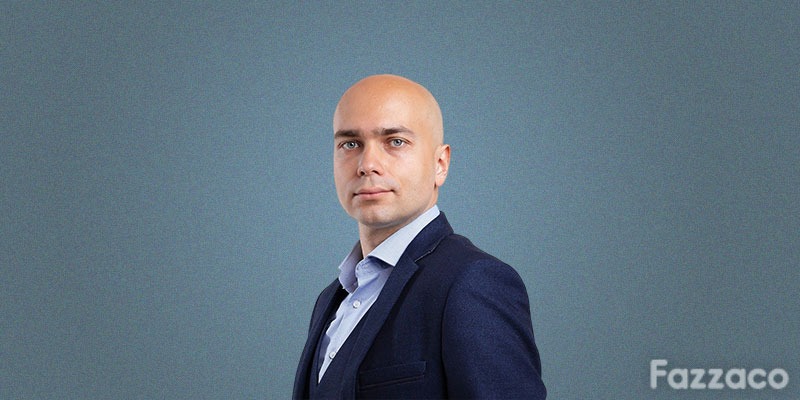
(Evgeny Sorokin, Business Development VP at Devexperts)
Similar to Devexperts, Bridgewise from Israel is another AI-advocating fintech firm. In our talks, the founder of the Tel Aviv-based company, Gaby Diamant, told us that their AI-based platform has been helping investment professionals in the finance sector to enhance their abilities, both for their organization and for their clients, "leading banks, investment houses, stock exchanges, and trading platforms worldwide have already integrated our technology."
"There is an unprecedented opportunity here for financial advisors and other experts to harness the power of AI for their own needs," he added.

(Gaby Diamant, Founder & CEO at Bridgewise)
What Are the Limits of Techs Like ChatGPT? How Far Can We Trust Them?
When it comes down to it, the biggest advantage of AI is still its speed - its ability to process vast amounts of information quickly, especially when it comes to automating repetitive tasks. While language models like ChatGPT may be well-trained, they still don't possess the ability to exercise judgement. A study from Stanford University showed that GPT-3 can solve 70% of theory-of-mind tasks, which is comparable to a 7-year-old child. The mind of GPT-3.5 is similar to that of a 9-year-old. Therefore, for AI that has not yet developed consciousness, no matter how powerful its capabilities may be or how well it can mimic human behavior, as a machine in nature, it still has limitations and even biases.
Styliana Charalambous is the Head of Investments & Market Research at Pure. She believed that "the role of human expertise in the financial industry will continue to be important, and brokers and other experts will remain valuable partners for clients seeking investment analysis and consultation."

(Styliana Charalambous Head of Investments & Market Research at Pure)
"All AI models, including ChatGPT, are only as unbiased as the data they are trained on. If the training data contains biased information, the model may learn and reproduce those biases," Nadhir Ninouh at XTB went straight to the heart of the matter, and pointed out the very nature of ChatGPT. "The model is still prone to fantasizing. It would rather make something up than admit it doesn't have the correct answer," Evgeny Sorokin commented, taking the point one step further.
When we were discussing to what extent can we place our trust in the AI, Ivan Kunyankin, the Senior Data Scientist at Devexperts, also Evgeny's co-worker, brought up that on behalf of many, it's highly desirable to see some disclaimers every time we read something generated by ChatGPT, "and it's not about the early stage of the product, but rather that it's focused on generating human-like responses. This small detail leads to ChatGPT being good at making a great impression even when it provides misleading and incorrect information sometimes."

(Ivan Kunyankin, Senior Data Scientist at Devexperts)
Some Fear Jobs Taken by AI Like ChatGPT, But We As Humans Should Never Fear Technological Progress
Over two centuries ago, James Hargreaves invented the Spinning Jenny, which greatly improved work efficiency and became one of the early achievements of the Industrial Revolution. However, the widespread use of machines quickly replaced jobs that were previously done by humans, sparking the Luddite movement and other anti-machine movements. With the rapid development of technology and the rise of artificial intelligence, the discussion about whether machines can replace some human jobs is heating up again, and the financial industry is constantly challenging its own survival in this tide of change. Especially since 2023, the financial industry has seen a wave of layoffs, which has made people even more worried.
The industry leaders spoke with Fazzaco today made it clear that they understand the concerns of some employees about the possible impact of AI on their jobs, but they still hold different views against such pessimistic sentiment, of which Viktor from AximTrade has made an excellent conclusion: "We are not afraid of the progress, and our employees will be always nice complimentary to the evolving technology. In the brokerage business, every day we encounter something new, market is new everyday and it creates scenarios, which we never had in the past, so only human brains can help to resolve the issues, and human brains can do it only because it collected sufficient experience over the time."
Discussions Aside, Let's Hear What ChatGPT Itself Has to Say
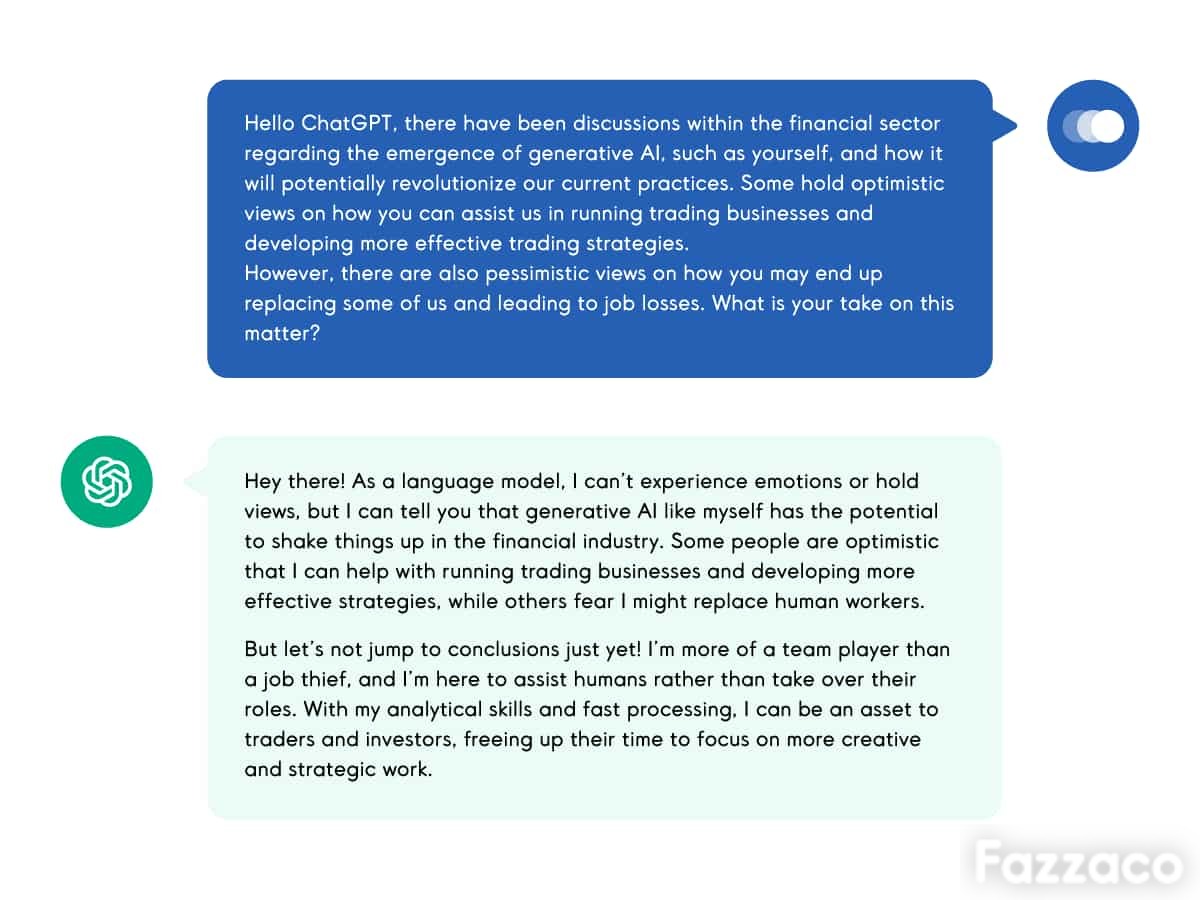
Fazzaco: Hello ChatGPT, there have been discussions within the financial sector regarding the emergence of generative AI, such as yourself, and how it will potentially revolutionize our current practices. Some hold optimistic views on how you can assist us in running trading businesses and developing more effective trading strategies.
However, there are also pessimistic views on how you may end up replacing some of us and leading to job losses. What is your take on this matter?
ChatGPT: Hey there! As a language model, I can't experience emotions or hold views, but I can tell you that generative AI like myself has the potential to shake things up in the financial industry. Some people are optimistic that I can help with running trading businesses and developing more effective strategies, while others fear I might replace human workers.
But let's not jump to conclusions just yet! I'm more of a team player than a job thief, and I'm here to assist humans rather than take over their roles. With my analytical skills and fast processing, I can be an asset to traders and investors, freeing up their time to focus on more creative and strategic work.
Final Thoughts: AI's "Omega Point"
French philosopher Pierre Teilhard de Chardin put forward an interesting and profound idea known as the "Omega Point". He believed that the human mentality is evolving from dispersion to aggregation, following the natural law of evolution and constantly developing towards a common direction. He used the Greek letter Ω (Omega) to represent the direction of this development and the ultimate destination. In other words, human consciousness is constantly approaching and converging towards the "Omega Point", which represents the ultimate destiny of humanity.
This viewpoint also applies to the development of artificial intelligence. Therefore, all discussions about AI have to wait for its "consciousness" to gradually improve, until it reaches the true "Omega Point". Only when this point arrives can we reveal the ultimate destiny of artificial intelligence.
Read More:
Listen to the Article: #ChatGPT, How Will It Revolutionize Finance?
Fintech Yearbook 2021 - AI, Automation, Cloud and API
How Artificial Intelligence can Help Your Brokerage in 3 Ways - Fintech Series (V)
 Subscribe Now