


Challenge Costs of Major Prop Firms Explained
One of the reasons why prop trading is so widely embraced among retail traders is the fact that not every one is able to afford to trade big in the market, and many of them trade as a means to earn a living. With prop firms' funds, these people can easily access the market with their expertise to generate profits without shouldering the financial risks associated with trades.
Prop firms are no philantropists for sure. Usually, traders have to pay a fee to take up a "challenge" in which they will be assigned with a demo account to trade, enabling firms to evaluate traders' capabilities. Only those who achieve the set profit targets are eligible to upgrade themselves to funded traders. Hence, the "challenge" acts as a risk control for prop firms. Today, we'll delve into how prop firms employ the "challenge" to manage risk, the potential for scams, and contrast the "challenge" costs across six prominent prop firms.
"Challenges", How Prop Firms Control Risks
At its core, prop firms provide traders with fund for trading, which is why some refer to them as "trader-funded firms." Yet, prop firms do not literally just hand out money; they offer a simulated trading environment and demo accounts that closely mirrors the real one with slight differences. Firms then utilize algorithmic trading (algo trading) and other automated mechanisms to mimic traders' moves on demo accounts for actual transactions.
Before one can call himself/herself a prop trader, firms enforce rigorous risk management protocols to vet applicants through the aforementioned "challenge," which typically involves a fee. The intent of this fee is to ascertain whether traders have the requisite skills and knowledge for profitable and accountable trading, or at least what being said is true for those firms that do not intend to just rip off some poor traders' money and disappear.
Upon passing a "challenge," traders can upgrade and share in the profits from their following trades. The profit split generally ranges from 60% to 90%.
Conflicts of Interest Between Prop Firms and Traders
Now, if you go to any social media platform or forums where prop traders frequent, it's not uncomon to come across accusations of how prop firms are simply trying to scam them. I am not saying those claims are illy grounded, as fees paid for unsuccessful challenges are no where from being refundable. This predicament bears resemblance to Ponzi schemes, where if 99 out of 100 participants fail, their fees will fund the profits of the sole successful participant. This is especially true for firms boasting a 100% payout rate, as most prop firms depend solely or mostly on challenge fees for revenue.
Nonetheless, it's crucial to point out that trading, in its very nature, is inherently fraught with risk. Prop firms offer a platform for those with superior strategies and acumen to capitalize on larger capital pools and leverage.
Challenge Costs of Six Big Prop Firms
We have six prop firms here: FTMO, Funded Next, E8 Markets, FXIFY, The Trading Pit, and The5ers. We've compared their challenge costs using 1-step, 2-step, 3-step, to challenge account sizes of $10K, $50K, and $100K.
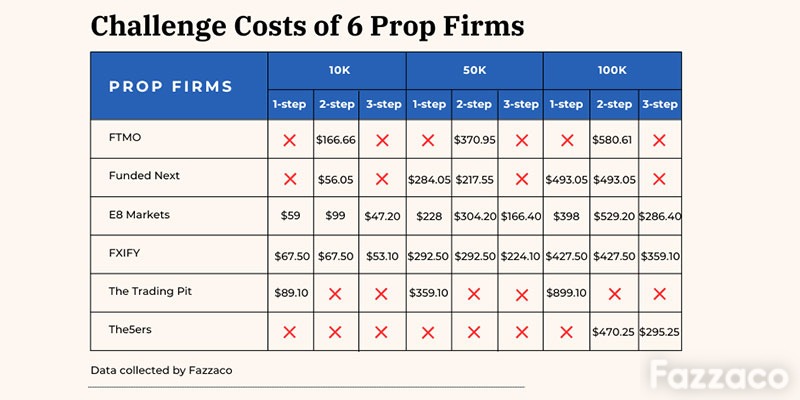
From the table above, we can see that challenge costs fluctuate with account size: $10K challenges cost about $100 regardless of steps. $50K challenges cost approximately $400 or less with one or two steps; for three steps, costs hover around $200. For $100K challenges aiming for one-step success, E8 Markets offers the lowest cost at $398; The Trading Pit has the highest at $899.10. For two-step challenges on $100K account size, costs range from $600 (FTMO) to $427.50 (FXIFY); for three steps, costs fall below $400.
Please bear in mind that this is nothing but a broad comparison of challenge costs; prop traders should also weigh in factors such as profit targets, profit split, maximum daily loss, commission per round lot, profit-target-to-drawdown ratio, among others.
 Subscribe Now