


Fazzaco Year-End AI Special Pt.III: How Will AI be Regulated Globally in 2025?
So in the last two episodes, we have discussed the risk control methods for the application of artificial intelligence (AI) in the financial sector in 2025 and explored the best AI use cases for the financial services sector in the coming year. Today, we will take a regulatory perspective to understand how AI will be regulated globally in 2025.
How is it Regulated Now?
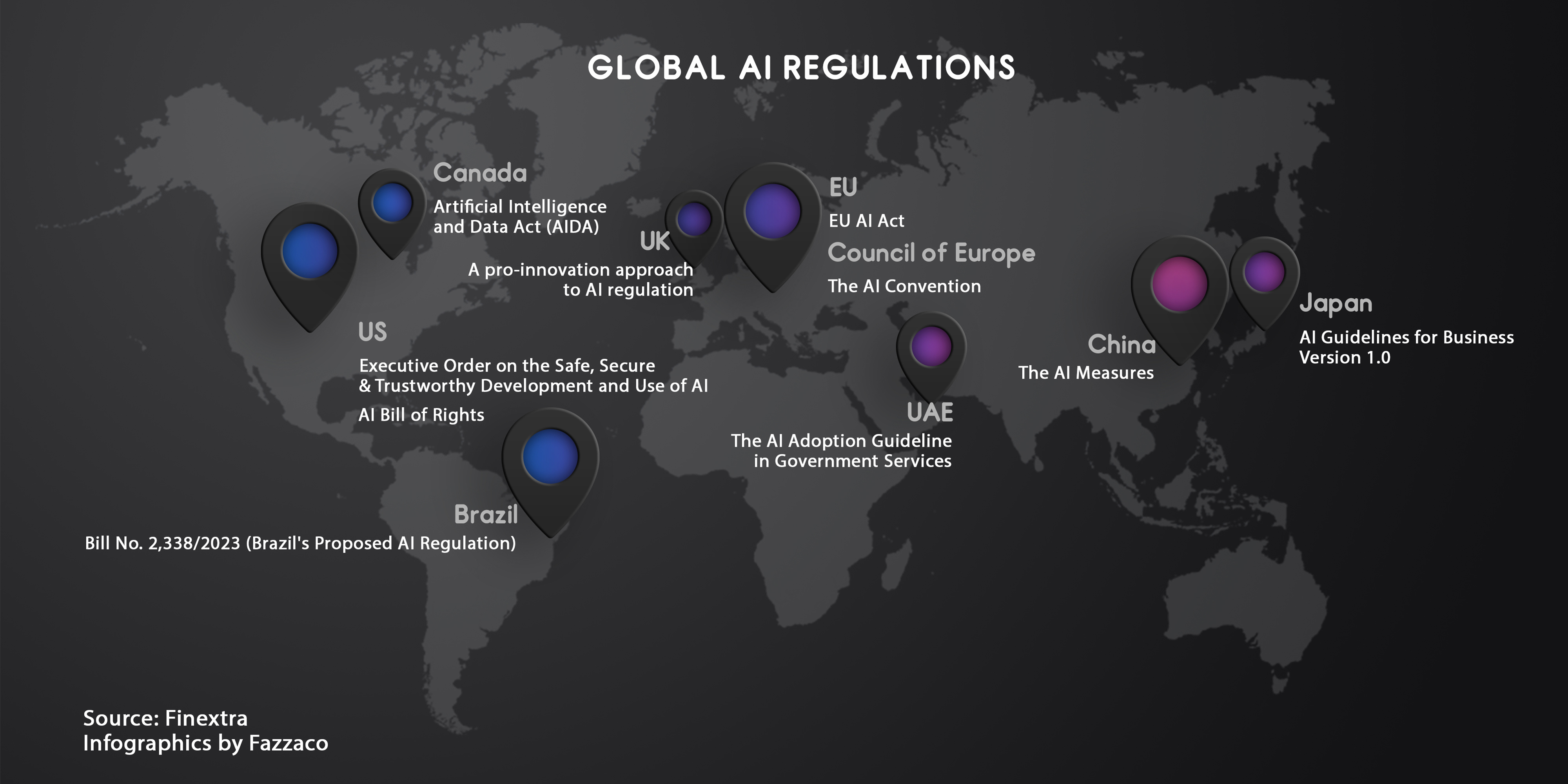
Above is a world map showcasing the existing AI regulatory frameworks across the world. This map lists out some of the legal frameworks and policies that are currently in place. Whether it's the EU AI Act, or state-level regulations in the United States, or the UK's principles-based framework, a clear trend is emerging globally: the adoption of a risk-based approach to regulation. High-risk AI applications, such as medical diagnostics and autonomous driving, are required to undergo rigorous evaluations before entering the market and must be continuously monitored throughout their lifecycle. On the other hand, low-risk technologies are allowed more freedom to develop, ensuring that technological progress is not hindered.
The EU Takes the Lead: A Risk-Oriented Comprehensive Legislation
In May of this year, we at Fazzaco published an article titled Everything Brokers Need to Know About the World's First AI Act, which mentioned: "The Act frames AI tech as 'human-centric' and shall be geared toward enhancing human well-being, certain applications are off-limits unless otherwise waived. This includes some uses that may crop up in processes like KYC by financial institutions, including brokers."

With the official enforcement of the Act in August, the EU entered a 24-month transition period, during which member states are drafting and implementing specific legislation, guidelines, and standards. This pioneering law introduces a risk-based classification system, which determines the intensity of regulation based on the level of risk associated with AI. Specifically, high-risk AI systems, such as those used in insurance, credit scoring, and similar sectors, must comply with stricter requirements for data management, transparency, human oversight, and documentation. For lower-risk areas, greater flexibility and room for innovation are permitted. This provides a much-needed legal framework for global enterprises, especially those conducting business with the EU, to deploy AI technologies while remaining compliant.
U.S: State-Level Regulations and Federal Guidelines

Although the US has not yet implemented the all-round AI legislation seen in the EU, certain states have taken active measures. In fact, state-level AI regulation in the US has far outpaced federal efforts. Many states have already begun passing their own AI laws, and the coordination and consistency of these regulations will be a critical issue moving forward.
In 2023, the Biden administration issued an executive order (Executive Order on the Safe, Secure & Trustworthy Development and Use of AI), promoting national efforts on AI safety, ethics, and accountability. In 2024, the White House released an update report on achievements from the past year, announcing several actions to ensure the safety of AI in critical infrastructure and publishing a risk management report on the use of AI in the financial sector. The US regulatory approach focuses on balancing innovation with safety, ensuring that technological advancements do not undermine social stability. However, with the return of Donald Trump to the White House, we remain cautious about the future direction of AI regulation in the US.
UK: Principles-Based Framework for Industry Oversight
Following Brexit, the UK has adopted a different model. Its AI regulation leans toward a flexible "principles-based framework." The Artificial Intelligence Regulatory White Paper released in 2023 made it clear that the UK government does not intend to introduce comprehensive AI legislation in the short term but will instead provide guidance on AI usage through existing industry regulatory bodies.

The advantage of this approach lies in its flexibility, allowing different sectors to regulate AI technologies according to their own needs. For example, the Financial Conduct Authority (FCA) has launched AI pilot programs and uses sandbox mechanisms to support businesses in testing new technologies under appropriate regulation. FCA Chief Data Officer Jessica Rusu emphasized that AI regulation is not only about ensuring technological safety but also about evaluating its impact on consumers and markets. Through this sector-based flexible approach, the UK aims to ensure the safe use of AI while fostering innovation.
AI Regulatory Challenges in 2025
The rapid advancement of AI presents significant challenges for regulators worldwide. One of the biggest issues regulators face is how to ensure customer safety while allowing businesses to innovate under appropriate supervision. As a result, financial institutions are particularly interested in the "sandbox" mechanism within regulatory frameworks. This mechanism provides businesses with space to test new technologies under regulatory conditions, ensuring safety while promoting innovation.
Although AI regulation may be seen as a major burden for businesses, it is essential for ensuring the safe development of technology. Companies should shift their mindset and view compliance as a way to enhance competitiveness rather than just a cost. In this process, balancing innovation and safety will be the shared mission of all legislators and regulators. Through continuous effort and international collaboration, we hope to see a safer, more sustainable AI future.
 Subscribe Now