


Let This Fazzaco's Poll Tell You How Brokers Feel About the Looming MetaQuotes Price Spike

At the start of December, Fazzaco reported that MetaQuotes, the developer behind MetaTrader 4 and MetaTrader 5, had informed its clients that, from January 1, 2025, it would be increasing its platform licensing fees. Industry insiders are speculating that the price hike could be as high as 20%.
Meanwhile, from various sources within the brokerage sector, we learned that MetaQuotes has been restricting brokers from integrating third-party applications (mainly TradingView) into the backend of its MT platforms. In response, during the final days of 2024, we polled the industry to gauge brokers' true views on MetaQuotes' impending license fee hike and its exclusivity policy.
Adapt and Live with It vs. Shifting to Alternatives
Poll Results
The debate over whether brokers will completely abandon MetaQuotes has been a long-standing issue within the forex industry. Ultimately, the discussion seems to revolve around two key perspectives: First, that "no matter what MetaQuotes does, brokers will have no choice but to accept it, given its unshakable market share (although shrinking)"; and second, that "with platforms such as cTrader and TradingView continuing to evolve, more brokers will abandon MT4 and MT5."
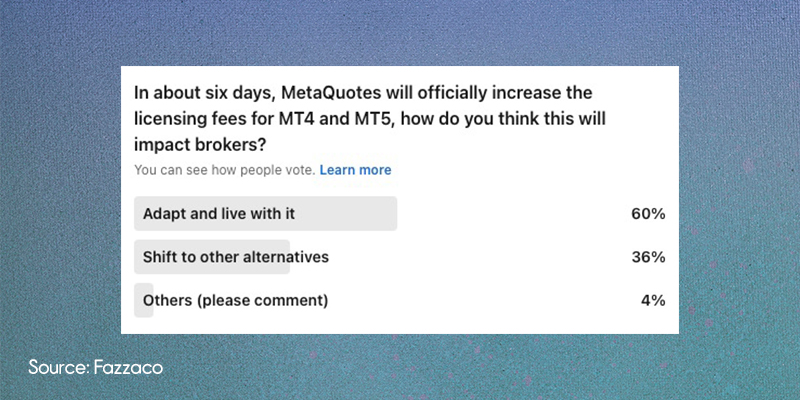
At the time of writing, the breakdown of votes for the three options was as follows: 1) Adapt and live with it (60%); 2) Shifting to other alternatives (36%); 3) Others (4%). This result aligns closely with the general consensus across the industry, and is perhaps not entirely surprising.
Shifting to Alternatives
Vladimir Syrov, founder of the recently founded Zeholding, shared his views on the matter: "I've spoken with many proprietary trading firm owners, and they've all said that getting approval from MetaQuotes is quite difficult, so naturally, they are moving to other providers... From a technical perspective, it's also extremely challenging to secure approval from global tech giants like Google and Apple, which requires huge investments to meet their strict requirements... Therefore, we can expect a growing shift to alternative platforms, and most brokers will likely develop their own platforms or use those that allow them to fully brand their offerings."
Mitchell S., the CFO at Fusion Markets, pointed out the practical challenges of migrating to other platforms, although he broadly agreed with Syrov's analysis. "I think more brokers will shift to cTrader, especially given MetaQuotes' current stance on integrating third-party applications like TradingView."
"For me, I've always found cTrader to be much more user-friendly, particularly for new traders, especially those who primarily use mobile devices and find TradingView intimidating," he added. "Who knows, perhaps in a few years someone will come up with a magical solution that combines the best aspects of all platforms."
Adapt and Live with It
The business development head for LATAM and EU regions at Doo Group explained why he believes brokers will simply "adapt and live with" MetaQuotes' price hike: "Brokers will adapt and take it, there will be no shift to native platforms as traders care about MT4 and MT5 massively unless you are someone like IKBR which is the exception."
"Most brokers are on B book flow generating massive revenue from losing traders anyway," he continued. "So in reality it will make no difference to a winning model business. They (brokers) can't go without them, want it or not."
MetaQuotes' Exclusivity: A Potential Misstep?
From multiple industry sources, we have learned that MetaQuotes has included a clause in its contracts with brokers purchasing its MT platforms, which prohibits the use of trading applications not reliant on MetaQuotes' API to connect to the MT platform. Violating this clause is considered a breach of contract. While the exact timeline for the enforcement of these restrictions remains unclear, industry insiders believe that the implementation may have started at some point last year.
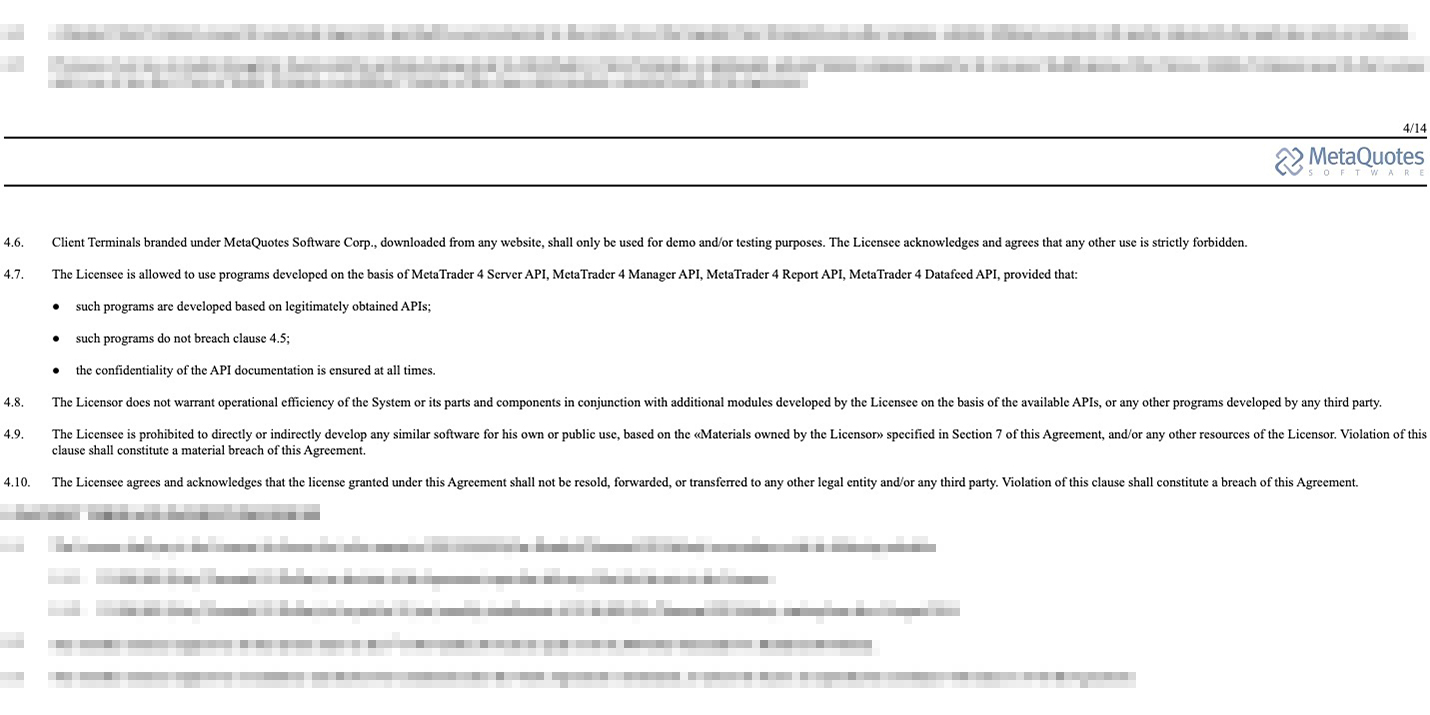
A broker's contract with MetaQuotes for licensing the MT4 platform.
One long-time trader remarked that while he enjoys using TradingView (although not for direct trading, but for its extensive charting tools), he has indeed faced difficulties when trying to integrate it with MT platforms. He highlighted two key issues: First, in many jurisdictions, exclusivity clauses are actually illegal because they severely reduce market competition. Second, in a volatile market with unstable purchasing behavior and heightened competition, such restrictive clauses are bound to drive clients away.
Francisco Fuetes, a business analyst at leading broker Tradeview Markets, echoed these concerns, arguing that restricting third-party APIs like TradingView would ultimately be detrimental to MetaQuotes. "We are in an era where technology evolves at an astonishing pace, driving innovation and enhancing user experiences. Restricting access to tools like TradingView not only hinders progress but also risks leaving behind those who fail to adapt to the changing needs of the market."
"Integration and flexibility are essential for a more connected and efficient future in trading. History has shown us time and again that someone will dare to take a bold step forward—and by then, it may already be too late." he said, sharply criticizing MetaQuotes while expressing optimism for a new era.
A New Era, A New Monopoly?
Interestingly, even though there are no immediate signs of MetaQuotes' monopoly being challenged, some have started to observe a potential trend towards a new monopoly emerging with TradingView. Nevill Hornsey, a director at Macrobriefing, shared his experience working with the broker OctaFX:
"OctaFX pulled out of having TradingView charts when I worked with them because TradingView insisted the broker paid to have the price feed into TradingView. The more popular the platform became, the more they encouraged brokers to pay. And I'm assuming it wasn't cheap. It felt like the start of a monopoly, and it hasn't given me any reason to change my mind."
 Subscribe Now

