


39 Brokers & Fintechs: Executive Moves Since Janaury 2023

Fazzaco has totaled all stories covering the turnover of senior positions and executives of multiple FX brokers and fintechs since 2023 (as of February 8). According to the statistics, we have seen multiple facets of executive moves and possible trends they suggest. In this article, we will start from the statistics and explore the characteristics of executive moves in the financial sector and possible future trends.
How Many Out? How Many In? How Many Promoted?
Fazzaco has, by going through the Fazzaco News database, covered a total of 35 stories on executive moves since 2023. 44 Job changes of 39 firms are involved. The firms can be roughly divided into two types, namely Brokers (26) and fintechs (13). Of course, such classification is far from accurate for certain firms operate astride more fields, providing both trading as well as B2B tech solutions.
Next, we have the numbers as follows:
Internal promotion: a total of 8, 6 of which are from 6 brokers and 2 from 2 fintechs, were promoted to executive or a higher office;
External hires: a total of 21, 14 from 13 brokers and 7 from 6 fintechs; and
Resignations /job hops: a total of 15, 8 from 8 brokers and 7 from 6 fintechs.
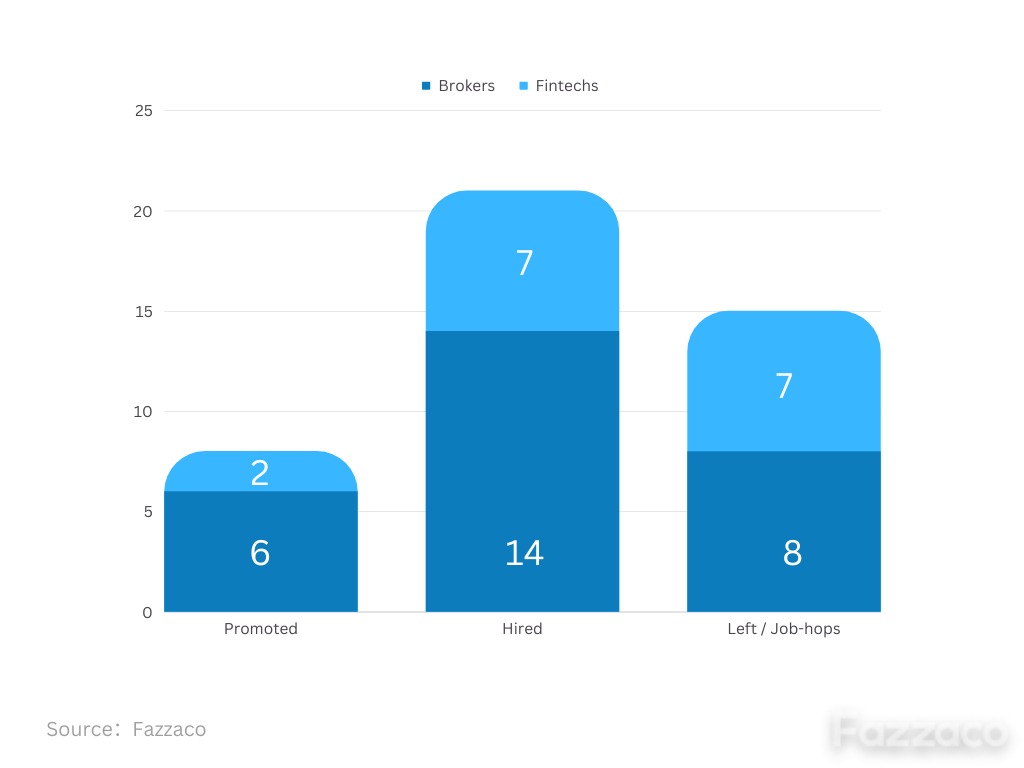 As the data showed, we can obtain the following statement regarding data distribution (also see the graph below):
Of all the covered executive moves since 2023, 47.73% is new hires, 18.18% is promotions, and the remaining 34.09% is resignations/job hops. In terms of company types, new hires among brokers are 50%, promotion 21.43%, and resignations/job hops 28.57%; in fintechs, both new hires and resignations/job hops are the same, at 43.75%, and 12.50% for promotions.
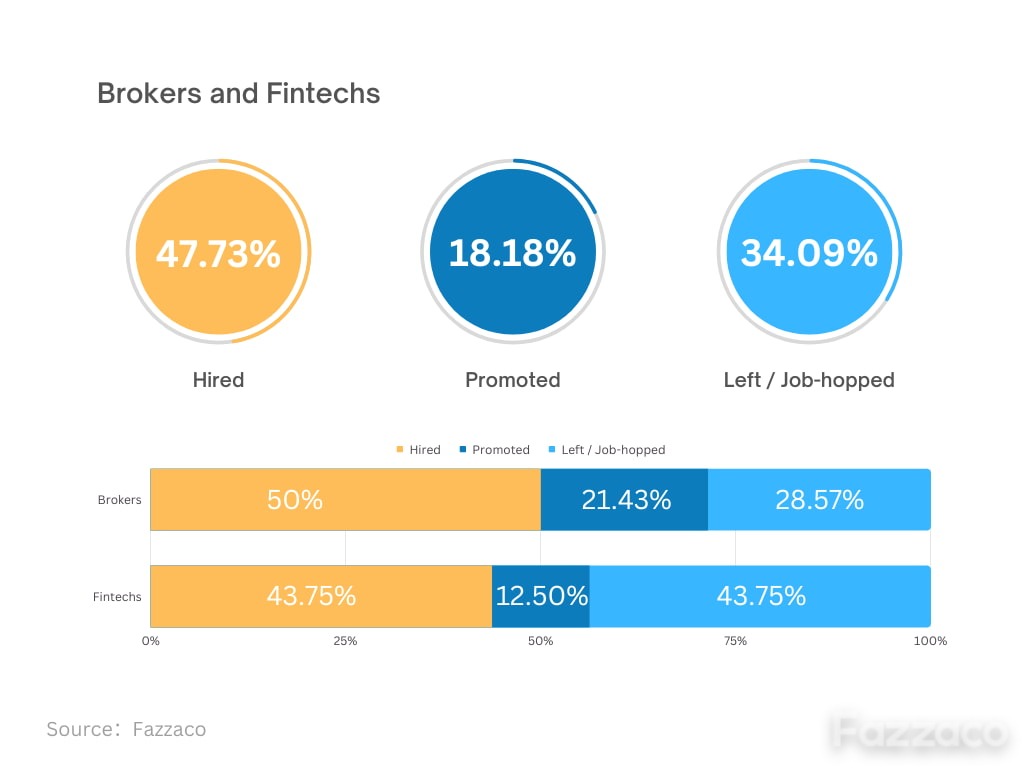
Overall, new hires remain the biggest share, indicating a strong demand for executives across the financial industry. Secondly, promotions only accounted for 18.18%, indicating that there is still room for more internal promotions within financial institutions. On the other hand, the relatively large proportion of resignations and job hops implicates a high turnover rate among industry executives.
Characteristics of Executive Mobility in Position & Regional Distribution
On the other hand, of the 44 job changes, exactly half of them, which is 22, are known as the C-suite jobs, and those also include co-founders and president /vice president. Of the 22 C-suite jobs, CEOs outnumber the rest by 6, followed by CFOs (3) and COOs (2).
As the leaders of the company, C-suites are crucial for the company's strategic direction and decision-making. Particularly the CEO position requires leading the company in developing and implementing comprehensive plans. Similarly, CFO and COO also play important roles in the organization, respectively responsible for financial management and daily operations. Therefore, the changes in these positions indicate that the financial sector is undergoing significant shifts in its decision-making circle and that reflects the community's effort to address the market challenges of the new year in order to achieve strategic goals dynamically.
In addition, the regional distribution is also too difficult to overlook, particularly with regards to appointments in the Middle East and North Africa (MENA) region. On January 11th, Julian Gay, who previously worked as the MENA Sales Director for the multi-asset online trading technology provider smartTrade Technologies, went to oneZero Financial Systems, a competitor, where he became responsible for institutional sales in MENA. This shows that, as previously mentioned by Fazzaco in the article "25 FX Brokers with New Licenses in 2022: 'Destination, MEA!'" that the Middle East and North Africa region is now the new arena for competition among participants in the financial services industry, and therefore such fact is reflected onto the demand, turnover, and competition for top talents in the industry.
Similarly, appointments involving MENA region include the MENA Sales Manager from AssetsFX jumping to Lirunex, and; XS.com appointing a new MENA Market Research Manager, and so on.
Executive Moves: A Barometer of the Financial Sector
By monitoring the moves of executives across the industry, we are enabled to take an insight of what the industry is going through. When a high influx of senior executives are being hired or promoted, that suggests rapid growth of the financial sector, and a promising future. Conversely, when a high number of executives are leaving their office, or leaving for another place, it could be that there is something wrong, or at least those who left do not have an optimistic outlook on the future prospects.
So, monitoring the moves executives allows us to have a clearer look at the business to make better decisions. At the same time, the moving of executives is a mirror of the workplace management of an organization, and even gives us hints on whether the company has a good future.
In conclusion, executive moves are significant. Go to Fazzaco News and hit the "Executive Moves" label to keep you posted of the latest news.
 Subscribe Now