


Across the Great Wall: A Glimpse of Internet Connectivity before Entering Chinese Market
 Foreign companies, including brokers, operating in China will inevitably face challenges with internet connectivity, due to the country's strict internet controls and complex cybersecurity regulations.
Finding the right internet provider, setting up a website, and handling VPNs are all crucial to your operation’s feasibility in the China market.
Before that, the top priority is to understand the situation of Internet service providers and the Internet access of China to other countries, so that you could reach the Chinese market and on-board clients across the Great Wall.
Internet Service Providers and its International Network
There are three telecom and Internet Service Providers (ISPs) in China: China Unicom, China Telecom, and China Mobile. They are all state-owned entities (SOEs) and each of them acts essentially as a monopoly within their respective markets.
1) Current International Network Construction of China
According to the latest statistics, the broadband users of three ISPs -- China Unicom, China Telecom, and China Mobile are as follows:
China Telecom: 349 million
China Mobile: 946 million
China Unicom: 266 million
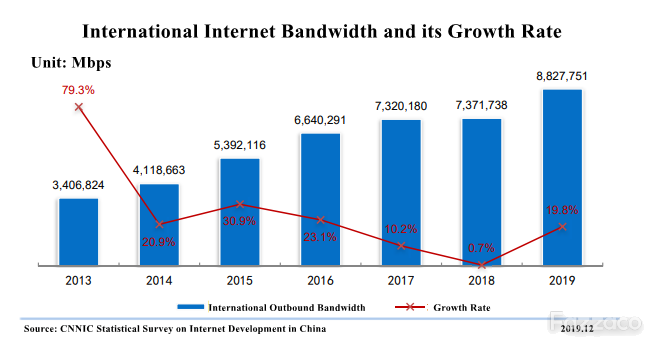
The 45th China Statistical Report on Internet Development published by China Internet Network Information Center showed that as of the end of December, 2019, China's international Internet bandwidth was 8,827,751 Mbps.
2) International Network Routing of ISPs
China Telecom
China Telecom has two network routing: ChinaNet 163 and ChinaNet Next Carrying Network (CN2).
According to statistics, the former routing carries 85% network traffic of the total network connection of China Telecom, while CN2 accounts for 15%. Both routings must go through Beijing, Shanghai, Guangzhou.
China Mobile
For the international network of China Mobile, most of its domestic traffic is carried by the AS9808 network, which has entry/exit optical cables in Beijing, Shanghai, Guangzhou. And the Guangzhou branch is responsible for most of its entry/exit traffic, such as Central America, East Asia and other regions.
China Unicom
China Unicom has a low growth rate of broadband users and takes the least market share, but China Unicom has the second largest international export bandwidth, only next to China Telecom. Its routings also must go through Beijing, Shanghai, Guangzhou.
The Internet access of China to other countries
How is China's Internet connected to foreign networks?The answer is linking to foreign servers via submarine optical fibre cable.
1)Connections between mainland China and foreign countries
China has three submarine optic fiber entry/exit points for all internet traffic, which are located in Shandong, Shanghai, and Guangdong respectively.
Specifically, they are Qingdao Shandong point of China Unicom, Chongming Shanghai point of China Telecom, Nanhui Shanghai point of China Unicom and Shantou Guangdong point of China Telecom.
The followings are 8 submarine optical fibre cable connections between mainland China and foreign countries:
Asia Pacific Cable Network-2 (APCN-2)
East Asia Crossing-City-to-City (EAC-C2C)
China-Japan Fiber Optic Submarine Cable System (C-J)
South-East Asia Japan Cable System (SJC)
Fiber-Optic Link Around the Globe (FLAG)
Asia-Europe Cable Network
CH-US Cable Network (CUCN)
Trans-Pacific Express (TPE)
2)Connections between Hongkong and foreign countries
HongKong, as one of the most important data transmission stations in the world, has strong network transmission capacity and builds submarine cable systems even more than mainland's.
According to the Office of the Hong Kong Government Communications Authority, as of January 2019, there are 11 submarine optical fibre cable networks.
Asia Africa Europe-1 (AAE-1)
Asia-America Gateway Cable System (AAG)
Asia Pacific Cable Network 2 (APCN-2)
Asia Pacific Gateway (APG)
Asia Submarine-Cable Express (ASE)
East Asia Crossing-City-to-City (EAC-C2C)
FLAG Europe Asia (FEA)
FLAG North Asia Loop/REACH North Asia Loop (FNAL/RNAL)
Sea-Me-We 3 (SMW3)
South-East Asia Japan Cable System (SJC)
-
TGN-Intra Asia Cable System (TGN-IA)
In a word, for forex brokers or other brokerage solution providers, solving Internet access is the first step to start their business in China. Because of the sensitivity of the internet in China – and therefore the intense scrutiny it is given by censors and regulators, they should undertake comprehensive studies of the Internet-related issues before entering, and a well-thought out IT strategy can be the difference between life and death for some companies.
Fazzaco, as an industry-leading B2B forex portal, is always here to assist forex brokers in entering and succeeding in the Chiense market with our professional team and in-depth understanding of China's policy. To know more about Chinese market, please visit Fazzaco.
 Subscribe Now