


After the Closing Price Is Set: How Euronext Matches AVD Orders
A stock can close at €42.60 with thousands of shares still offered at that price. The market has found a price at which buyers and sellers can trade, but there need not be one more buyer for every remaining seller. For a broker working an equity order against the official close, those leftover shares may matter more than the last change in the indicative price.
Euronext, the European exchange operator, built an equity order type for precisely this situation. Its Auction Volume Discovery order, or AVD, lets a member submit additional interest for an opening or closing auction. The order waits while the regular auction determines the price. Only once a valid price exists can the order seek shares at that price. The exchange announced the launch in December 2025.
Who sets the close, and who can use it?
In the closing call, the exchange collects regular auction orders. A member can also have a buy order waiting specifically for the closing uncrossing, the point at which the exchange matches the auction book. An AVD order remains hidden through the call. Neither its quantity nor its limit helps determine the official price. An asset manager can therefore specify the most it will pay while leaving the price-setting decision to participants in the regular auction.
After the uncrossing, Euronext has two pieces of information: a price and any eligible regular orders still unmatched there. The exchange first lets AVD interest take the opposite side of that imbalance. It then matches compatible AVD buys and sells remaining on its own books. The sequence matters. A sell imbalance can supply an AVD buyer immediately, but even a perfectly balanced regular auction can leave two AVD participants able to trade with each other.
A 5,000-share instruction, followed through the auction
Suppose a broker enters an AVD order to buy 5,000 shares, with a €42.65 limit and no minimum fill. The closing auction sets a valid price of €42.60 and leaves 3,600 regular shares for sale at that price. For simplicity, assume there is just one AVD buyer and one eligible AVD seller offering another 900 shares. These are illustrative quantities.
The first match gives the buyer 3,600 shares and uses up the regular sell imbalance. Of the 1,400 shares the buyer still wants, the AVD seller supplies 900 in the second match. The two fills give the broker 4,500 shares at €42.60, worth €191,700 before fees. The other 500 expire at the end of the auction. Counting the 900 on both sides as fresh volume would overstate what traded: the buyer’s second fill and the AVD seller’s fill describe the same 900 shares.
Change just one input and the outcome changes. If the official price is €42.70, this buyer’s €42.65 ceiling rules out both matches, however many shares are on offer. Conversely, if the price stays at €42.60 but the AVD seller withdraws before the auction, the broker can still buy the 3,600 regular shares. What it can afford to pay and how much it can actually buy are separate questions.
What the desk can infer before sending an order
In its launch announcement, Euronext put the average daily value of unmatched auction interest in 2024 at more than €200 million, around 6% of auction volume. That measures what was left across the market before AVD launched. It gives no fill rate for a particular stock. A broker seeking to buy one name needs sellers in that name, in the relevant auction, at a price its customer accepts. Unmatched buyers elsewhere do nothing for that order.
The exchange also allows a minimum acceptable quantity that can be met against one or more orders. That condition matters when the client values a sizeable execution more than a small partial fill. The public auction imbalance alone cannot settle the question: Euronext does not publish the AVD imbalance, and the regular imbalance can change before the auction price is set.
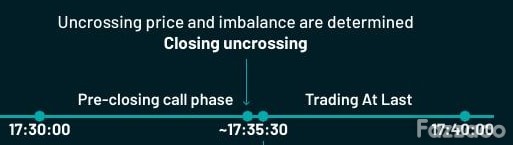
Euronext’s example timetable places the closing uncrossing between the call and Trading At Last. The times shown illustrate that schedule.
Timing determines what happens to the unfilled balance. AVD supports the opening and closing auctions, with an instruction available specifically for the close. It does not match in intraday auctions. When an eligible auction ends, the unfilled AVD quantity expires rather than carrying into Trading At Last. For the broker in the example, the closing report should show 4,500 shares bought, 500 expired and no live instruction for those 500. A client who still needs them must make a separate execution decision.
 Subscribe Now