


Application Fees Comparison: AFS License vs FMA's Derivatives Issuer License
As is known to all, forex brokers are required to obtain necessary authorisation for providing financial services/products in certain jurisdictions. Given that the most important criteria for traders when selecting a forex broker are the regulatory status of the broker and its governing authority, brokers who have a strong presence often choose to apply for licenses in areas with more stringent regulations to onboard more global clients.
Fazzaco has collected detailed information about application fees for brokers to obtain an AFS license from the Australian Securities & Investments Commission (ASIC) and a Derivatives Issuer License from the New Zealand Financial Markets Authority (FMA) for reference.
Application Fees for the AFS License
ASIC has adopted tiered fees for regulatory service activities that vary in complexity – high and low – for AFS license applications. The complexity is determined based on the applicant type and the financial service and product authorisation the applicant is seeking.
The following table outlines the fees for a body corporate to apply for an AFS license, effective from 1 July 2021.
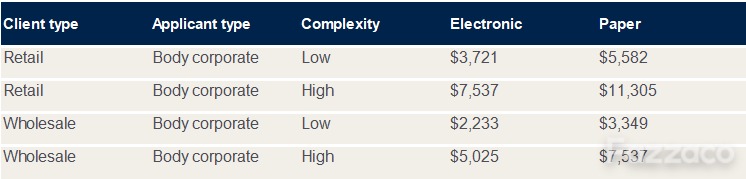
As you can see, the application fee for a retail financial services license by a company ranges from $3,721 to $11,305. While the fee for a wholesale financial services license ranges from $2,233, even lower than the processing fee for a license from the Financial Services Authority (FSA) Seychelles, to $7,537.
Application Fees for New Zealand FMA's Derivatives Issuer License
According to the FMA, the fees to be paid for a derivatives issuer license totals $10,695 (including GST) which includes 70 assessment hours.
The regulator may charge an additional fee at the FMA hourly rate where its assessment of an application exceeds the included number of hours stated above.
In terms of application fees, the cost of applying for an AFS license for brokers is much lower than that of applying for a derivatives issuer license in most cases. Up to now, 25 entities have been granted the license or have been authorised by the FMA. By contrast, ASIC has issued 776 new AFS licenses in 2020–21 financial year.
Difference Between Financial Services Regulatory Regime in Australia and New Zealand
The main regulators responsible for the regulation and supervision of the Australian financial market are the Australian Prudential Regulation Authority (APRA), ASIC, the Australian Treasury and the Reserve Bank of Australia (RBA). FMA and the Reserve Bank of New Zealand (RBNZ) are the supervisors in New Zealand for the financial sector.
In Australia, there is no separate regime for registration. While in New Zealand, nearly all individuals or businesses providing financial services are required to register on the Financial Service Providers Register (FSPR).
Brokers must hold an AFS licence (unless they are exempt or are authorised to provide those services as a representative of another person who holds an AFS license) to carry on a business of providing financial services. The New Zealand financial services regulatory system has not yet introduced an authorized representative system.
AFS license may vary depending on the applicant type, way of application, client type, and the complexity of the license. Each license describes all the financial activities the holder is authorised to conduct (and all those who are authorised by the holder to act under the AFSL). However, there are not different types of licences for different financial activities in New Zealand.
 Subscribe Now