


Avelacom Trading Connectivity, Colocation and Market Data
Avelacom supplies network connectivity, colocation, market data and managed hosting to firms that trade across financial markets. Its offering is relevant when an execution team needs to connect infrastructure in one location to a venue, data feed or counterparty in another, or put servers closer to the systems they use. The practical decision for a buyer is which parts of the trading stack to place with the supplier and which to manage independently. A firm that already operates exchange-adjacent servers may need only a circuit, while a team entering a new market may need hosting, data delivery and a separate order-entry connection.
Low-latency connectivity between trading locations
Avelacom describes an owned and operated network with point-to-point Layer 2 and Layer 3 services, DWDM wavelengths, dark fiber and public cloud connectivity. Its connectivity materials list bandwidth options from 1 Mbps to 100 Gbps. The service available at a given address depends on the route, access facilities and handoff, so procurement teams should obtain a quote against the exact endpoints and capacity they require. The vendor also describes routes that use fiber and high-frequency radio. Teams comparing those options should ask how each proposed path performs under normal operation and how traffic moves when a segment is unavailable.
A Layer 2 handoff can suit firms that want to run their own routing on both ends. A Layer 3 service can suit teams that want the provider to take on part of the routing scope. A wavelength or dark fiber involves a different division of responsibility for optics, equipment and monitoring. Buyers should define the handoff before comparing prices or delays. Two proposals for the same city pair may terminate in different facilities, and the cross-connect or last-mile segment can materially change both the cost and performance.
What the Shanghai route figures measure
In a June 2026 announcement, Avelacom reported round-trip delays from Shanghai Tonglian Data Center of below 16.5 ms to Hong Kong, below 50 ms to Singapore and below 24 ms to Tokyo. The figures describe specific network routes published by the supplier. The announcement also describes onward connectivity to Chicago. For a broker or trading firm assessing Asian connectivity, these figures are a starting point for requesting the route, measurement endpoint and service configuration that match its own deployment.
Round-trip network delay measures how long a signal takes to travel between two points and back. An application-level order acknowledgment also depends on the firm's own gateway and risk checks, the venue's gateway and the path taken by the reply. An acceptance test should timestamp traffic at the agreed circuit handoff and record application timestamps separately. Capture median and tail latency, packet loss and jitter across representative sessions. Testing around the market open and on the failover path helps show whether the service meets the strategy's actual operating requirements.
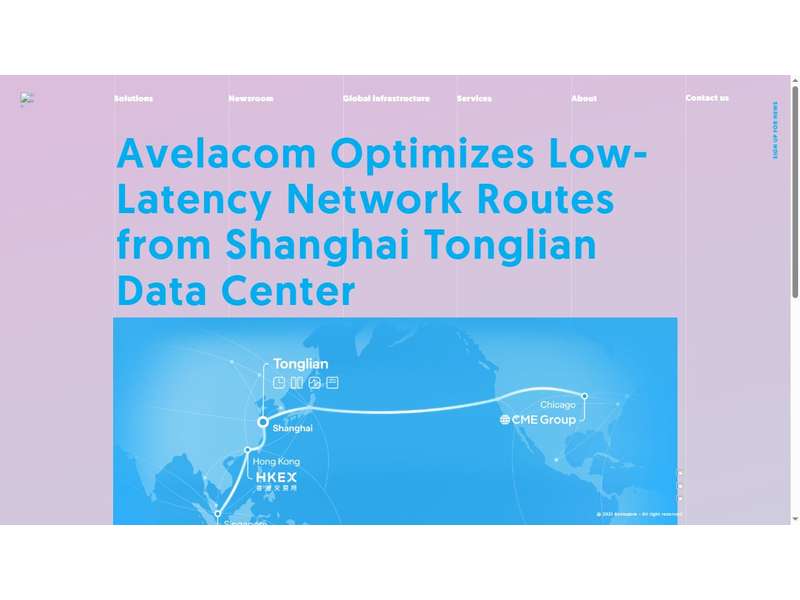
Avelacom’s announcement on network routes from Shanghai Tonglian Data Center
Colocation and managed hosting
Avelacom advertises proximity hosting across more than 80 venues and describes colocation space ranging from a single rack unit to a cabinet, with fiber connectivity and remote technical assistance. A firm placing its own equipment should map out the full path from its server port to the exchange or data provider. Confirm facility access, rack dimensions, power feeds, cross-connect lead times and how remote hands requests are handled. Being in the same metropolitan area as an exchange is a different deployment from reaching its handoff inside a particular data center.
Managed hosting moves more of the infrastructure work into the supplier's scope. Avelacom describes dedicated infrastructure near financial venues, remote server access and options for short proof-of-concept deployments of three to six months. These options may fit a team that wants to test a market before acquiring hardware. Before moving production traffic, assign responsibility for system images, patches, spare parts, access permissions and backup recovery. The operating model matters most during a failure, when the teams need to know who can act and how quickly.
Market data and order entry are separate workstreams
The supplier describes access to native direct market data feeds, with raw or normalized delivery and trial options. Raw delivery suits teams that need venue-native message types or operate their own feed handlers. A normalized feed can simplify integrations across markets, particularly when the main objective is to compare instruments or monitor multiple venues using a common interface. A trial should check sequencing, recovery after gaps, timestamps, instrument reference data and the treatment of venue-specific events. The venue list and delivery format should be confirmed for the proposed configuration.
Avelacom separately advertises order-entry connectivity. Data permissions, order routing, venue access and clearing may each involve different parties and agreements. An engineering team should document where each connection terminates and which credentials or entitlements are needed. For example, a market-data subscription may give a system visibility into quotes and trades while the order gateway still needs separate connectivity and onboarding. Validate these flows independently before testing the full trading cycle.
How to scope a multi-venue deployment
Start with the application and its dependencies. For an execution gateway, record where the orders originate, where checks run and which venue or counterparty receives them. For a data collector, document the feeds and the consumers downstream. If analytics run in a public cloud while execution stays at a venue-adjacent facility, size those links independently. A network designed to send data to analytics services has different throughput and recovery requirements from a circuit carrying time-sensitive orders.
For a resilient design, request route diversity down to the access circuit, building entry and relevant exchange handoff. A second circuit can share failure points with the first. Where detailed routing cannot be disclosed, ask for a description of the shared segments and a demonstration of failover. Test whether reconnecting causes gaps in market data and whether the trading system can reconcile open orders after a disconnect. Write down who initiates a switchover and who confirms the primary path is ready before moving traffic back.
Commercial comparisons should include recurring bandwidth and rack charges, one-off installation and cross-connect fees, exchange charges where applicable and support coverage. Put the measurement method and escalation contacts in the acceptance plan. An incident involving a venue connection can span the application, server, network and exchange. A buyer should know where each party's responsibility ends and which evidence is needed to open a ticket.
What to include in a production pilot
Use the same server location, interfaces and traffic patterns planned for production. For a data-intensive application, capture whether bursts cause drops at the network interface or inside the feed handler. For order entry, check session reconnects and compare the order state recorded by the application with the state available from the venue. A fast result from a quiet network probe leaves those application behaviors untested. The pilot should include the operations team so alert ownership, escalation and recovery can be tested alongside the connection.
Retain the circuit identifiers, test endpoints, time synchronization settings and measurement windows with the results. Agree in advance how each party will interpret discrepancies. If the provider measures at its own equipment while the buyer measures at the application host, the numbers can differ because they include different segments. A shared diagram and timestamped traces help both sides separate the circuit, the facility cross-connect and the host. They also give the team a baseline for diagnosing a later change in performance.
Where Avelacom fits
Avelacom fits the shortlist when a firm needs financial-market connectivity across regions or wants to source network, hosting and feed delivery as part of the same deployment. Existing infrastructure determines the best entry point. A firm with racks in place can compare exact circuit endpoints and diversity, while a new-market team can start with managed hosting and test data delivery before production onboarding. For either approach, request a proposal that names the handoff locations, applicable feed formats and operational responsibilities, then use a representative trading session to test it against agreed acceptance criteria.
 Subscribe Now

