


B2CORE: Forex CRM, Traders Room and Broker Back Office
B2CORE is B2BROKER's customer-management and back-office product for Forex and crypto businesses. It combines a branded Traders Room with client records, wallets, payment connections, administrative workflows and partner management. The client portal and the staff environment work with the same underlying customer activity, helping a brokerage connect account opening, funding and ongoing service.
For a broker selecting a Forex CRM, the central question is how these operations fit together. A trading account, a wallet balance, a verification request and an IB commission represent different records and responsibilities. B2CORE provides an operating layer around them, while integrations connect that layer to trading platforms and external service providers. Its current SaaS plans also distinguish features by tier, making commercial scope part of the implementation decision.
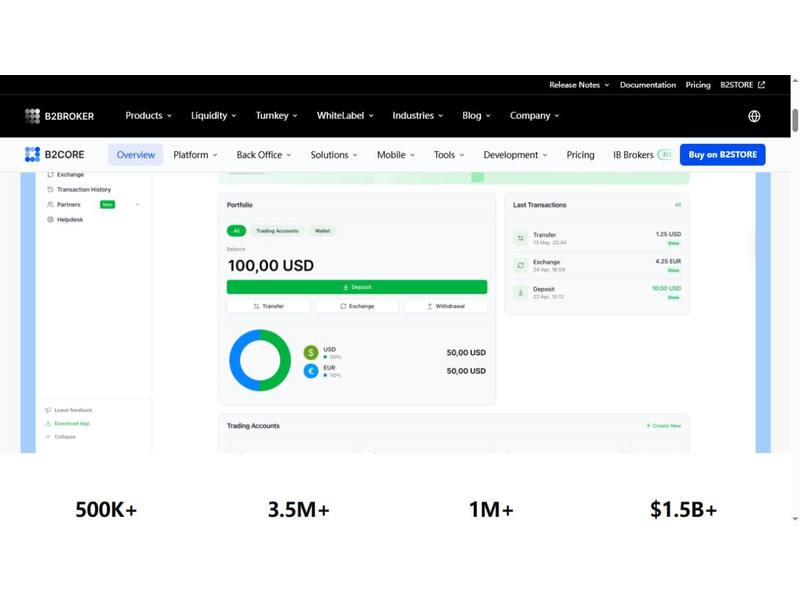
B2CORE client dashboard displayed on B2BROKER’s official product website.
Traders Room and CRM: two sides of client operations
The Traders Room is the client-facing part of B2CORE: customers register, submit verification documents, fund wallets and request trading accounts there. The back office is where staff review and manage those requests. B2BROKER describes both sides as working from one database, so a customer action can become an identifiable task for the relevant department.
This connection is useful when departments need a common account history. Support can investigate a funding request, finance can review its transaction record and an administrator can check the customer's verification state without each team assembling a separate picture. The implementation still needs agreed status definitions and responsibility for exceptions, so that a request marked pending has the same meaning to everyone handling it.
The product overview presents a customizable dashboard and interfaces for deposits, trading platforms, wallets, helpdesk requests, bonuses and IB activity. The broker can therefore organize the portal around its intended client journey. A practical design starts with the tasks clients perform most often and keeps the relationship between wallet funds and individual trading accounts clear.
Onboarding, verification and access permissions
B2CORE includes KYC and AML workflows in its listed SaaS plans. Verification uploads made through the client environment appear in the back office for staff handling. For brokerage operations, the important connection is between document status, account availability and the action an authorized employee can take.
B2BROKER describes rights-based user groups that restrict administrators to the sections their departments need. A tagging system can also limit the client data an administrator monitors to assigned customers. These mechanisms support different working roles for sales, customer service, finance and compliance within one system.
Configuring permissions is an operational design task. A broker can define which employees may view identity documents, approve a withdrawal, change a customer assignment or access reports. Testing those roles with sample accounts helps confirm that the intended work is possible and sensitive actions remain accountable. Workflow tools support a company's procedures; the actual acceptance and review policies remain part of the broker's business arrangements.
Wallets, payments and trading-platform connections
The current pricing matrix lists fiat and crypto wallets, payment integrations and support for MetaTrader 4, MetaTrader 5, cTrader and B2TRADER across all five SaaS tiers. The broader overview also displays integrations with other trading platforms and infrastructure providers, including TradeLocker, DXtrade, Match-Trader, oneZero, PrimeXM and Centroid.
Those connections have different purposes. A trading-platform integration links client administration with trading accounts; a payment integration handles funding or withdrawals; an infrastructure connection may support another part of the broker's environment. The project specification should identify the required direction of data flow, the records exchanged and who handles a failed or delayed response.
B2BROKER advertises more than 150 integrations. Availability of a connector provides a technical starting point, while an individual payment provider's merchant acceptance, settlement terms and geographic coverage require their own arrangements. A broker should test the exact methods it will offer, including currency conversion, duplicate notifications and reconciliation after a payment exception.
A useful demonstration follows funds from the client portal into the relevant wallet and onward to a trading account, then traces a withdrawal request back through approval and reporting. This exposes the operational relationships more clearly than viewing a list of payment logos.
IB management with configurable rewards
B2CORE's IB product supports tier-based rewards, multi-level payments, instrument-specific reward ratios and configurable payment schedules. Its dedicated IB page describes hourly, daily, weekly and monthly calculations and distributions, as well as revenue models based on lots, spreads and fees. Referral links, partner dashboards and reports give partners a view of their activity without requiring staff-level access.
Several detailed controls address real administration problems. Bulk editing applies or removes payment plans across selected IB types, trading groups and symbols, with a backup and row-level error reporting. Opening-deal commission handling can use the opening commission when the closing deal has none. A platform-specific trade cutoff prevents earlier transactions from generating rewards, which is particularly relevant during migration.
These controls help a broker express how its partner network is supposed to work. The implementation needs consistent definitions of qualifying trades, eligible instruments, levels, payout periods and corrections. A sample involving an account transfer, a corrected trade and a cutoff date can show whether the resulting partner statements match the agreed commercial policy.
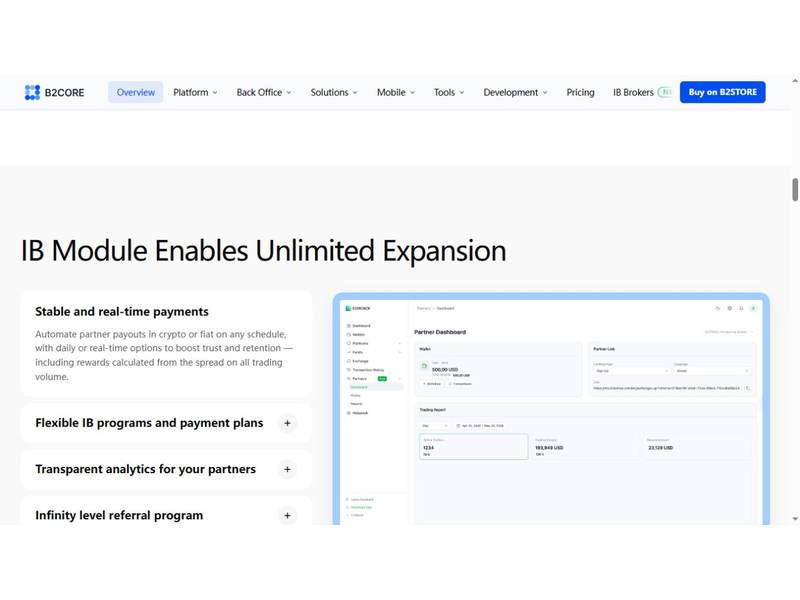
B2CORE partner dashboard and IB features on the official product website.
Branding, mobile access and localization
B2CORE is offered as a white-label environment. B2BROKER describes branding across the web Traders Room, mobile apps, emails and partner portal, including logos, colors, domain and languages. B2TRANSLATE is included in the current SaaS plans and provides a central localization tool within the product ecosystem.
The pricing page treats branded iOS and Android apps as additional items, with a published one-time setup amount of US$1,000 per app. That distinction matters when comparing a web-only launch with a mobile rollout. The proposed scope should identify app branding, distribution, publishing support and the release process for later updates.
Localization also involves operational consistency. A translated funding status, verification message or account instruction needs to describe the same process as the corresponding back-office record. Reviewing a complete client journey in each launch language helps ensure support teams and customers share the same understanding.
Cloud SaaS, dedicated deployment and migration
The company presents B2CORE as cloud SaaS available through B2STORE and also describes dedicated installations through B2BROKER. Its overview identifies AWS-based infrastructure and security features such as two-factor authentication, whitelisting and access controls. These product descriptions provide a basis for discussing hosting and governance requirements with the vendor.
The broker should specify access administration, data exports, backups, incident escalation and responsibility for integration credentials within its deployment arrangements. A dedicated installation and a subscription channel may have different operating and commercial details, so the agreed service scope should identify the actual option being purchased.
B2BROKER states that it supports customer-data imports and can adapt migration scripts to a client's specifications. The current SaaS matrix includes sales-assisted onboarding or migration from Advanced upward. Migration planning should inventory client identities, verification states, wallet records, trading-account links and partner relationships, then reconcile balances and totals before switching production traffic.
The published same-day activation claim relates to making the service available. A brokerage moving an existing business still needs acceptance testing, staff preparation and coordination with payment and trading-platform providers. Treating activation and business migration as separate milestones gives the project a more useful completion standard.
Current SaaS pricing and feature boundaries
B2CORE's October 2026 pricing page lists five monthly SaaS plans. Each includes the client portal, back-office panel, KYC/AML workflows, wallets and listed platform integrations. Additional capabilities appear at successive tiers.
| Plan | Monthly subscription | Successful inbound-deposit fee | Feature step |
|---|---|---|---|
| Starter | US$1,000 | 1.00% | Core portal and back office |
| Advanced | US$2,500 | 0.75% | IB functionality and assisted onboarding/migration |
| Growth | US$5,000 | 0.50% | BackOffice API |
| Pro | US$10,000 | 0.25% | Multiple brands/domains |
| Enterprise | US$20,000 | 0.10% | Prioritized delivery |
The pricing page says the processing fee applies to successful inbound deposits only. It is therefore distinct from a trading-volume charge. The same page lists free setup, a three-month minimum commitment and a 15% subscription discount for annual prepayment. Branded mobile apps and other extras should be considered separately in the budget, and the final quotation should confirm channel-specific terms.
For illustration, US$1 million of successful inbound deposits would produce a US$10,000 processing charge at Starter's listed 1% rate, plus the US$1,000 subscription. At Growth's listed 0.5%, that component would be US$5,000 plus its US$5,000 subscription. These examples exclude payment-provider fees and other items. They show why the relevant comparison combines fixed cost, deposit activity and required functionality.
Choosing a plan around the brokerage's workflow
B2CORE is relevant to firms seeking a unified customer portal and staff operating environment around their trading business. The plan decision can follow concrete requirements: whether the broker needs IB management, programmatic back-office access, multiple brands, assisted migration or branded mobile apps. Choosing those requirements first makes the price comparison more meaningful.
A focused evaluation should connect registration, verification, wallet funding, trading-account creation, a support request and partner attribution. Adding a declined verification, delayed deposit and adjusted commission tests how exceptions travel between client and staff interfaces. That gives the purchasing team a practical basis for assessing B2CORE as a brokerage operating system and identifying the configuration, integrations and staff responsibilities needed for launch.
 Subscribe Now