


"Building the Backbone of Modern Prop Trading" - Interview with Justin Hertzberg, CEO of FPFX Technologies & PropAccount
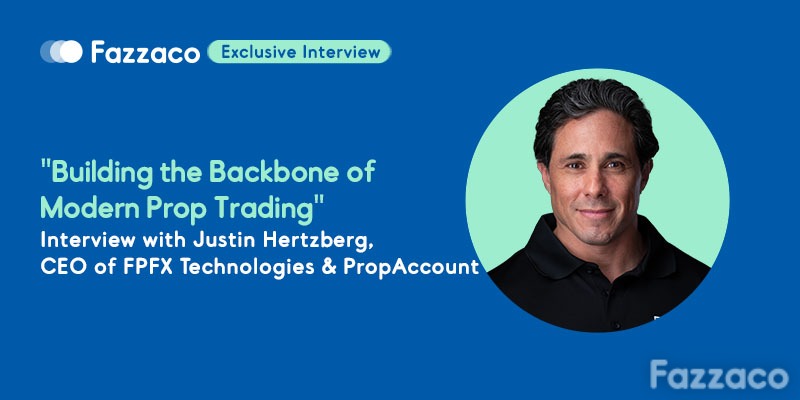
As prop trading evolves from a niche practice into a global business model, few names have been as instrumental in shaping its infrastructure as FPFX Technologies and PropAccount.
At the London Prop Trading Expo 2025, the first event entirely dedicated to prop trading, CEO Justin Hertzberg shared his views on how the industry is maturing—and where it's headed next. Fazzaco had the honor to invite Justin to sit down and have a talk with us, and he shared with us about this Expo as well as the prop trading community.
A Real Milestone for the Industry
"When we were invited to help shape the London Prop Trading Expo, we were very excited about the idea of a dedicated prop trading event," Hertzberg recalls. "But merely putting on any event doesn't make it a milestone. What was a milestone was the resounding success of the Expo."
The debut event drew nearly 2,000 attendees and overwhelmingly positive feedback, prompting plans for two dedicated expos in 2026—one in Dubai and one in London.
For Hertzberg, that response reflected not only the industry's momentum but also its growing recognition as a legitimate and scalable model within the broader trading ecosystem.
From IB to Infrastructure
The roots of FPFX Technologies trace back to Hertzberg's early days as an Introducing Broker, where he and his partners encountered one of the first retail-focused prop firms as early as 2016.
"That experience exposed us to the inner workings of retail prop trading—the commercial models, cash flows, workload, and backend risk management," he says.
Recognizing that end-to-end automation would be essential for scaling operations, FPFX Technologies began developing its Prop Trading Tech Kit in 2019 and brought it to market in 2020.
PropAccount.com followed a year later—an unbranded, unmarketed prop firm backed by FPFX's technology, infrastructure, and capital, now powering over 125 white-label partners worldwide across FX, Futures, and Crypto.
Technology, Risk, and the Next Evolution
Looking ahead, Hertzberg sees a new wave of participation from brokers and institutions entering the prop space to diversify revenue and reduce client acquisition costs.
At the same time, smaller standalone operators may face tougher conditions.
"Those that lack institutional infrastructure or massive social reach will find it harder to remain profitable," he notes.
This is where PropAccount's model comes in—offering a turnkey solution that lets smaller operators monetize their audiences while leveraging shared infrastructure.
"By defraying infrastructure costs across 100+ firms, we help operators focus on running sustainable and consistently profitable prop firms," Hertzberg explains.
On "Hybrid" Models and Risk Tools
Asked about the recent rise of "hybrid" models—prop firms working with brokers or adopting exchange-custodied accounts—Hertzberg offers a nuanced take:
"What we're seeing isn't really brokers adopting exchange-custodied accounts. They're simply operating as brokers for prop firms that want direct market access or wish to hedge exposure."
He emphasizes that A-booking order flow is not a passing trend but rather a risk management tool—one that can be powerful in capable hands but potentially ruinous in the wrong ones.
Regulation: A Welcome Development
FPFX's recent expansion into Cyprus coincides with growing discussions about regulating the prop trading industry, particularly in Europe.
"I've said for years that we absolutely and unequivocally welcome regulation," Hertzberg asserts.
"There need to be steeper barriers to entry to ensure only well-capitalized, high-integrity operators can run prop operations. That's essential to protect traders and preserve the industry's credibility."
He adds that FPFX would be eager to contribute to any regulatory sandbox aimed at shaping proper oversight frameworks for prop trading.
Beyond MetaTrader: A Platform Shift
FPFX Tech now integrates with over a dozen trading platforms, including DXtrade, cTrader, and Match-Trader.
While MT5 remains dominant, Hertzberg points out that MetaQuotes' restrictive stance toward prop trading has opened new opportunities for alternative platforms.
"This shift is allowing other providers to seize market share—and more importantly, to become the first platform experience for the next generation of traders," he observes.
Balancing Automation and Human Oversight
Automation, in Hertzberg's view, is the backbone of scalability in modern prop operations—but not a substitute for human judgment.
"For operations, automation is essential," he explains. "But in treasury and risk management, human oversight remains critical. The system is only as good as the data fed into it—if it's garbage in, it's garbage out."
He believes quants and analysts must continue to review data, refine models, and monitor deviations to ensure both security and profitability.
Technology Is Crucial—But Risk Management Is Key
After supporting more than 100 prop firms globally, Hertzberg has seen one recurring challenge: the shift from focusing solely on technology to mastering risk management.
"Unless you have an intimate understanding of the numerous risk factors affecting prop firms, you'll find yourself upside down and effectively insolvent," he warns.
Defining Success in the Next Five Years
For Hertzberg, the definition of a truly successful prop firm is straightforward:
"It's exactly what PropAccount.com is—one that delivers on its promises to all parties."
He notes proudly that PropAccount has never denied a trader payout and that its white-label partners have earned millions of dollars by building their own brands atop FPFX's infrastructure. "That, to me, is the model of a sustainable and successful prop firm," he concludes.
 Subscribe Now