


Cat Wu Joins OpenAI: Career, Core Products Role and AI Agents
Former Anthropic Claude Code product lead Cat Wu announced on X on November 5, 2026, Beijing time, that she is joining OpenAI to lead product management for Core Products. She said she looked forward to working with OpenAI’s product managers and colleagues across the company to build agents that support individuals and teams while keeping users in control.
Her announcement followed a farewell post published on November 4, Beijing time. Wu said the preceding Friday—October 30, 2026—had been her last day at Anthropic, and thanked the teams behind Claude Code, Cowork and Tag. She had spent roughly two years at the company.
The appointment brings OpenAI a product leader whose experience spans the growth of a coding agent, individual knowledge work and team collaboration. That background offers a useful starting point for understanding what she could contribute, without assuming that a new hire alone determines a company’s product direction.
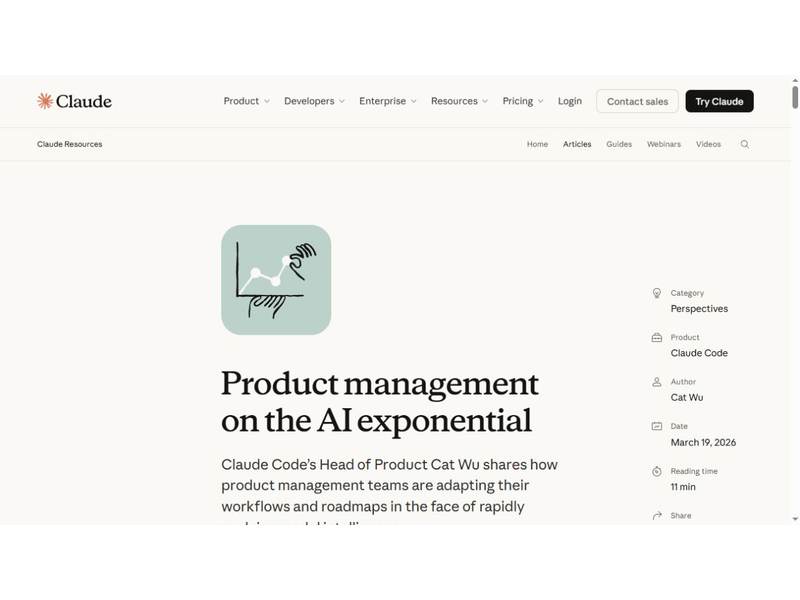
Cat Wu’s March 2026 article on AI product management. Screenshot: Claude’s official website.
Who is Cat Wu? From engineering and investing to AI product management
Cat Wu, whose full name is Catherine Wu, studied computer science at Princeton University and graduated in 2017. Her career combines software engineering, venture investing and AI product management.
Before joining Anthropic, she worked in engineering and product development at Scale AI and Dagster, then became a partner at Index Ventures. An official Index Ventures article published in 2024 identifies her as a partner.
Career timeline
| Period | Experience |
|---|---|
| 2017 | Graduated from Princeton University with a computer science degree. |
| Early engineering roles | Product engineer at Scale AI and engineering manager at Dagster Labs, working on product development and commercialization. |
| 2021–2024 | Partner at Index Ventures, spending close to three years in venture capital. |
| August 2024 | Joined Anthropic’s Research PM team, connecting model research with customer needs. |
| At Anthropic | Led product for Claude Code and contributed to work on Cowork and Claude Tag. |
| October 30, 2026 | Last working day at Anthropic, according to her farewell announcement. |
| November 5, 2026, Beijing time | Announced that she was joining OpenAI to lead product management for Core Products. |
These roles require different but complementary judgments. Engineers assess whether a feature can be built and whether the system will hold up in use. Product managers identify user needs and decide what to prioritize. Investors examine positioning, demand and business models. In fast-moving AI products, technical feasibility and user value often have to be assessed together.
A task that works in a demonstration still has to cope with incomplete data, ambiguous instructions, execution failures and insufficient permissions in a real product. Product leaders help teams address those conditions so that a successful demonstration becomes something people can use repeatedly. Wu’s experience covers several stages of that transition from technical capability to a usable product.
Claude Code, Cowork and Tag: three connected kinds of work
The three products Wu mentioned in her farewell post serve software development, knowledge work and team collaboration. They share a practical challenge: how to let people delegate tasks to AI while retaining the information and decision-making authority they need.
Claude Code: bringing models into development workflows
Anthropic introduced Claude Code as a limited research preview on February 24, 2025. Its initial announcement described an agentic coding tool for the command line that could help developers read and modify code, write and run tests, and handle development tasks. It connected the model to the codebase, command-line tools and the process of checking its work.
In her farewell post, Wu recalled asking an early internal version of Claude Code to build a reinforcement-learning environment. She steered it without writing the code herself. That experience, she said, convinced her to join the team.
From a product perspective, coding agents must understand existing projects, carry out tasks with multiple steps, show what they changed and make the results reviewable. Code quality matters, but so do delivery and verification: both affect whether developers are willing to delegate another task.
A developer asking AI to fix a bug needs to know which files changed, whether tests passed and what else might be affected. How clearly a product presents that information determines part of the time needed to review its work. Experience with Claude Code is therefore directly relevant to designing agents that users can trust with real development tasks.
Cowork: extending delegation to knowledge work
Cowork launched in research preview on January 12, 2026, extending agentic capabilities beyond coding to work such as handling files, organizing information and producing deliverables. On September 16, Anthropic announced the integration of Cowork and its everyday chat experience, allowing people to ask questions or delegate more involved tasks within a unified Claude experience.
That expansion introduces different design demands. Developers can often inspect code, interpret errors and provide a working environment. Office users are more likely to ask for an outcome: organize these materials, or turn the findings into a report. The product must help clarify the goal, gather the relevant files and present a useful finished result.
The combination of Cowork and chat illustrates a broader expectation: people want to state what they need, while the product takes on more of the work of identifying the task and arranging its execution. An understandable starting point and continuity of context influence whether a general-purpose agent’s capabilities translate into actual use.
Claude Tag: moving from individual use to collaboration
Tag in Wu’s announcement refers to Claude Tag, which Anthropic introduced on June 23, 2026. Its first setting was Slack: team members could call on Claude in authorized channels, delegate tasks and give it access to selected tools, data or codebases. Administrators could define access and inspect activity records.
Team use adds further requirements. One person may initiate a task that another needs to continue. Information available in one channel may not be appropriate for another department. Products have to reconcile shared context, responsibility for tasks and data permissions.
Consider an employee asking AI to analyze a project’s progress. Colleagues need to understand which materials informed the analysis, what remains unresolved and whether someone else can continue from the same context. The result has to be understandable, reviewable and usable by the team.
Wu’s experience thus touches three related settings: development tasks, individual knowledge work and collaboration. Their connection helps explain the relevance of her background to general-purpose agents.
Her approach: prototypes and evaluations that keep pace with models
In a March 2026 article published by Anthropic, Wu described how rapid improvements in models are changing product management. She advocated short experiments, working prototypes and practical evaluations, together with reassessing existing features when a new model arrives.
A hypothetical document workflow illustrates the point. A team might initially require users to divide a long-document task into several steps because the model frequently overlooks constraints. A few months later, the model may handle the complete task more reliably. At that point, the original workflow deserves another look. Keeping unnecessary steps can prevent users from benefiting fully from the model’s improvement.
The reverse is also important. A successful demonstration must be tested with different files, instructions and failure conditions. Teams need to establish whether success is repeatable, whether errors are detectable and how users can correct the result.
Prototypes make the discussion concrete; evaluations help determine whether a feature is ready to ship. Wu’s published approach emphasizes keeping model progress, user feedback and product changes connected. That experience could help OpenAI bring new capabilities into practical workflows more quickly. This is an interpretation of her public work, rather than confirmation of any particular assignment at her new company.
What does leading product management for Core Products mean?
Wu’s announcement says she will lead product management for Core Products. She also named Tibo Sottiaux and OpenAI’s PM team among the colleagues she was looking forward to working with.
The announcement did not provide a complete list of the products within her remit. It establishes a product-management leadership role in Core Products; it does not, by itself, establish that she has been appointed head of Codex. More specific responsibilities would require further disclosure.
OpenAI has already invested in software-engineering agents. In May 2025, it introduced a research preview of the cloud-based Codex agent, describing work such as implementing features, fixing bugs, running tests and producing changes that developers could review.
Against that background, Wu’s appointment can be understood as the addition of relevant product-management experience. Its potential value lies in connecting user needs, development priorities and the experience of using the product. Its actual impact will depend on what ships, the quality of completed tasks and feedback from users.
Why keeping users in control matters
Wu emphasized agents that support individuals and teams while keeping people in control. That aspiration addresses a practical challenge as AI takes on more of a workflow.
When an agent can use tools, change files, update records and work through extended tasks, users need to know what it can access, what it intends to do, what it has done and how to intervene. The way those controls work affects how much people are willing to delegate.
OpenAI’s published description of workspace agents includes administrative permissions, approval steps, activity visibility and monitoring. Control and collaboration are already concrete parts of its agent product design.
For product teams, user control can be framed through four questions:
Is access understandable? Users and administrators should be able to identify which files and systems an agent can use, and how to change those permissions.
Can consequential actions be reviewed? Sending messages, changing business records or submitting material externally should follow the relevant authorization and approval rules.
Is execution visible? Longer tasks need understandable progress, results and exception reporting so that users can judge whether the work is on track.
Can users correct the course? They should be able to stop a task, change the request, review edits and, where supported, restore an earlier version.
The difficulty is to provide that control without unnecessary interruptions. Asking for confirmation at every minor step can turn delegation into constant supervision. Unclear authorization, on the other hand, makes consequences difficult to anticipate. The appropriate interaction depends on the task, the permission involved and the impact of the action.
A weekly sales report provides a simple example. Collecting existing data, calculating metrics and drafting the report can proceed under agreed rules. Sending it to a customer or changing an official record should follow the applicable approval process. Distinguishing these steps gives automation and human judgment appropriate roles.
Competition among agents therefore involves more than task-completion quality. It also concerns whether users can grant access clearly, inspect work effectively and take over smoothly. Wu’s work on coding and team products provides relevant experience with those questions.
What the move could mean for OpenAI, Anthropic and users
For OpenAI: relevant experience, with results still to come
Wu’s background suggests potential contributions in understanding how developers delegate, identifying obstacles for knowledge workers and handling context and permissions in teams. Those areas align with the individual and team agents she described in her announcement.
Product improvement is a joint effort across research, engineering, design, product and operations. Useful measures of the appointment’s impact would include whether tasks become easier to start, failures become easier to correct and work moves more naturally between products.
For complex work, a model’s ability to complete one step does not guarantee that a person can complete the whole job smoothly. Providing materials, explaining requirements, reviewing results and deciding what happens next remain product-design challenges.
For Anthropic: continuity and the transfer of experience
A product leader accumulates knowledge about user feedback, priorities and collaboration across teams. A departure creates a need to transfer that knowledge. Relevant signals for Anthropic include the continuity of product iteration, responses to feedback and the user experience.
A single move establishes a change in personnel and responsibilities. It cannot, on its own, explain a company’s competitive strength. Models, engineering systems, customer demand and collaboration continue to shape the products. Wu herself credited the teams behind the products in her farewell message.
The more useful evidence will be observable product changes: whether frequently used features keep improving, reported problems get addressed and experiences remain consistent across different kinds of work.
For users: measure the effort needed to finish the job
For developers and business users, an appointment does not immediately change whether a product suits their work. A more useful comparison is the total preparation, waiting, review and rework needed to complete the same task.
An AI-generated report may arrive quickly, but the overall saving can be modest if the user repeatedly has to supply missing data, explain the background and correct conclusions. Products that retain necessary context, flag problems clearly and deliver editable results are easier to incorporate into everyday work.
Teams can also ask whether another member can understand and continue the work, whether an interrupted workflow can be resumed and whether administrators can see the agent’s access and activity. Together, these factors determine how much work an agent can meaningfully take on.
Four signals to watch
The longer-term significance of Wu’s move will be clearer in observable product behavior.
| Area | What to look for |
|---|---|
| Task delivery | More reliable completion of complex tasks, with clear explanations and recovery paths when something fails. |
| Continuity | The ability to continue with existing files, context and requirements, with less repeated setup. |
| Collaboration | Shared understanding of progress, effective review and handoffs, and clear permission boundaries. |
| User control | Authorization, approval, visibility and correction that are easier to understand and use. |
These are changes users can experience directly. Whether Wu’s new role turns relevant experience into sustained product improvements will determine the lasting importance of the appointment.
Frequently asked questions
Who is Cat Wu?
Cat Wu, also known as Catherine Wu, is a product leader with engineering, venture-capital and AI product-management experience. She worked at Scale AI, Dagster and Index Ventures before leading product for Claude Code at Anthropic and contributing to Cowork and Claude Tag.
Where did Cat Wu study?
She studied computer science at Princeton University and graduated in 2017.
What role is Cat Wu taking at OpenAI?
On November 5, 2026, Beijing time, she announced that she was joining OpenAI to lead product management for Core Products. Her announcement did not list the complete scope of products she would oversee.
Why did she leave Anthropic?
Her farewell and appointment announcements did not explain her reasons in detail. She said October 30, 2026, was her final working day at Anthropic, before announcing the move to OpenAI.
What is Tag?
Claude Tag is Anthropic’s agent product for team collaboration. It initially brought task delegation and execution into Slack, with access permissions and administrative controls.
Has she been named head of Codex?
Her announced position is leading product management for Core Products. That statement alone does not justify describing her as head of Codex; specific product responsibilities require further disclosure.
 Subscribe Now

