


Centroid Solutions: CS 360, C24 and Broker Technology
Centroid Solutions provides trading technology for brokers, liquidity businesses and other financial institutions. Its current product range connects liquidity aggregation and order execution with risk analytics, server hosting, trading applications and client lifecycle management. For a B2B buyer, the useful question is how those components fit the operating model of a brokerage: where prices enter, how orders are routed, how exposure is measured and how clients move between onboarding, funding and trading.
This guide maps CS 360, C 24, CS Drive, C2C and CS Maystro to those business functions, then examines Centroid's prop trading offering. It draws on Centroid's official product pages and the Fazzaco company profile, checked on September 22, 2026. Product capabilities and service terms described here are vendor-published information; the operational examples are Fazzaco's analysis of how an institution could evaluate them.
What is Centroid Solutions?
Centroid Solutions is a UAE-headquartered capital markets technology provider. Fazzaco lists it under Forex Network Solution, Forex Bridge Provider and Forex Risk Management. Those categories describe its role in the institutional technology supply chain: it supplies systems that financial businesses use to operate their services.
Its current website presents a modular architecture. An institution can select individual components or combine them into a broader environment covering trading, risk, infrastructure and customer operations. This matters for established brokers, which may need to replace a bridge while retaining their existing front end, as well as for businesses planning a larger platform launch. The scope of a deployment therefore starts with the institution's existing systems and target operating model.
Centroid's product portfolio at a glance
| Product | Primary function | Business workflow |
|---|---|---|
| CS 360 | Liquidity aggregation, connectivity and execution | Receive prices, configure liquidity and route orders |
| C 24 | Risk monitoring and analytics | Assess exposure, client behaviour and portfolio scenarios |
| CS Drive | Trading infrastructure hosting | Place and operate servers near relevant trading venues |
| C2C | Multi-asset trading and investing platform | Deliver web and mobile trading experiences |
| CS Maystro | Client lifecycle management and CRM | Coordinate onboarding, accounts, wallets and reporting |
| Prop trading solutions | Execution controls and trading-account analytics | Monitor trading behaviour, drawdowns and rule-based alerts |
The separation is practical. A CRM record, an execution record and a risk calculation describe different aspects of the same client relationship. A coherent implementation connects those records while preserving clear responsibility for each function. Centroid's range gives buyers several possible starting points for that design.
CS 360: liquidity aggregation and execution control
CS 360 is Centroid's bridge engine for managing pricing, liquidity and execution from a central environment. The official page describes connections to liquidity providers, trading platforms and FIX API clients, alongside tools to customize and redistribute liquidity. Its feature set includes aggregation controls, order routing, margin management, exposure monitoring and real-time configuration.
For a broker, aggregation brings price streams into a common environment, while routing determines how an order proceeds through the available execution paths. The commercial value of the arrangement depends on the configuration: instruments, liquidity relationships, client groups and execution policies must agree across the connected systems. CS 360's central configuration is relevant because those decisions otherwise become scattered across several operational interfaces.
APIs and data access
Centroid lists native FIX 4.4 connectivity and WebSocket/REST APIs, as well as FIX Drop Copy, database access and real-time data dissemination. These are useful integration paths for proprietary trading applications, internal reporting and post-trade reconciliation. The existence of an API is the starting point for integration design; message fields, identifiers, permissions and recovery behaviour define the actual interface an institution will operate.
Consider an internal reporting team that needs to reconcile an order with its fills and subsequent exposure. Its implementation should preserve the original order identifier, execution identifiers, timestamps and instrument mapping across the bridge and downstream systems. That example illustrates why connectivity and data consistency belong in the same project, even when different teams own them.
Execution controls and quantitative features
The CS 360 page lists exposure-limit hedging, automated internalization, flow-based price skew, market-impact analysis and passive hedging using time-to-live orders. It also describes delayed hedging, copy trading, notifications and audit trails. These features address decisions about when and how exposure is handled and how execution activity can be reviewed.
A useful demonstration would follow one instrument through several defined conditions: ordinary order flow, a configured exposure threshold and an unavailable liquidity connection. The broker can then examine which routing rule applies, what alerts appear and which records explain the result. The objective is to connect each control to an explicit business policy and an observable outcome.
C 24: a consolidated view of trading risk
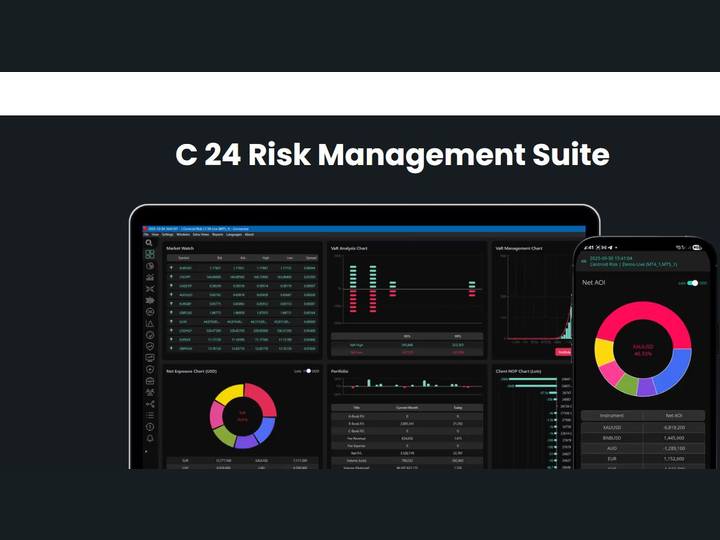
C 24 is the portfolio analytics and risk-management component. Centroid lists real-time Value at Risk, exposure monitoring, concentration modelling, stress testing, client risk profiling, client and portfolio profit-and-loss analysis, alerts and business reports. The vendor also describes dynamic dashboards with saved filters and data views.
This gives a dealing or risk team several perspectives on the same trading book. Instrument exposure identifies where positions sit; concentration analysis shows where activity clusters; client analysis adds behavioural context; and stress testing explores specified market scenarios. Each perspective answers a different operational question, so a useful dashboard design starts with the decisions the team needs to make.
For example, a firm operating more than one trading platform may want a consolidated view of exposure to an underlying asset. The aggregation requires consistent symbol definitions, contract sizes, account currencies and timestamp handling. Centroid states that multiple platforms can connect to a single C 24 instance and that API access is available for extracting data into internal systems. Those capabilities support a common risk view when the underlying data mappings are agreed.
C 24 and CS 360 also have distinct responsibilities. CS 360 places risk-related controls close to liquidity and execution; C 24 adds broader analytical views, portfolio scenarios and client-level interpretation. A broker can define how observations in the risk system inform decisions in the execution environment, with named owners for thresholds and changes.
CS Drive: infrastructure close to trading connections
CS Drive is Centroid's server-hosting offering. Its official page identifies Equinix LD4 in London, NY4 in New York, TY3 in Tokyo and SG3 in Singapore, and describes co-location and cross-connect arrangements involving trading servers, engines and liquidity providers. It also lists dedicated hardware, ISP redundancy, monitoring, VPN connectivity, DDoS protection and infrastructure redundancy.
The business rationale is proximity and operational coordination. Hosting a trading server near the relevant execution infrastructure can shorten part of the communication path. A deployment still contains several distinct paths: a client's connection to an access point, the access point's connection to the server and the server's connection to the execution or liquidity environment. Mapping those paths helps a technology team select the appropriate location.
For a broker serving several regions, the infrastructure discussion should therefore cover both the central trading environment and regional access. A London location may align with a particular liquidity relationship, while client connectivity elsewhere requires its own design. Performance acceptance criteria can measure response times, price continuity and recovery behaviour on the paths that the broker actually uses.
C2C: web and mobile trading experiences
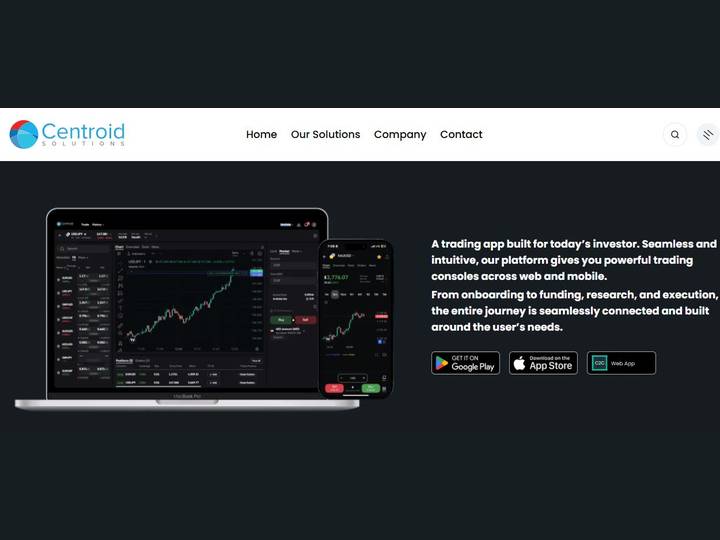
C2C is Centroid's multi-asset, multi-account and multi-currency trading and investing platform. The product page lists web, iOS and Android applications, together with onboarding and funding integration, order functionality, tiered margining, commission definitions, trade confirmations and data extraction. It also describes corporate actions, settlements and custody reporting where a custody-account setup applies.
Centroid offers two front-end approaches: white-label customization of its existing interfaces, including brand identity, or API-based development of a proprietary experience. This creates a practical choice for a product team. A branded interface can organize a launch around an existing interaction model; a proprietary application lets the institution design more of the client experience around its own service.
The product specification should follow the intended customer journey. For example, a client with multiple accounts needs to understand which account is active, which currency is used and how a transfer affects available funds. A multi-asset proposition also needs consistent treatment of instrument information, order status and confirmations. Those are concrete areas to examine in a demonstration across both mobile and web.
CS Maystro: onboarding, wallets and client operations
CS Maystro is Centroid's CLM/CRM platform. The published functionality covers configurable onboarding, automatic account creation, account management, multi-currency wallets, funding workflows, partner payments, rebate management and multi-entity support. Centroid also lists integrations with identity-verification and KYC providers, connections to payment gateways and API connectivity to the wider broker technology stack.
Its relationship with C2C is particularly relevant. Centroid describes account creation through integration with its trading platform and a connected onboarding-to-funding journey. A broker evaluating both products can examine how one client identity links to trading accounts, wallet balances, permissions and customer-service records. Clear ownership of those records helps operations teams resolve questions about account status and transaction history.
CS Maystro's reporting dashboards are described as built on Tableau, with pre-built reports and the ability to customize dashboards. A useful reporting design can track movement through an onboarding process, funding activity and account usage. The definitions should be agreed before launch: an approved client, a created trading account and a funded account are separate events, each with its own role in operational reporting.
How the components fit a broker's operating model
An illustrative deployment begins with a client onboarding through CS Maystro and using a trading interface delivered through C2C. CS 360 supplies the liquidity and execution layer, C 24 provides analytical oversight, and CS Drive hosts relevant infrastructure. The exact interfaces and included components depend on the contracted implementation. The sequence helps stakeholders discuss the whole service without treating every component as interchangeable.
| Operational question | Relevant component | Evidence to examine in a demonstration |
|---|---|---|
| How does an approved client obtain an account? | CS Maystro and C2C | Identity mapping, account creation and status history |
| How is an order priced and routed? | CS 360 | Instrument mapping, routing configuration and execution records |
| How does the dealing team see aggregate exposure? | C 24 | Cross-platform data, dashboard filters and alerts |
| How is infrastructure continuity managed? | CS Drive and hosted services | Deployment topology, monitoring and recovery procedures |
| How are client transactions reported? | CS Maystro and connected systems | Wallet records, transaction identifiers and report definitions |
An established firm could instead keep its current CRM and trading application and focus on CS 360 or C 24. The modular proposition is relevant precisely because a buyer's existing investment determines which integration boundaries matter most. A clearly scoped component project can establish the data and operating conventions for later expansion.
Prop trading technology and PropShield
Centroid's prop trading solution brings together execution capabilities, hosting, account analytics and rule-based monitoring. The official page describes drawdown monitoring, trading-behaviour alerts, copy trading, adjustable exposure scaling, order-routing controls and execution logs. It gives examples of configurable triggers involving high-frequency activity, coordinated trading patterns and positions without stop-loss protection.
The same page introduces PropShield as an anonymous shared-intelligence network for detecting suspicious patterns across participating firms. This is a vendor description of a product capability. For a prop firm's operating team, the useful distinction is between an automated signal and a reviewed account decision. Alert context, relevant records and the firm's published rules need to support any subsequent investigation.
A practical evaluation can use known test cases to examine which trigger fires, how it is explained and how an analyst records a conclusion. This connects technical detection with a repeatable review process. It also keeps account oversight distinct from the separate work of managing the firm's aggregate trading exposure.
Deployment, support and project planning
Centroid states that CS 360 is supplied as a hosted SaaS service with a dedicated instance. Its C 24 FAQ likewise describes a dedicated hosted instance and a backup instance. The published setup guidance refers to a few working days for CS 360 once setup details are supplied, and 7–10 working days for C 24's initial deployment and data synchronization, followed by testing and training. These are vendor planning indications; a firm's integration scope determines its project schedule.
The product FAQs specify 24/5 support and 24/7 emergency support. That distinction is useful when assigning internal escalation responsibilities and planning coverage across time zones. A launch plan should identify the institution's own service owner, its support contacts, the incident information to collect and the handover between internal teams and the vendor.
Implementation work can be organized into three stages: agree data and configuration, demonstrate representative workflows, then rehearse operational handover. A bridge project needs pricing and execution cases; a risk project needs reconciled positions and scenario results; a client-platform project needs onboarding, account and funding cases. Each stage produces evidence that the relevant business team can review.
Frequently asked questions
Is Centroid Solutions a broker or a technology supplier?
Its official website presents Centroid as a capital markets technology provider. Fazzaco categorizes the company in network solutions, bridge technology and risk management. This profile addresses those B2B technology services.
What is the difference between CS 360 and C 24?
CS 360 focuses on liquidity connectivity, pricing and execution, with embedded risk controls. C 24 focuses on risk analytics, including exposure, client and portfolio analysis, stress testing and dashboards. Their responsibilities can complement each other in a broker's operating environment.
Can a broker retain its existing trading platform?
Centroid describes API connectivity for custom platforms in CS 360 and vendor-managed custom-platform integration for C 24. A broker can evaluate a component deployment around its existing systems, with interface requirements agreed during scoping.
Does Centroid offer a CRM and a trading front end?
Yes. CS Maystro is the CLM/CRM product, and C2C is the web and mobile trading platform. Their official pages describe connected account creation, onboarding and funding, alongside options for branded or proprietary front ends.
Where Centroid fits in B2B vendor discovery
Centroid's relevance to a broker's shortlist comes from the breadth of its connected technology functions and the ability to scope individual components. CS 360 addresses the execution environment, C 24 adds risk intelligence, CS Drive covers hosting, and C2C with CS Maystro extends the proposition into client-facing operations. Evaluating those functions against a documented operating model gives a buyer a more useful basis for discussion than a feature count alone.
For company context, visit Centroid Solutions on Fazzaco. Product references: Centroid company overview, CS 360, C 24, CS Drive, C2C, CS Maystro and prop trading solutions. Information checked September 22, 2026.
 Subscribe Now