


Cities Contending for the World's Capital City: Who will be the Winner?
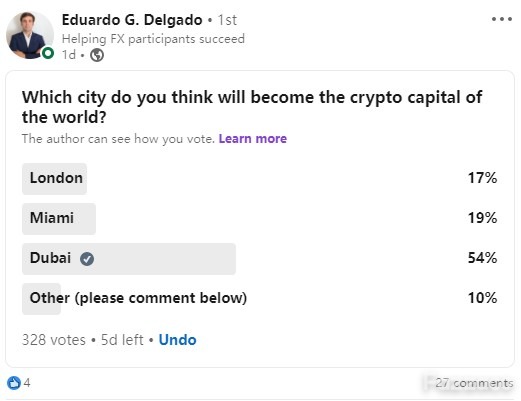
 Fazzaco has noticed an interesting voting on LinkedIn, posted by a person in the financial industry, titled "Which city do you think will become the crypto capital of the world?"
Except for the last option, which is "Others", all three options are London, Miami, and Dubai. Up to the writing of this article, Dubai got the most votes, accounting 54% of all, followed by Miami (19%) and verly closely London (17%). Today, let's take a look at the crypto industry in these three cities, and find out whether the world's crypto capital in the future will be one of the three, and if there will be a dark horse.
London: Will it be shackled by FCA's regulations?
As part of its goal to become a global hub for cryptocurrencies, the British government has unveiled measures to regulate stablecoins for payments. The United Kingdom has now entered a competitive contest among countries to develop the next generation of regional crypto centers.
Although the government has stated its aim to bring stablecoins under financial regulation, it has left crypto firms based in the United Kingdom in the dark. The Financial Conduct Authority (FCA) had set a March 31 2020 deadline for all crypto firms to register with it, but it was unable to process all of the applications on time, requiring the deadline to be extended. Many people mistook this for heel-dragging and walked away.
Wirex, a bitcoin debit card issuer, and B2C2, one of the world's major liquidity providers, both withdrew their applications, opting to relocate their operations to businesses not under the FCA's authority. Others have followed suit. This is a challenge for lawmakers not only in the United Kingdom, but also around the world.
After all, crypto companies tend to be more capricious. If the situation does not improve, they will relocate to a jurisdiction that better suits their interests. They don't have to deal with the same issues that other businesses have, such as availability to trained personnel, transportation, and economies of scale.
Miami: The crash of the city's token and the love-hate story with New York City
Miami Mayor Francis Suarez launched MiamiCoin, a crypto token for the city, in 2021, and it has since produced $5 million for the city. With no state income tax and a corporation tax rate of only 5.5 percent, it's easy to see how a town dubbed "The Magic City" may appeal to a still-developing business that is frequently accused of magical thinking. In early 2021, crypto behemoth Blockchain.com relocated from New York City to Miami and acquired a large office in the city.
Things appeared to be going well at first, until the mayor was cited in the Miami Herald saying "I don't know whether it's (MiamiCoin) going to work". And the value of the city’s token sank to approximately four-tenths of a cent, and it now sits at $0.0017, down more than 90%, according to Coinbase.
On the other hand, as the battle between NYC and Miami heats up, and as venture capital firms buy real estate in the Big Apple to grow their involvement in the field, New York City has been making strides toward being the crypto capital.
According to Forbes, which cited data from CB Insights, New York City drew $6.5 billion in crypto startup funding last year, accounting for 46% of all U.S. funding to crypto-focused companies. Silicon Valley came in second with $3.9 billion in funding. Both Los Angeles and Miami are said to have made $760 million.
Also in June, it was rumored that Coinbase would open an office in New York City. A Coinbase representative did not immediately respond to the request for comment on the company's decision to expand to New York.
Dubai: The most voted city
On April 4, 2022, cryptocurrency exchange Bybit announced that it would relocate its headquarters from Singapore to Dubai. In addition, Crypto.com has stated that it will open a regional office in the city.
Global crypto exchanges such as FTX and Binance had already been granted licenses to operate in the city. Sheikh Mohammed Bin Rashid, the ruler of Dubai, said in March that the emirate had passed its first law governing virtual assets and established an independent regulator to oversee the cryptocurrency industry.
The Dubai Virtual Asset Regulation Law was enacted in order to promote Dubai and the UAE as regional and worldwide crypto market destinations.
The Dubai Virtual Assets Regulatory Authority (VARA), a regulatory agency, will supervise the regulation, licensing, and governance of the virtual asset business environment.
Dubai has been fostering the expansion of the crypto sector by building a regulatory framework to lure crypto enterprises and talent to the city as regional economic competition heats up.
Conclusion
Cryptocurrencies are sometimes referred to as a "bubble" by critics, and the markets can be quite unpredictable, just like a balloon, if you squeeze one portion, another pops out.
That dynamic has been on display this year, as governments that were once regarded to be crypto-friendly (such as Singapore's) or at least crypto-tolerant (India, despite central bank reluctance) have put pressure on the industry, not to mention where crypto industry met iron-fist crackdown, such as mainland China.
So, Dubai looks like an unanimous winner here, but let us not forget that even if a ballon can change shape under pressure, it’ll burst if squeezed too tightly.
 Subscribe Now