


Exclusive with CMC Head of Greater China Biyi Cheng: Necessity as the Mother of Invention – Evolution in Derivative Trading
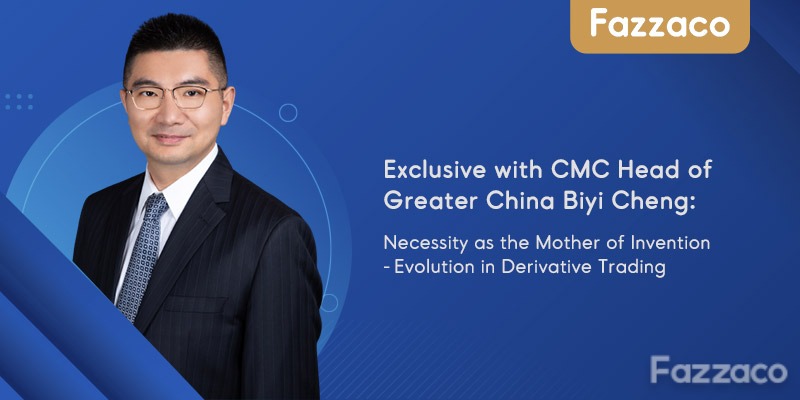
The retail leveraged trading landscape has been transformed in recent years. From a backdrop that centred around high profile currency crosses, along with select precious metals and a few indices, the tradable universes offered to clients have now ballooned. Companies like CMC Markets evolve on a continuous basis to ensure that they – and the brokers they integrate with – can stay ahead of the pack in an eternally competitive industry. Tens of thousands of different instruments are now accessible, but exactly what is it that's driving this change and why does it hold such an allure in the APAC region? We spoke to Biyi Cheng, Head of Greater China for CMC Markets, to understand more about how the situation has been evolving – and where he thinks it will go next.
Fazzaco: If we look back a decade, what was the typical market proposition in 2012?
Cheng: This market has been evolving for some time and it's probably fair to say that Europe was at the front of this curve, but as confidence amongst providers grew, the ambitious first turned to Australia before looking to target the wider APAC region. If we focus in on that, offerings a decade ago were FX centric and typically could be best described as functional, but traders still had access to high levels of leverage and that ability to back a market moving in either direction, all from a single account. It was a great first step in the democratisation of trading – giving retail access to structures which had previously been the preserve of institutions.
Fazzaco: Is there any one factor that has proved instrumental in delivering change?
Cheng: No. I believe there have been at least three key drivers. Changing demands of the regulators, greater competition and innovation from within the industry and traders having to look beyond that initial core instrument set to find the potential for returns.
Taking those points in turn, regulatory oversight of the industry has progressively tightened over the years, especially with regard to highly leveraged instruments which are only traded over the counter. That means a clear reference price can be difficult to ascertain especially for smaller brokers who are less well connected, in turn producing challenges when it comes to clients disputing trades. There is however a more accommodative regulatory stance seen when it comes to the use of exchange traded products such as equities, whether that's on a futures or cash basis.
There's a well-known phrase that competition breeds success and this has certainly been played out in the industry. As the number of providers has expanded, the have been forced to innovate to attract and retain customers. Ultimately providers want to be acting as a one stop shop, allowing clients to meet all their needs from a single account. Not only does this ensure a 'sticky' relationship with the customer, but it also offers a better understanding of risk and may also facilitate benefits such as cross-margining of positions. And that extends well beyond just having a comprehensive tradable universe on offer – brokers are also having to compete on the overall trading experience, so we've seen a proliferation of well-engineered and expertly maintained proprietary platforms, as well as numerous value-add trading functions from news feeds to charting, pattern recognition software and sophisticated trade types being added.
Finally, there has been the change in what clients are seeking. Historically there was no shortage of volatility in currency markets, but decades of ultra lax monetary policy and central bank stimulus measures served to remove a lot of the price action and classic trading opportunities which surrounded rate hikes. By the time that returned at the start of 2020, the industry had broadened out the instruments on offer, allowing clients to tap into those faster moving markets.
Fazzaco: What about Meme Stocks – is that now consigned to history?
Cheng: The episode was driven by a series of fascinating fundamentals, and it laid bare the fact that the very biggest institutions can still be left exposed when the small players act as one. However, we went through a period of many people being abnormally rich both in terms of time and money as a result of COVID lockdowns. It seems unlikely that we will ever see a repeat of that, but it does underline the benefit of having a single account from which a client can access a huge array of different assets. Regardless of where clients were located in the world, if they were connected directly through CMC Markets, they had access to all these stocks and for those intermediary brokers using an API connection, facilitating access if it wasn't already in place was a process that could be completed in a matter of seconds. We know that many of today's traders are simply chasing volatility and are agnostic to the underlying asset, so for them to know that their broker can always deliver on this count provides a huge degree of confidence. What's more, it also serves to build a lasting relationship.
Fazzaco: And what does the future hold for trading trends?
Cheng: I believe we will continue to see the media – especially emerging, user generated formats, influencing the decisions clients make. It may move away from the mindset we saw through the meme-stock cycle, but technology innovations are likely to remain popular, but within the current format and also Web 3 based concepts such as the Metaverse and Social Audio. Climate investing is also likely to be increasingly popular – there's a whole host of regulatory fundamentals that stand to provide influence here as to which stocks have the greatest upside potential, but this is all likely to be backed off around companies – and maybe even consumers – having to pay for the carbon they use. With that in mind, towards the end of last year at CMC Markets we added carbon futures to our platform, too, again with that aim of reassuring brokers and their clients alike that we can deliver the one stop solution to meet all their trading needs. And that's just one small example of the company responding to changing trends and demands, with the universe of well over 12,000 different instruments recently having been augmented by the addition of constituents ranging from newly IPO'd equities to innovative ETFs covering defined niches ranging from Cloud Computing in China, to Electric Vehicles, Social Media, e-Sports and even Cannabis.
Fazzaco: What do end-user clients need to consider here?
Cheng: The important point is to ensure that they have access to the array of instruments they might want to trade at any point in time, supported by the functional tools that offer them the best trading experience. So that could be charts and news feeds, or the ability to use complex order types that support their trading strategy. There's also the need to have confidence in the upstream process, so that means understanding what is the broker doing with their trades, knowing that orders will be filled efficiently and so on. Headline promises over price or execution speed are all well and good, but clients need to ensure that providers are good to their word over time.
Fazzaco: And for intermediaries plugging into CMC Markets Connect, where's the benefit?
Cheng: It's perhaps too easy to believe that these API connections linking orders to liquidity are little more than simple functional pieces of code, which would mean that the industry as a whole is highly commoditised. But the reality is way more nuanced than that. It's vital that clients can get into the market as seamlessly as possible, hence the benefit of brokers connecting directly to a non-bank liquidity provider. We have also noted the benefits of being able to offer a wide range of relevant instruments – and having the ability to change that array quicky to respond to client demand also helps. Furthermore, with over 30 years of experience, we understand the pain points institutional clients face so structure our whole system – including aspects like regulatory reporting, margin management and the value of deep markets with consistent pricing. It's vital that intermediaries understand exactly what their access point into the market actually provides, beyond simply a headline price.
 Subscribe Now