


How CME Group’s FX Link Turns One Spread into Two Trades
An asset manager holds €1 million in cash and wants to keep its euro exposure through a particular futures expiry. Selling the euros today would remove the exposure. Buying euro futures while still holding the cash would add to it. On CME Group’s FX Link market, the manager can enter one order for the difference between the two prices. A fill sells the cash euros and buys futures for the same euro amount. The two trades execute together. They then reach different people on the operations desk.
What the price on Globex buys
CME Group operates the electronic market, Globex, where participants can bid or offer for the spread between a specified FX futures contract and an over-the-counter spot transaction. For EUR/USD, the order book expresses both prices in US dollars per euro. Subtract the spot price from the futures price and the result is the basis traded on FX Link. A desk can therefore set the difference it will accept without entering two outright orders and waiting to see where the second one fills.
The contract month matters. Spot and futures have different value dates, and the interest earned on one currency relative to the other over that interval affects their price relationship. A positive spread on its own says little about whether a dealer expects the euro to rise. Nor does buying the spread always open a new directional position. In the manager’s case, the euro sale offsets the cash already held and the future carries the exposure forward.
From eight spreads to a cash settlement
Consider a hypothetical fill. CME specifies €125,000 per EUR/USD spread, so eight spreads cover €1 million on each leg. Assume the futures leg is assigned a price of 1.10240 and the spread trades at +0.00120. The spot price implied by that fill is 1.10120. The difference is 12 pips, with one pip worth 0.0001 dollars per euro. These figures illustrate the booking arithmetic.
For the spot value date, the manager has sold €1 million and is due to receive $1,101,200 before any charges. The futures account shows eight long contracts in the chosen delivery month, each entered at 1.10240. Treating $1,102,400, the dollar equivalent at the futures price, as a second cash transfer due on the spot date would give the treasury team a spurious funding requirement. Treating the $1,200 difference as earned income would also miss what it measures: two exchange rates for different dates applied to the same euro amount.
The desk can reconstruct the agreed spread from the two leg prices even if its cash ledger has no field called “basis.” The account, currency amount, direction and dates still have to match the fill. A cash report showing euros received would be inconsistent with this particular order even if the exchange rate were correct.
Why a USD/CAD spread buyer makes two sales
A booking rule copied straight from the euro example would reverse one side of a Canadian dollar trade. An OTC USD/CAD quote gives Canadian dollars per US dollar, whereas the CME Canadian dollar future gives US dollars per Canadian dollar. The futures price must first be inverted to put both rates in the same units. Only then does subtracting spot give a meaningful spread.
Buying the USD/CAD spread therefore sells USD/CAD spot and sells the Canadian dollar future. Read the currencies behind the verbs: the spot leg sells US dollars and buys Canadian dollars; the futures sale takes the opposite Canadian dollar exposure. The standard amount per spread is C$100,000. Assuming US$100,000 simply because USD appears first on the spot screen would place the wrong amount on the settlement instruction.
Where the two confirmations go
CME Clearing clears the futures through the participant’s futures commission merchant. The spot trade uses OTC credit relationships through a central FX prime broker. Depending on its arrangement, the participant faces its own FX prime broker or the central prime broker directly. For an institution assessing access, its futures clearing account answers one question. Its ability to settle the spot currencies on the required date answers another.
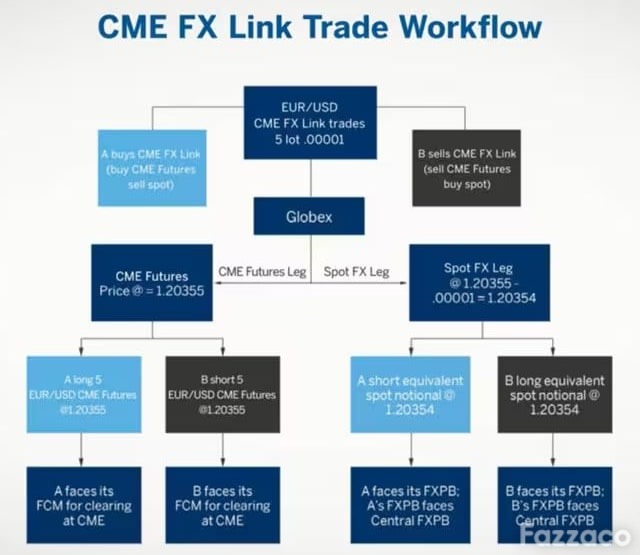
CME Group traces a five-lot example through Globex to the clearing and prime brokerage accounts.
The manager’s next roll may call for a different order altogether. Once the euros have been sold and the eight futures are on the books, moving the position to a later expiry can involve selling those eight futures and buying eight in the new month. CME calls that a futures calendar spread. Both resulting records belong to futures accounts. The presence of an actual spot cash flow on the first roll, and its absence on the second, tells the operations team which confirmations it should expect.
 Subscribe Now