


CommPeak Dialer, TextPeak and Cloud Communications for Brokers
CommPeak supplies business communications technology spanning predictive dialing, messaging, cloud telephony and voice connectivity. Its product range includes CommPeak Dialer, TextPeak, Cloud PBX, SIP Trunking and DID numbers, with additional tools for number lookup, softphone calling and speech-to-text. For brokers and fintech service teams, this combination connects the practical work of reaching customers with the infrastructure that carries those conversations.
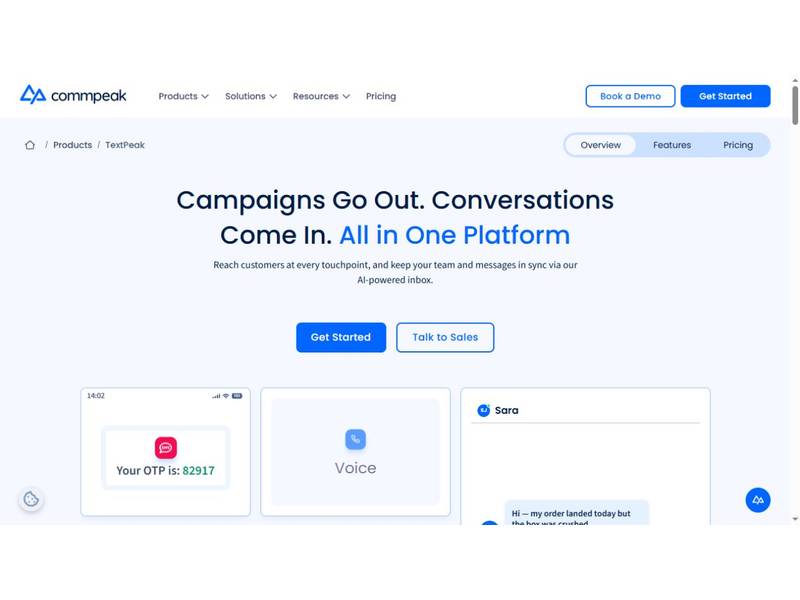
TextPeak messaging platform. Image: CommPeak website.
The portfolio is useful to examine as several connected layers. Voice connectivity and phone numbers establish the communications route. A dialer organizes outbound activity. Messaging software handles notifications and replies. Integrations connect those interactions to customer records and business processes. Choosing the right combination starts with the workflow a firm wants to improve, rather than the number of channels it can activate.
A communications stack for customer-facing operations
CommPeak's cloud-based products address the needs of contact centers and business calling teams. A broker can use this type of infrastructure to support account-service callbacks, respond to enquiries and organize communication across regional teams. The customer relationship remains anchored in the firm's business systems; the communications layer provides the calling, messaging and operational controls around it.
The distinction between products matters during procurement. Cloud PBX is presented as a business phone system, while SIP Trunking supplies voice termination and DID numbers provide local telephone numbers. CommPeak Dialer adds campaign and lead-distribution logic. TextPeak focuses on outbound messages, incoming conversations and shared inboxes. A deployment can bring these components together where the customer journey requires them.
Consider a client who submits an account-support request and asks for a callback. The team needs the correct contact details, an available agent with the right language skills, a recognizable calling number and a place to record the outcome. That single journey touches customer data, dialing, telephony and follow-up. Defining it explicitly makes the responsibilities of each component clearer.
Predictive dialing with configurable campaign logic
CommPeak Dialer is built around AI-predictive dialing and a configurable rules engine. The company describes lead routing based on language proficiency, product knowledge and profile experience, alongside custom priorities for high-intent actions, local calling hours and lead weights. These controls allow a contact center to shape which conversations happen first and which team member handles them.
For a brokerage service operation, the relevant application might be a queue of requested callbacks rather than a broad outbound campaign. A multilingual team could assign a customer to an agent who can resolve the enquiry in the customer's preferred language, then prioritize cases according to service needs. These are examples of workflow design using the described controls, not preset brokerage processes supplied automatically with the software.
A well-defined campaign connects each contact attempt to a reason and an outcome. Teams can distinguish an unanswered call from a completed conversation, a callback request from a closed case, and a transferred enquiry from an unresolved one. Consistent outcome definitions make the dialer's activity useful to the people managing the wider customer journey.
The pilot should therefore measure more than attempts per hour. Useful measures include completed callbacks, time to reach the appropriate agent, repeat contacts and requests resolved. Segmenting these results by language, campaign and customer group helps managers understand where the setup is working and where the routing or staffing model needs adjustment.
Human and AI voice agents within one strategy
CommPeak's current Dialer page describes using human agents, AI agents or a hybrid team under one campaign logic. It also names Vapi, ElevenLabs and LiveKit as examples of providers that can be connected for AI voice-agent workflows. This is an integration proposition: the dialer manages how leads are called, while the connected voice agent handles its assigned part of the conversation.
That architecture gives operations teams a way to separate routine tasks from conversations requiring a person. An automated interaction could collect a limited set of request details or establish whether a callback is still needed, with escalation to a human when the conversation moves outside its defined scope. The precise behavior depends on the selected AI provider, configuration and connected data.
The handover is a key acceptance point. A human agent needs enough context to continue without asking the customer to repeat everything. Teams should test what happens when the customer changes language, asks an unexpected question or requests a person immediately. Responsibility for the next action should remain visible even when the interaction crosses between systems or agents.
CommPeak also describes live monitoring of AI agents alongside human agents. For supervisors, a shared operational view is useful when it reveals which interactions are active, which outcomes were recorded and which cases need intervention. It should support accountable service delivery, with clearly assigned ownership for the conversation after a transfer.
TextPeak: linking campaigns with incoming conversations
TextPeak brings outbound messaging and incoming customer replies into a connected environment. Its product page lists SMS and two-way messaging, WhatsApp Business, Telegram Bot, WebChat, email and OTP services. Campaign functions include WhatsApp and SMS outreach, marketing and transactional SMS, segmentation and AI-assisted writing.
The operational distinction is what happens after a message is sent. A service notification may prompt a customer to ask a question or provide missing information. TextPeak's shared-inbox approach is intended to connect those replies with the team that handles them, making campaign delivery and customer response part of the same process.
For a firm with several brands or departments, TextPeak describes separate team inboxes, different workflows for each inbox, and user roles and permissions controlling access to lead data. This structure can help an organization preserve ownership across teams instead of treating every incoming message as work for one undifferentiated queue.
A broker implementing messaging should define the source of each trigger and the destination of each reply. An account-status update, for example, needs a reliable event from the business system and a route back to a team that understands that status. Delivery tracking then becomes one part of the picture; resolution and response quality complete it.
OTP delivery and the surrounding authentication flow
TextPeak describes OTP delivery through SMS, WhatsApp, Telegram and voice calls, with the ability to decide which channels to use and in what order. This gives application teams several communication routes for sending a code when designing a verification journey.
The delivery service and the application's verification logic have distinct responsibilities. A successful message delivery does not by itself establish that the intended user has completed authentication. The application still needs to manage code validity, the attempt flow and the resulting account action. Implementation teams should make those boundaries explicit when connecting the messaging service.
Testing should include delayed messages, a customer switching channels and repeated requests for a code. The user-facing journey needs to make the next step clear while keeping the underlying event records consistent. For customer support, visibility into the delivery stage can help distinguish a messaging issue from an application-side verification problem.
Voice infrastructure, numbers and integration design
CommPeak presents SIP Trunking as A–Z VoIP termination and DID numbers as a way to establish local calling presence. Its website also describes regional switches, carrier relationships and points of presence. For the buyer, the important questions concern the actual destinations served, number availability and the calling routes needed by the operation.
A local number should fit the complete service journey. The team should know what identity a customer sees, where a return call is routed and who handles it outside the original agent's working hours. A useful acceptance test includes both outbound contact and a subsequent inbound callback, rather than testing only whether the first call connects.
TextPeak offers an API route as well as platform integrations, and CommPeak maintains integration and developer resources across its portfolio. A technical design should identify the system that owns customer data, the fields passed into a communication request, and the destination for delivery or call outcomes. Error handling and duplicate events deserve attention alongside the successful path.
| Business requirement | Relevant component | Implementation focus |
|---|---|---|
| Prioritized customer callbacks | CommPeak Dialer | Language, campaign rules, ownership and consistent outcomes |
| Combined human and AI calling | Dialer and voice-agent integrations | Defined scope, context transfer and escalation |
| Messages followed by service conversations | TextPeak and team inboxes | Trigger accuracy, reply routing and access permissions |
| Verification-code delivery | Omnichannel OTP | Channel order, delivery events and application-side verification |
| Business calling and regional numbers | Cloud PBX, SIP Trunking and DID numbers | Destination coverage, caller identity and return-call routing |
From a pilot to an operating model
A focused deployment can begin with one team, one region and one measurable customer-service process. Establish the contact list, routing rules, permitted data access and the expected result of each interaction. Then test the full journey through the CRM or business application, the communication channel and the final follow-up record.
Commercial comparison should reflect the actual mix of seats, destinations, phone numbers and message traffic. CommPeak publishes different charging units for its products, so a useful cost model separates agent activity from usage-based communications and recurring number or phone-system charges. Teams can then compare the projected workload with the proposed package and support arrangements.
CommPeak's distinguishing feature within this procurement discussion is the breadth of its communications stack: dialing logic, messaging workflows and telecom connectivity can be considered together. Its strongest fit is an operation that wants to connect outreach with the service work that follows, giving agents, supervisors and technical teams a shared view of how each customer interaction moves toward completion.
 Subscribe Now

