


DeFi Hacks Expose Structural Liquidity Isolation, Broader Crypto Market Unscathed
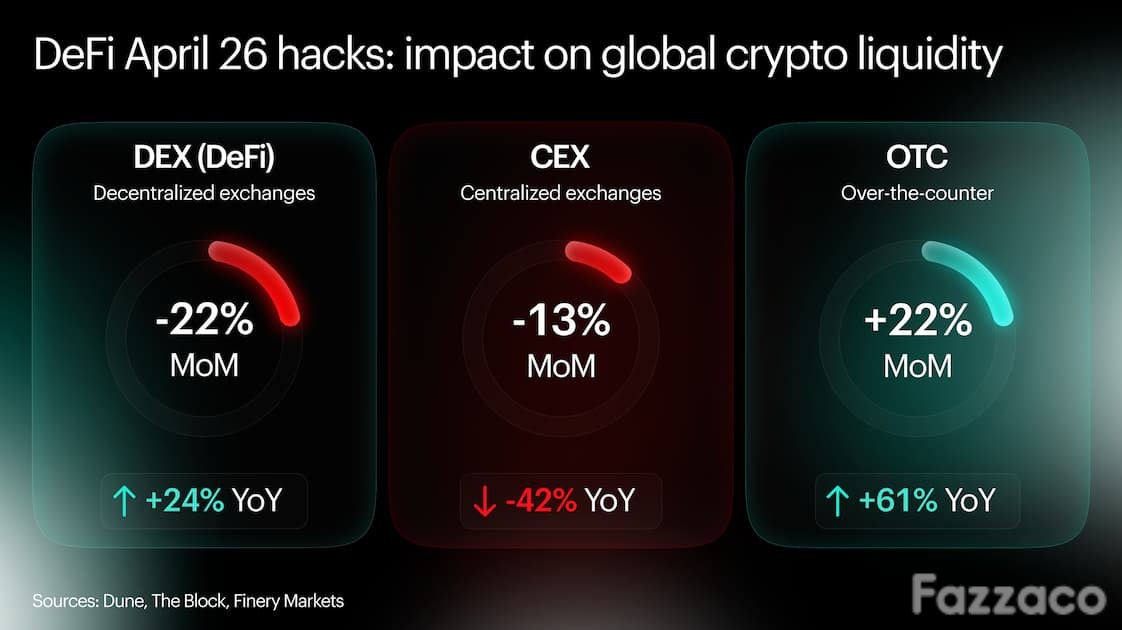 The worst month in DeFi history, marked by nearly 30 exploits and $635 million in losses, revealed a structural isolation of liquidity across the global cryptocurrency ecosystem. During the peak of the crisis, withdrawals erased approximately $13.5 billion in total value locked within 48 hours, with leading protocols like Aave suffering significant deposit and loan outflows.
Finery Markets CEO Konstantin Shulga noted the aftermath highlighted two key observations: traditional finance allocators retreated to familiar trading architecture despite crypto's institutionalization narrative, and the global crypto liquidity ecosystem proved interconnected yet structurally isolated. Crucially, the record hacking activity produced no spillover into centralized exchange (CEX) or over-the-counter (OTC) markets, with the broader crypto sector absorbing the shock without a major risk-off reaction.
The dynamics suggest a state of 'discommunicating vessels' within crypto liquidity. While DEX, CEX, and OTC markets operate globally, the April crisis showed the DEX "disease" did not easily infect other parts of the liquidity pool. This is attributed to starkly different participant profiles: DEXs are dominated by crypto-native yield farmers and algorithmic traders, CEXs cater to a broad retail base, and OTC serves institutions and high-net-worth individuals requiring deep liquidity for large trades.
Trading data confirms the contained impact. While DEX volumes fell 22% month-over-month and CEX volumes declined 13%, the OTC market posted a 22% MoM increase, as institutions historically seek its efficiency during volatility. The longer-term trajectories held firm, with DeFi volumes up 24% year-over-year, OTC up 61%, and CEX down 42%, consistent with established Q1 2026 trends.
The hacks, which resurfaced bridge and collateral vulnerabilities reminiscent of 2022-2023, may cause some institutional DeFi explorers to pull back. However, analysts view this cooling-off as necessary for industry maturity, serving as a pointed reminder of risks in complex collateral structures. The long-term potential for DeFi in tokenized real-world assets remains unchanged, with the episode stress-testing the market's internal architecture and mapping liquidity flow under pressure rather than breaking it.
 Subscribe Now