


Devexperts: DXtrade, White-Label Brokerage and Trading Technology
Devexperts: where its software fits in a broker technology stack
Devexperts develops capital-markets software for brokerages and other financial institutions. Its portfolio is broader than a single trading front end: the company presents DXtrade as a trading-platform family, dxFina as a packaged broker solution, DXcharts as an embeddable charting component, and separate exchange and custom-development offerings. For a brokerage evaluating a replacement platform or planning a new launch, that breadth matters only if the selected components fit its execution model, product set, regulatory obligations and operating team.
This Fazzaco company introduction examines the vendor from a B2B buyer's perspective. Product descriptions below are drawn from Devexperts' official website and the official DXtrade website, checked on 24 September 2026. Questions about integration, cost and operational control are editorial procurement considerations, not claims that Fazzaco has tested a live installation. The company is listed in Fazzaco's company directory under software, white-label, risk-management and bridge-provider categories.

Devexperts official website, captured 24 September 2026.
What Devexperts actually supplies
The starting distinction is between a product family and a turnkey brokerage. Devexperts describes DXtrade as a multi-asset, broker-agnostic trading platform. Its separate DXtrade site distinguishes DXtrade CFD for FX, CFDs, spread bets and certain crypto trading use cases from DXtrade XT for instruments such as equities, options, futures, funds and bonds. It also presents technology for proprietary-trading firms. A buyer should therefore specify the particular configuration being offered, rather than assume every asset class, feature or integration is available in one identical deployment.
The parent company website describes dxFina as a white-label broker solution combining web and mobile trading, dealer desk, back office and built-in market data. It also lists DXcharts, a charting library for apps and websites; DXmatch, exchange infrastructure; an order-management system; FIX/FAST gateways; and custom software-development services. These are distinct buying decisions. An institutional project may use only a front end, combine a platform with back-office modules, or commission substantial integration work around existing systems.
| Offering | Vendor-described role | Buyer question |
|---|---|---|
| DXtrade CFD | Trading experience for FX, CFDs and related products | Which execution, margin and dealing workflows are included in the proposed configuration? |
| DXtrade XT | Trading experience for exchange-traded and other multi-asset instruments | How do custody, corporate actions, market data and order routing connect? |
| dxFina | Packaged broker stack with trading and operational components | Which services are pre-integrated, and which remain the broker's responsibility? |
| DXcharts | Embeddable charting and technical-analysis tools | What are the licensing, customization and data-entitlement boundaries? |
| DXmatch and custom services | Exchange technology and tailored development | Who owns deployment, change control, surveillance and ongoing maintenance? |
Platform selection starts with the brokerage's operating model
A trading platform is not selected solely by comparing terminal screenshots. A CFD broker needs to understand pricing, margin, execution, hedging and dealing-desk controls. A securities broker may need market-data entitlements, routing to executing brokers, custody, corporate actions and different options or futures margin processes. A prop firm adds challenge rules, account lifecycle and risk limits specific to its business. Devexperts markets solutions across these segments, but procurement should begin with a written requirements matrix tied to the buyer's actual entity, jurisdictions and products.
The first workshop should map the full trade path: market-data source, price distribution, client order, validation, margin check, routing or internalization, execution report, ledger update, statement and supervisory record. For every step, record the responsible system and operator. This exposes gaps that can be obscured by an attractive trading interface. It also makes clear whether the project is a front-end replacement, an end-to-end platform migration or an integration programme with legacy components.
DXtrade and the client experience
On its own site, DXtrade emphasizes multi-asset access, configurable user experience and broker branding. It also describes built-in risk-management tools, trader-support features and APIs. Those are useful areas to examine, but feature availability should be confirmed for the contracted version and target asset classes. A demonstration using a generic sample account is insufficient where the buyer needs complex orders, local disclosures, multi-currency statements or specialized margin rules.
For client experience, test tasks rather than screenshots: registration-to-first-trade flow, watchlist and chart performance, order modification, rejected-order messages, mobile continuity, accessibility, notifications and statements. Use realistic account states, including partial fills, insufficient margin and interrupted connectivity. Ask for browser and device coverage, localization workflow, release cadence, rollback arrangements and the degree of control the broker retains over interface changes. If white-label branding is important, inspect which elements can be changed by configuration and which require vendor development.
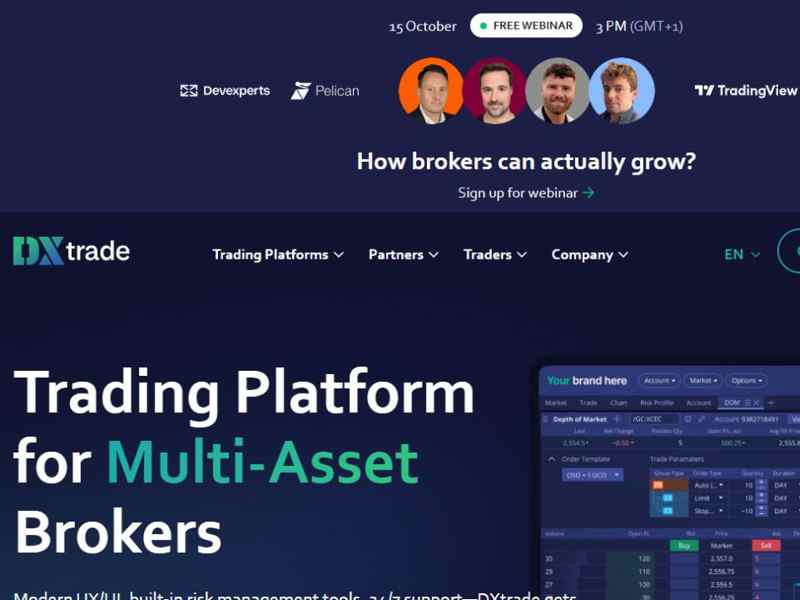
DXtrade official website, captured 24 September 2026.
Execution, risk and market-data boundaries
The most consequential technical question is where the platform ends and the broker's execution infrastructure begins. Vendor literature can describe routing and risk functionality without specifying the exact counterparties, protocols or account model for a particular deployment. Buyers should request a system diagram showing order entry, pre-trade checks, price source, liquidity or executing-broker connectivity, trade reporting and recovery paths. The diagram should identify any third-party dependencies and which party supports each connection.
Risk controls need scenario testing. Examples include a fast market with delayed prices, a disconnection during an open order, a corporate action, a margin-call threshold and a manual dealer intervention. Review permission boundaries, audit trails, maker-checker approvals, alert routing and the time needed to reconstruct an incident. For exchange-traded assets, establish where market-data licensing and custody responsibilities sit. For OTC products, establish how prices and execution quality are monitored. None of these checks can be replaced by an unsupported claim about speed or uptime.
White-label and back-office implications
Devexperts positions dxFina as a packaged brokerage solution with trading, dealer desk, back office and market data. That packaging may simplify the number of suppliers a new broker must coordinate. It does not remove the need to define client onboarding, KYC/AML procedures, funding and withdrawals, ledger reconciliation, reporting, complaints, data retention and access controls. The legal entity running the brokerage remains responsible for its own obligations even where software automates part of the workflow.
A useful due-diligence exercise is to walk one client record through onboarding, deposit, order, fee, withdrawal and dispute. Check whether the back office exposes the underlying evidence and whether events can be exported in a usable format. Ask how exceptions are handled when a payment provider, executing broker or identity service is unavailable. Integration specifications should include payloads, error handling, rate limits, versioning and test environments. A pre-integrated partner list is a starting point, not proof that a particular commercial or jurisdictional arrangement is ready to use.
Charting, APIs and custom development
DXcharts is presented as a charting library that can be embedded in a broker application or website. For a buyer, this raises a different set of questions from buying a full trading platform: data-feed rights, symbol mapping, indicator consistency, mobile rendering, accessibility and the license's treatment of multiple brands. If charting is a critical acquisition or retention feature, test the component with the broker's own instruments and real market-data permissions.
Devexperts also advertises custom development and integration components. These can be useful when a standard white-label deployment cannot accommodate a complex broker process. The trade-off is project governance: a custom feature requires a written specification, acceptance tests, code and intellectual-property terms, maintenance ownership and a plan for future platform upgrades. Ask which work is configuration, which is a supported product extension and which is a separately maintained customization.
How to evaluate a Devexperts proposal
Comparison should use the same use cases and data for every shortlisted vendor. A request for proposal can ask for a target architecture, exact product edition, supported asset classes, named integrations, deployment model, service boundaries, security evidence, recovery objectives, implementation plan and a complete pricing schedule. Require every promise that matters to appear in the statement of work or service agreement. Marketing language on a public site is not a substitute for a contractual scope.
| Evaluation area | Evidence to request |
|---|---|
| Functional fit | Live demonstration with the buyer's instruments, account types and exception cases |
| Integration | Architecture diagram, API documentation, connector ownership and sandbox access |
| Risk and controls | Role matrix, audit-log samples, incident workflow and reconciliation examples |
| Security and resilience | Current third-party assurance where available, data-flow map, backup and recovery tests |
| Commercial scope | Implementation fees, recurring charges, market-data costs, support tiers and exit terms |
| Migration | Data mapping, parallel-run plan, cutover criteria, rollback plan and named responsibilities |
The strongest pilot is not a polished sales presentation. It is a controlled test with anonymized accounts, realistic instruments and scripted failure cases. The buyer should document pass/fail criteria before the demonstration and retain recordings or logs. Operational teams, compliance, dealing, technology and client support should all sign off on their respective workflows. A platform can be capable in one configuration and unsuitable in another; the pilot establishes which statement applies to the actual procurement.
Implementation and migration questions
A new platform may be introduced alongside an existing system, with old accounts remaining on the legacy stack while new clients move to the new one. That can reduce cutover risk but creates temporary complexity in reporting, payments and client support. A full migration requires data mapping for clients, balances, positions, order history, consents and regulatory records. Agree the reconciliation process and who signs off each dataset. Test the broker's busiest operational periods, not only quiet-market conditions.
Deployment governance should identify the vendor release channel, change windows, incident severity definitions and escalation contacts. Ask how the broker receives notices of breaking API changes and how urgent fixes are validated. Document the route for exporting data and continuing operations if the commercial relationship ends. These questions are relevant to any major platform supplier; they should be answered in the context of Devexperts' specific proposal.
Bottom-line assessment for B2B buyers
Devexperts is a relevant candidate for brokers seeking trading-platform, white-label and supporting capital-markets technology. Its public portfolio spans DXtrade, dxFina, charting, exchange technology and custom services, giving buyers several ways to assemble a solution. The value of that range depends on precise product selection and integration boundaries. Fazzaco has not independently measured performance, audited security or verified a particular client's results. The sensible next step is a scoped technical demonstration and contractual review against the broker's own operating model.
Frequently asked questions
Is Devexperts itself a forex broker?
No. The company describes itself as a software provider for financial institutions. Fazzaco lists it in technology-related directory categories, not the Forex Brokers category.
Is DXtrade one identical product for every asset class?
The official DXtrade site presents different offerings, including DXtrade CFD and DXtrade XT. Buyers should verify the exact edition, instruments and licensed modules in a proposal.
Does a white-label solution include every operating service?
Do not assume so. Confirm onboarding, payments, market data, execution connectivity, custody, reporting and support responsibilities in writing for the proposed deployment.
How should a broker compare Devexperts with other vendors?
Run the same realistic use cases across each shortlist candidate, obtain architecture and commercial documents, and test operational exceptions with the teams that will run the platform.
Sources and verification: Devexperts official website; DXtrade official website; Fazzaco company profile. Checked 24 September 2026. Vendor product descriptions are attributed to the vendor; procurement analysis is Fazzaco editorial commentary.
 Subscribe Now