


Exactly: Payment Gateway, Reporting and Broker Payment Flows
Exactly offers an online payment gateway, merchant account, reporting tools and mass payments. For a brokerage assessing its payment infrastructure, the useful question is how a customer's deposit is captured, reported and reconciled, and how any available payout service fits the firm's separate withdrawal controls. Product availability depends on the merchant's business model, contracting entity and approved markets.
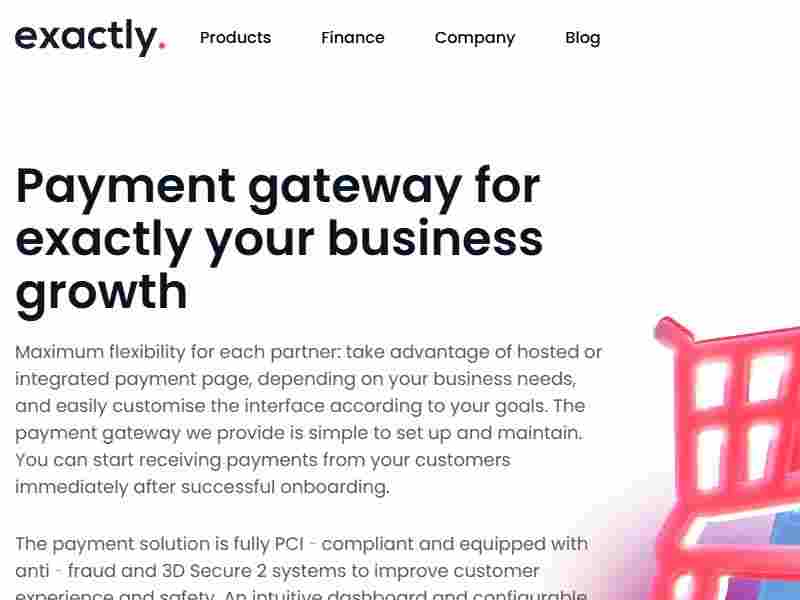
Image: Exactly.
Where the gateway fits
Exactly describes its gateway as a way for online businesses to accept payments and access reporting. Its public material presents hosted checkout and an API-integrated payment page as alternatives. The gateway is one part of a wider chain that may also include a merchant account, acquirer, payment network and the brokerage's own customer ledger.
A brokerage should map the full path of a deposit before comparing features. The customer chooses an available method, receives any required authentication prompt and sees a payment status. The operations team then needs a reliable transaction reference and status before crediting the appropriate account. A customer returning to the brokerage's site is not by itself proof that funds have settled.
Exactly's site is written largely for e-commerce merchants. The provider must confirm eligibility for the specific entity, activity, countries and customer base.
Hosted checkout and integrated pages
On its gateway page, Exactly describes a hosted page operated by the payment system and an API-powered integrated page. A hosted experience sends the customer to a provider-controlled checkout; an integrated experience gives the merchant more scope over the surrounding interface. Both require careful testing of redirects, user messaging and the events returned to the brokerage.
Branding is only one consideration. A team should ask which party collects sensitive card details, which domains the customer visits, how failed authentication is displayed and how the customer returns to a pending or declined transaction. The available integration pattern and compliance scope should be confirmed with the provider and acquiring partners.
Exactly also refers to CMS plugins and API integration. A brokerage should not assume that a plugin built for a retail store automatically fits a trading portal. Its developers need current documentation, a test environment and a written map between gateway events, CRM identifiers and trading-account records.
Payment methods, currencies and settlement
The provider's website lists cards, digital wallets and bank transfers, with multi-currency payment processing. Its pages use different coverage counts, which are not a reliable substitute for a current merchant-specific schedule. Supported methods, transaction currencies and settlement currencies can differ by country, legal entity and approval.
Before rollout, request an itemised matrix for each target market. It should show eligible customers, minimum and maximum amounts, fees, processing windows, settlement currency and the rules for refunds. The rate used for currency conversion and any reserve or withholding arrangement should also be set out in the contract.
Compare payment authorisation, capture and settlement as separate events. A successful authorisation does not necessarily mean funds are irrevocably available. The brokerage's finance team should know how fees, reversals and settlement batches appear in reports and when funds become available for its own obligations.
Dashboard and reconciliation
Exactly describes a dashboard with configurable reports, role permissions, an action tracker and CSV export. A transaction view can help support staff investigate an individual deposit; settlement and balance reports serve a different purpose for finance. The buyer should verify which fields are present in each view and how long records remain accessible.
A useful reconciliation exercise follows a small test set from the customer's request to the gateway event, the brokerage ledger and the settlement report. Include equal-value transactions, a rejected payment, a reversal and a status update that arrives late. Matching by amount alone can misidentify a deposit when the same customer makes repeated attempts.
Assign separate roles for viewing records, managing configuration and approving financial actions. Ask whether permissions can be scoped by legal entity or team, how changes are logged and how reports are retrieved if an integration is unavailable. Those questions should be tested against the contracted configuration.
Mass payments and exceptions
Exactly's mass-payments page describes adding recipients manually, importing CSV files and connecting through a REST API. It presents batch payments as a tool for multiple recipients. The documentation does not by itself establish that a brokerage can use the product for every type of client withdrawal; this must be agreed during onboarding.
Batch processing changes the shape of operational risk. A single file can contain both valid and invalid entries, so the firm needs a status for each item rather than only an overall batch result. Test how duplicates are identified, which errors can be corrected, and how a rejected or pending payment is retried without sending funds twice.
For client withdrawals, the brokerage should define identity checks, destination verification, approval authority and customer communication before a payout instruction is created. Confirm the provider's cut-off times, available routes and handling of returned payments. Record the relationship between the original withdrawal and any later adjustment.
Security, disputes and responsibility
Exactly describes fraud controls, PCI DSS compliance and 3D Secure 2 on its gateway page. These are provider statements, not proof that every customer transaction is safe or that a merchant has no compliance duties. Request current evidence for the relevant entity and service scope, then assess the brokerage's own handling of payment data.
Authentication, fraud monitoring and chargeback management involve different parties. Agree who receives a dispute notice, how evidence is collected, what deadlines apply and how a disputed amount affects the merchant balance. A rejected payment may also need a customer-support response that does not expose unnecessary security information.
Ask how credentials are issued and rotated, whether two-factor authentication is available for the chosen dashboard roles, and how incidents are communicated. Marketing promises about preventing fraud or eliminating compliance work should not replace contractual allocation and independent review.
Commercial and implementation checklist
Exactly says pricing is tailored to the customer. A meaningful comparison should capture transaction and gateway fees, currency conversion, settlement timing, chargeback costs, reserves, minimum commitments and any integration or support charges. Confirm which terms apply to the actual contracting entity and payment method rather than relying on a general example.
| Area | Questions for the provider |
|---|---|
| Eligibility | Approved business model, entities, countries and payment methods |
| Integration | Hosted or API flow, events, testing and data responsibilities |
| Operations | Transaction references, settlement, reversals and reconciliation |
| Mass payments | Eligible recipients, batch errors, retries and cut-off times |
| Governance | Security evidence, disputes, fees and contractual roles |
Run a pilot with representative deposits and, if approved, a small batch of payouts. Follow each instruction through customer messaging, payment status, the brokerage ledger and finance reporting. Exactly's gateway and reporting can then be assessed as part of an actual operating process, with limitations and responsibilities agreed before expansion.
 Subscribe Now