Add Fazzaco to desktop

Add Fazzaco to desktop

Access Fazzaco from desktop next time

Add now
English

Exclusive: A Survey on Broker Clients Profitability after ESMA Restrictions for Two Years

Source: Fazzaco

586530bd5bd97c79f5318ca957a5617.jpeg
It has been two years since the European Securities and Markets Authority (ESMA) required EU-brokers to cut the maximum leverage to 30:1 on major FX pairs.
Under this new regulation measures, many forex brokers applied offshore license and transferred their client accounts to offshore jurisdiction. Even certain brokers ceased providing service in China for the stringent regulation requirements.
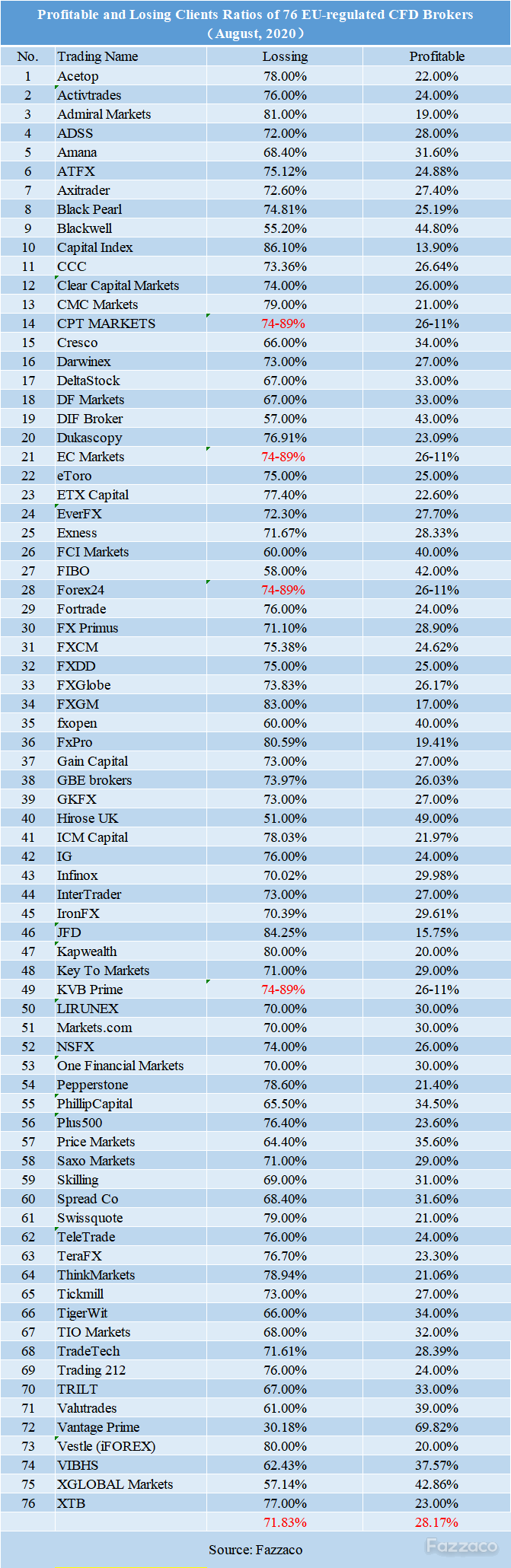
Volumes have changed dramatically as large numbers of retail clients have moved to offshore.The total value of transactions was $5.508 billion in the first quarter of 2018 and only $4.593 billion in the second quarter of 2019, decreasing 17%.To understand the impact of ESMA leverage in more detail? Fazzaco conducted a survey of EU-brokers, looking at the losing and profitable ratios of 76 brokers’ clients.
The Profitable and Losing Ratio of 76 Brokers’ Clients
As shown in the figure below, the specific profit-and-loss ratios of 76 EU-brokers’ clients in August 2020 are as follows:
Note that CPT MARKETS, EC MARKETS, Forex24 and KVB Prime are not specific figures, but roughly range 74-89%. For the convenience of calculation, we use their average losing and profitable values, namely 81.50% and 18.50%.
What’s the Change in Losing and Profitable Ratio within 3 Years?
According to statistics from foreign media, in August 2018, the average losing ratio was 76.3%. In July 2019, the average losing ratio was 76.5 per cent.
However, according to the newest statistics from Fazzaco in August 2020, the brokers losing ratio changed into 71.83%.
In other words, two years after the ESMA leverage was implemented, the average loss ratios fell by 4.47 percentage.
Brokers’ Different Responses under Same Leverage Restriction
In 2019, the Australian Securities and Investments Commission (ASIC) published its consultation papers on product intervention measures for binary options and contracts for differences (CFDs). Recently, the regulator has published some of the feedback it has received from industry participants, especially forex brokers.
The results showed that many brokers agreed with the banning of binary options, but criticising the FX leverage restrictions. On the one hand, they thought ASIC’s proposals would drive Australian retail investors into offshore or even unregulated jurisdiction, on the other hand, ASIC proposed more strict leverage limit than ESMA (ESMA 30:1, ASIC 20:1), which easily caused to regulatory arbitrage.
In fact, the attitudes of Australian brokers are understandable.Since ESMA imposed leverage restrictions in 2018, many European clients have moved to offshore or to Australian jurisdictions.With high leverage and safe regulation, Australian brokers became popular among retail clients and ushered in huge opportunities, and the license price of ASIC even hit whopping 4 million dollars
It is no wonder that Australian brokers strongly opposed the regulator’s leverage measures, and some brokers even claimed to take ASIC to court. when the measures were initially proposed in 2018,
Currently, Europe's leverage limit measures appears to be mature, as most EU countries have made it permanent and the profitable and losing ratio has declined slightly in the two years .
However, it remains to be seen whether ASIC can implement the leverage limit, because the COVID-19 is still severe across the globe and ASIC have to take the economy and employment under consideration.
Create Company Page