


FactSet: Why Entity, Security and Listing IDs Are Different
FactSet provides financial data and software, including tools for connecting records that use different identifiers. Its Symbology API translates market symbols into other identifier systems, while Entity Firmographics supplies reference data and relationships around a master entity identifier. For investment platforms and data teams, these products address a deceptively simple question: when two records appear to describe the same investment, are they actually referring to the same thing?
A company, one of its securities and a particular exchange listing are related objects, but they are not interchangeable. A join that ignores those distinctions can attach an issuer's data to the wrong instrument or combine prices from different listings. FactSet's identifier hierarchy makes those distinctions explicit; using it well means deciding which object each dataset describes before matching its codes.
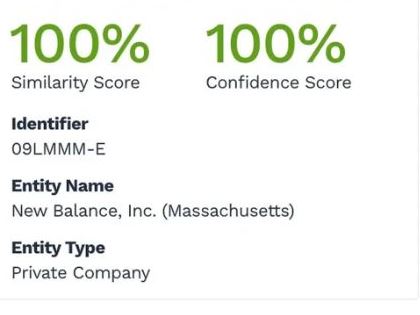
FactSet’s official data-connectivity example shows an entity identifier and entity details. Scores shown belong to the vendor’s demonstration.
Four identifiers, four different jobs
FactSet's API documentation separates entity identifiers ending in -E, security identifiers ending in -S, regional identifiers ending in -R and listing identifiers ending in -L. The regional level identifies a security's preferred regional data series per currency; the listing level identifies a particular listing. These are separate keys, not alternative spellings of one universal ticker.
Consider a hypothetical issuer with two share classes, one of which trades on two exchanges. An issuer-level financial statement belongs with the entity. Share-class information belongs with the relevant security. A quote from a specified exchange requires the listing context. Sharing an issuer does not make the two share classes equivalent, and sharing a security does not make two venues' prices interchangeable.
This distinction determines the shape of a database join. A company-to-securities relationship may legitimately produce several rows. If an application expects one row and simply keeps the first result, a successful identifier lookup can still produce an incorrect portfolio record. The object being matched, the expected number of matches and the intended price series should therefore be defined together.
The default result depends on the input
The Symbology API returns the submitted identifier as requestId alongside translated fields. Its default fsymId is context-dependent: regional or composite inputs use a regional identifier, exchange-specific inputs use a listing identifier, entities use an entity identifier, and fixed-income inputs use a security identifier. A column named fsymId should therefore not automatically be treated as a column containing only securities.
The response model also separates security, regional, listing and entity fields. FactSet documents that the listing field does not populate for composite identifiers because those inputs do not specify a listing exchange. That absence carries information: selecting an exchange-specific quote requires another decision, rather than copying a regional identifier into a listing field.
For less conventional inputs, the advanced translation endpoint accepts an explicit symbol type. FactSet lists LEI and BIC among the inputs that map by default to entity identifiers, while WKN and VALOREN map to security identifiers. When a symbol type is specified, all submitted identifiers must belong to that type. Preserving the input code and its declared type makes the resulting mapping easier to trace when several upstream systems use different conventions.
Today's ISIN does not answer every historical question
FactSet offers separate current and historical ISIN translation methods. The historical service can return the sequence of identifier changes or a mapping for a requested date. Its response includes effective start and end dates; the end date is null when the ISIN remains active. Those dates turn a cross-reference into a time-dependent relationship.
Suppose, purely as an illustration, that a security used identifier A through June and identifier B from July. A reconciliation of March holdings performed in November needs the mapping applicable to March. Looking up only the current identifier answers a different question. The historical endpoint's as-of date helps distinguish those tasks without treating an old code as necessarily invalid.
There is a further distinction between when an identifier relationship applied and when a particular system learned about it. An effective-date history alone does not establish what every user could have known on an earlier date. A team reconstructing its own past decisions would also need its ingestion records and the versions of data it actually received. This is a data-management implication, not an additional capability implied by the translation endpoint.
Permanent keys still describe changing relationships
FactSet's Permanent Security Identifier guide explains that a change of primary exchange within a region changes the listing identifier while leaving the security and regional identifiers unchanged. The distinction allows continuity at one level without pretending nothing changed at another. It also explains why replacing every identifier after an exchange move would discard useful continuity, while preserving every listing relationship indefinitely would lose the move itself.
Entity Firmographics extends the model beyond symbol conversion. FactSet describes links among entities, securities, people and funds through time, along with entity and security reference data and LEI linkages. Its coverage includes active and terminated entities and securities. A terminated record can remain relevant to old holdings or transactions even when it no longer belongs in a current trading universe.
For an investment platform, this separates two useful operations: resolving the instrument in a transaction and grouping related instruments for analysis. An entity relationship can support the latter, but it does not by itself identify the listing used in the former. Keeping both relationships lets a team aggregate where appropriate without erasing instrument-level distinctions.
Moving from a lookup to a maintained mapping
The documented translation requests accept up to 3,000 identifiers. GET requests also face an 8,192-byte request-line limit, so FactSet directs larger request lines to the corresponding POST method. The identifier count is a per-request limit, not a promise of throughput. Access permissions are separate: the API documentation distinguishes unauthenticated requests from requests that are not entitled to use an endpoint.
A practical integration would retain the original identifier, translated keys, relevant effective dates and unresolved cases, rather than overwriting its source column with a single new code. That makes it possible to revisit a mapping when the venue, security or company relationship changes. FactSet's contribution here is a structured way to connect financial records; the application's contribution is to preserve the level and date that make each connection meaningful.
 Subscribe Now