


Fair Trading Technology: How BrokerTools Connects IB Links to Trading Conditions
Fair Trading Technology develops BrokerTools, a modular software suite for brokerage operations. It brings together the staff-facing back office, the client's Trader's Room and the partner network. One particularly consequential connection sits at the beginning of the customer journey: an introducing broker's registration link can carry trading conditions as well as identify the source of a referral.
The Sweden-based software provider serves business customers. Its product range spans CRM, account administration, partner management, asset management and social trading. Within that broader range, the relationship between referral links and account configuration explains how BrokerTools connects distribution to day-to-day brokerage operations.
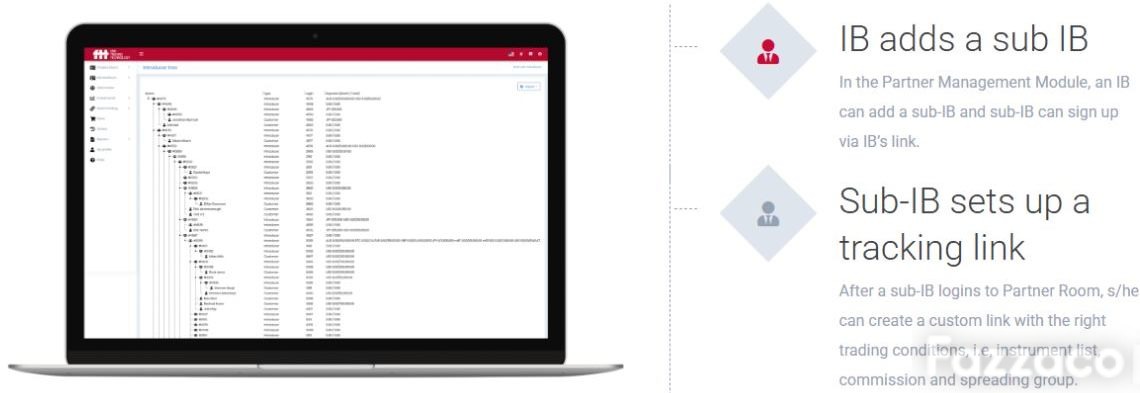
BrokerTools partner hierarchy and registration-link workflow. Image: Fair Trading Technology.
A referral link can determine the account group
In the company's Partner Management workflow, an IB can recruit a sub-IB, who then creates a tracking link in the Partner Room. The link can be configured with an instrument list, commission settings and a spread group. When a trader registers through it, the resulting account is assigned to the selected group. This goes beyond recording which partner supplied the lead: the referral route also helps determine the conditions attached to the account.
Consider a hypothetical brokerage with two approved partner campaigns. One is intended for one account group and the other for a different group. If the wrong registration link is distributed, a campaign attribution report alone will not explain the client's experience. Staff also need to identify the group created through that link and the conditions applied on the trading platform. The commercial promise, the registration route and the trading configuration must be read together.
BrokerTools' Client Configuration Management feature provides the next part of that connection. Fair Trading Technology describes managing groups, spreads and commissions in BrokerTools and synchronising them with MT4 and MT5 servers. The company also offers an API for brokers combining selected components with their own back office. These are distinct implementation choices: using a supplied portal and building a custom interface around an API do not imply the same integration work.
Registration, approval and funding remain separate events
The Back Office module handles customer records, onboarding and platform configuration. Its published onboarding sequence moves a customer from a configurable registration form into the Trader's Room, where documents can be uploaded and agreements signed. Staff receive a notification and handle approval; third-party KYC lookup tools can also be integrated. Funding follows approval in the described workflow.
That sequence gives an operations team three different states to work with: a person who has registered, an account whose onboarding has been approved, and an account that has received funds. Collapsing those into a single “new client” count would conceal where customers are waiting. A registration link can choose a segment without itself establishing that the applicant has passed the broker's checks.
The Trader's Room supplies the customer-facing side of the process, including account administration and payment access. In the funding flow described by the company, the customer chooses a payment method, sees available providers and is redirected to the payment page. A portal therefore connects the customer to payment processing; the appearance of a payment option is not, by itself, evidence that a particular broker can offer it in every market.
Commission calculation is not the same as payout
Partner Management calculates commissions across the IB hierarchy as clients trade. A sub-IB can follow trading activity, while the senior IB has a more limited view of indirect clients and the commission generated through the sub-IB. The published process also distinguishes an accumulated commission from a withdrawable payment: a minimum payout level must be reached before the partner cashes out.
For a brokerage, this separates the explanation of an amount from the release of that amount. A partner asking “why have I not been paid?” may be questioning the calculation, the threshold or the payment route. Those are different operational questions even when the partner sees one balance. A report should make the relevant stage understandable without giving every level of the network unrestricted access to client information.
What the modular approach changes
Fair Trading Technology positions the Trader's Room as more than a document and deposit portal. It can also provide access to a store and published investment strategies; the latter requires the Asset Management component. Its product description separately notes that trading through WebTrader is an add-on whose availability depends on the broker. A module list should therefore be read as a set of configurable capabilities, rather than a promise that every installation includes the same customer journey.
For a broker evaluating BrokerTools, the useful unit of comparison is the complete path from a specific partner link to an approved account, its trading group and the resulting commission. A feature can exist in isolation while the handover between systems remains unfinished. BrokerTools' appeal is its proposed connection of these steps; the deployment scope still needs to specify which modules, platform connections and payment arrangements make that path work.
 Subscribe Now