


FCA Deep Dive: Unpacking the Risks and Realities of Trading Apps
The UK's financial watchdog, the Financial Conduct Authority (FCA), has peeled back the layers on the booming world of trading apps, publishing crucial insights from its multi-firm review that pinpoint areas demanding urgent attention from platform providers. Far from a mere technical check, the regulator's deep dive assessed how digital design, user interfaces, and operational models are truly impacting consumers and aligning with regulatory obligations.
The review cast a wide net, examining firms across the spectrum - from agile fintech newcomers to established brokerage giants - and highlighted a noticeable variation in the maturity and effectiveness of their compliance frameworks and customer protection measures.
Beyond the Hype: Understanding What's Truly On Offer
The FCA's assessment offered a revealing snapshot of the diverse product ranges now readily available to retail investors through these apps. It's clear the offerings extend significantly beyond traditional share dealing, encompassing a growing array of instruments, including those the FCA identifies as carrying higher risk.
Here's a breakdown of the product availability among the firms reviewed:
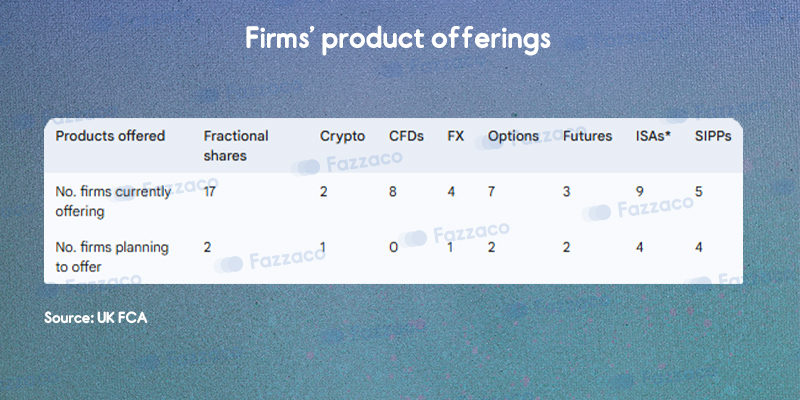
*These include cash ISAs and stocks and shares ISAs.
This data underscores the broad accessibility of products like CFDs, FX, Options, and Futures - instruments requiring a higher level of understanding and risk tolerance - directly through mobile applications.
A Question of Fit: Hitting the Right Target Market?
A cornerstone of the FCA's concern lies in how effectively firms are identifying and serving their intended customer base. The regulator underscored the imperative for firms to define their target market with "granular[ity]," factoring in crucial elements such as "customer age, characteristics, experience, objectives, and financial status."
While the review highlighted positive examples of firms employing "risk indicator scoring and classifications" and even proactively identifying 'negative target markets' to steer unsuitable clients away from higher-risk products, the FCA also found shortcomings. Some firms, it noted, did not specify their target market with sufficient detail, raising the possibility of customers stumbling into products that simply aren't appropriate for their financial situation or understanding.
The Hidden Costs: Peeling Back Revenue Layers
The allure of "low or commission-free trading" is a major draw for many users, but the FCA's review delved into the less visible ways these platforms generate income. The regulator pointed to significant revenue streams derived from "transaction fees, subscription fees, and interest on customer cash balances."
Critically, the FCA emphasized that firms must diligently manage any potential conflicts of interest tied to these revenue models to ensure they genuinely prioritize positive outcomes for their customers. While some firms operating on subscription models did consider whether the fees aligned with customer trading volumes for "fair value," the FCA observed that others did not clearly demonstrate how they assessed "fair value across products and services."
Digital Design: Nudging Behavior with Care!
The very design and interactive features within trading apps can subtly, or not so subtly, influence how users trade. The FCA scrutinized Digital Engagement Practices (DEPs), noting that while firms generally displayed "awareness of using DEPs responsibly," ongoing vigilance is essential.
The use of push notifications, for instance, was examined. Some firms provided alerts on price movements, allowing users control over these notifications, while others offered analytics to help users track their activity. The FCA's message is clear: these digital tools must genuinely support constructive customer engagement and not inadvertently encourage excessive risk-taking or trading frequency.
The Suitability Hurdle: Are Appropriateness Tests Doing Their Job?
For products carrying elevated risk or complexity, a robust appropriateness test is a vital safeguard, ensuring investors comprehend what they are getting into. The FCA's review revealed a spectrum of effectiveness in these crucial assessments.
Commendable practices observed included the use of "clear eligibility criteria and complex question banks with high pass marks." Some firms even implemented "lockout periods for customers who failed the test" and actively "monitored pass/fail rates." However, the FCA also encountered instances of "inadequate appropriateness tests," raising concerns that individuals ill-equipped to handle the risks could gain access to unsuitable products.
In conclusion, the FCA's high-level observations serve as a compelling call to action for the trading app industry. The findings underscore the necessity for firms to move beyond headline-grabbing features and instead embed strong consumer protection, absolute transparency, and a deep understanding of their customers' needs and risk profiles at the core of their operations. This is not just about compliance; it's about building a more secure and trustworthy digital investment environment for everyone.
 Subscribe Now

