


Female Executive in Fintech Talks: Andria Evripidou, Chief Banking Officer at Xace - Maintaining an Open Regulator-Industry Dialogue is Crucial
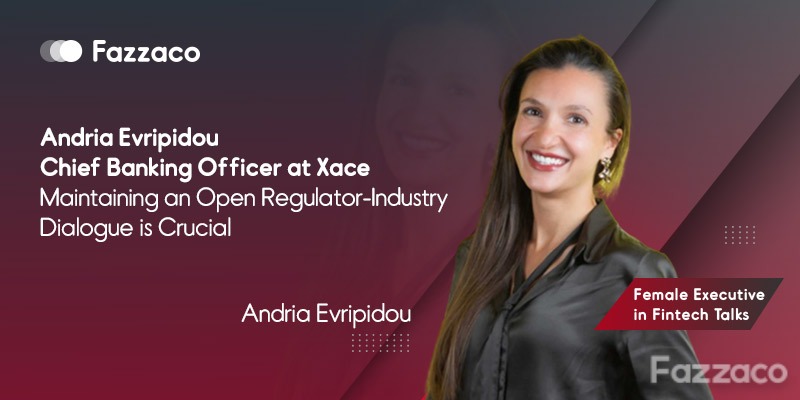 Andria Evripidou was once working at the Financial Conduct Authority. Now she left the regulator and joined the industry being regulated, working as the Chief Banking Officer at Xace. She was happy to accept Fazzaco's invite to the Women's Day Q&A, and talks on various female topics as well as how she changed her ideas on financial regulation as she moved from the regulator to the regulated.
Fazzaco: Hi Andria, thanks for joining! Could you first tell us what you do at Xace?
Andria: Hello and thank you for extending this invitation. At Xace, I hold the role of Chief Banking Officer. It's a neoteric role that has emerged from the FinTech industry and it essentially means that I am responsible for the geographical expansion of the company. It involves all aspects of going live to new markets from identifying the most fertile grounds for expansion, to applying for the regulatory licence and finding the right banking partners in that country to support us with our product offerings. Day-to-day I get involved in pretty much all aspects of its operations. We are a relatively small company and so the concept of 'remits' in job specifications doesn't really exist. One day I'd be advising on new EU regulations and the next I'd be involved in operationalizing a new process for client onboarding. I am the main point of contact for our existing banking partners and I am always on the look out for new opportunities to partner up with innovative providers that will help us offer new products to our clients.
Fazzaco: As the Chief Banking Officer at Xace, are there any interesting stories you can share with us on your career?
Andria: Yes, certainly. Perhaps the part of my career that I personally find the most interesting is the switch from working for the financial regulator (FCA) to working for the financial industry; and arguably one of the most highly regulated segments of this industry. Xace's core offering targets the gaming and gambling industry which are highly regulated by gambling authorities around the world. It's been quite a humbling experience. Working for the regulator I used to think that many of the policies that I used to advice on would be fairly easy or frictionless for the industry to implement. Moving to the other side, I realized how complex and resource intensive the operationalization of those policies can be from the industry's perspective. It made me appreciate even more the importance of maintaining an open dialogue with the regulator to accurately portray the challenges faced by the industry and support the development of regulatory policies that continue to put the UK at the forefront of financial and technological innovation.
Fazzaco: What was the story that led you to the current position?
Andria: Frankly, Xace was a surprise for me. Prior to Xace, I worked at Yapily – an open banking infrastructure provider heading its Public Policy function and was greatly enjoying the role. However, before that I used to work at Revolut, managing global authorisations for the company (a role very similar to my current one). I dreamed of having my then boss' job and have the ability to make the decision as to where the company shall expand, the type of expansion (acquisition v starting a new company) etc… but I didn't think I'd get the opportunity to do so early in my career. So when I received a phone call asking if I'd be interested in this role, I thought it's a long shot, but I knew that I was well equipped to succeed. When I met David and Natalie (the co-founders) I just knew that Xace was a company that I wanted to work for and see it grow internationally. It almost felt like coming home – strange as it may sound. I have been with Xace for the better part of a year now and I couldn't be more proud of my decision to join the company.
Fazzaco: As a female leader, do you believe that it is challenging to work in a mostly male-dominant industry like the financial services sector?
Andria: It definitely comes with its challenges. It has changed a lot since I started my career when the glass ceiling was far more obvious and I could tell that better opportunities were offered to my male colleagues. If I were going into meetings with mainly male professionals, I'd make a habit of booking them for an additional fifteen minutes as I knew that the first part of the meeting would be spent in being lectured on topics that I was already fairly proficient on. These days this sounds silly, but that was my reality seven years ago. Today, many companies have made conscious efforts to eliminate such biases and offer fair and equal opportunities. At Xace, 75% of the senior leadership is composed of females – an impressive statistic for this industry. Even in companies where there are still remnants of sexist biases, there are HR departments that do a great job in setting the conduct expectations. There is still work to be done but overall I'd say we are on the right path.
Fazzaco: Are you happy with your work-life balance now?
Andria: Yes! It's probably one of my favourite aspects about working at Xace. I strongly believe that the attitude towards work-life balance starts from the top. When I met David and Natalie, I asked them about the type of culture that they were aiming to implement at Xace and I distinctively remember how they said: work hard, play hard. And it is very true. Xace is a very pragmatic company with a huge emphasis on keeping operations efficient. There is no reason to compromise on the life aspect of employees if the company operates efficiently. We have sufficient employees and efficient enough processes so that no one has to work excessive hours. Naturally, there are periods where we all have to work longer hours but we all know when these are coming and they are few and far in between.
Fazzaco: Which female is your role model that has always been inspiring you over the years?
Andria: My role models are not, unfortunately, famous people that you might have heard of. They are people that I have worked with or have been instrumental in the development of my character. Professionally, it has to be Ms Carole Begent, the Head of Legal at the Payment Systems Regulator. I have never worked directly under her but I have worked with her and her team on numerous occasions and I always saw her as a mentor. She is a hugely inspirational woman in my opinion, a fountain of knowledge and an exceptional lawyer. However, what truly inspired me about her was her ability to rise above any conflict and disagreement and put her arguments forward in such an eloquent and elegant manner. Even today, when I find myself in awkward situations or have to deal with more difficult personalities, I always ask myself: what would Carole say? How would she deal with this?
Naturally, my other role model is my mother. She has taught me the importance of integrity and built the strength of my character. She has engrained in me a very strong work ethic and told me that regardless of where I work, I should always work as if that company were my own – some day it might be!
Fazzaco: A survey found out that women are better at managing money than men, now as an expert in finance, and a woman, do you agree with that? What is your opinion?
Andria: It's hard to argue with statistics, but it is possible. I tend to avoid making generalisations because sometimes they miss important elements of context. Men are potentially more impulsive and tend to have a higher risk appetite, on average, so one could argue that they are not as good as women in managing their cash flows. I say cash flow because it is important to define what we mean by managing 'money'. Managing 'money' is different to managing cash flows. On the other hand, because men may take higher risks are also more likely to have higher returns on the risks that they have taken. So in the long term, I'd say both sexes are equally as good at managing 'money'. Women may take fewer risks and have lower returns (and lower losses) while men take higher risks that translate to higher returns (or higher losses).
Fazzaco: What is a typical non-working day like for you? What do you usually do to enjoy such time?
Andria: I really enjoy dancing and taking long walks in nature. On my ideal non-working day I'd take a dancing class in the morning followed by a long walk in Epping Forest with my friends. A typical non-working day would involve a combination of either dancing, walking, cooking, taking a yoga class or reading a good book to relax. Currently, I am re-reading the Road Less Travelled by M Scott Peck, a book that I would wholeheartedly recommend to anyone who finds the area of psychology interesting.
Fazzaco: Any exciting news from Xace in near future you could share with us?
Andria: Xace is definitely focusing on its expansion efforts so I can say that we will have a lot of exciting news for our European customers coming up soon as well as more ways for making easier cross border payments.
 Subscribe Now