


Finantick: Trading Platform, CRM and White Label Brokerage Software
Finantick supplies trading software and white label technology for online brokerage businesses. Its offering combines a client-facing trading interface with a back office covering CRM, cashier administration, affiliate tracking, reporting, website management and trading-related controls. The central proposition is operational continuity: the client experience and the staff tools behind it belong to the same software package.
For B2B buyers, that places Finantick in the discussion about how a brokerage runs its own branded service. The platform interface is one part of the decision; the other is how sales teams, payments staff, marketing managers and dealing personnel administer the business. Finantick's public materials emphasize control over these functions, presenting the product as an integrated environment that a broker can configure around its operating model.

Finantick official website: the trading technology homepage.
A white label package spanning the front and back office
Finantick organizes its product description into front-end and back-end capabilities. The front end covers trading interfaces for Forex and cryptocurrency trading, while the back end addresses customer relationships, payment administration, affiliate activity and operational settings. Its homepage also lists a customizable website, automated retention, CRM automation, cascading payment service providers and reporting tools.
This package structure matters for a broker planning a branded launch. Instead of treating the website, trading screen and administration environment as isolated purchases, the firm can examine how they connect. A client acquired through a campaign needs an account record; a payment request needs operational visibility; trading activity needs the relevant account conditions and reporting. An integrated package offers a framework for connecting those events.
Procurement scope should still distinguish software delivery from the other arrangements needed to operate a brokerage. Finantick identifies itself as a technology company supplying brokers and states that it does not provide services to their end users. The brokerage remains responsible for its own activities and regulatory obligations. The software relationship therefore sits alongside the firm's legal, commercial and operational arrangements.
| Component | Published product scope | Business use |
|---|---|---|
| Trading interface | Forex and cryptocurrency trading front ends | The client-facing trading experience |
| CRM | Sales flow, organizational hierarchies, permissions and data views | Managing staff access and customer relationships |
| Cashier | Cascading processors and deposit/withdrawal reporting | Administering payment activity |
| Affiliate tracking | Qualification strategies, ROI and multi-deal calculations, tracking and API permissions | Connecting acquisition channels to commercial outcomes |
| Risk controls | PNL and exposure reporting, spread groups and asset-level settings | Managing trading conditions and business visibility |
| Website and marketing | A supplied website, self-management and Push To Web functionality | Maintaining the brand's public and customer-facing presence |
The trading interface emphasizes a simpler client journey
Finantick's product narrative emphasizes making the trading interface easier to use. Its Forex section describes a simplified initial experience with advanced features available for more experienced users. Its cryptocurrency section places the interface alongside CRM, retention tools, payment processing and configurable trading settings. The product is consequently presented as part of a wider brokerage service, rather than a charting screen on its own.
For a brokerage, interface simplicity has practical implications for customer service and training. Navigation, account information and the visibility of trading conditions influence what clients ask support teams to explain. Finantick's design objective is a more accessible journey through the software. That objective should be assessed through an actual demonstration of the screens and controls available in the proposed deployment.
A simplified presentation does not change the economic characteristics of leveraged trading. Clients still need clear information about prices, exposure and the conditions applying to their accounts. A broker can use an interface review to establish where those details appear and how staff explain them. This keeps the software's usability proposition connected to the firm's own client communication standards.
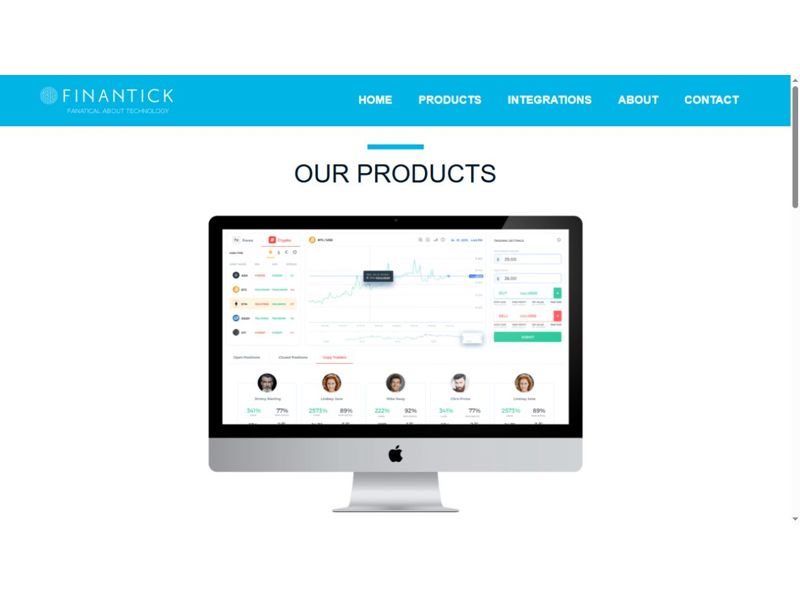
Finantick official website: product presentation and trading interface.
CRM connects sales administration with organizational controls
The back-office CRM description focuses on controlling sales flow, building organizational hierarchies, assigning permissions and presenting business data. These capabilities address an important distinction between a customer database and an operating system: staff need to know which records they can view, which tasks they own and which actions require another role.
Finantick also lists CRM automation and automated retention among its headline functions. In a brokerage environment, these tools sit around ongoing customer contact and the coordination of staff activity. The public pages do not specify every trigger, action or permission boundary, so the implementation specification should describe the actual workflows the business intends to automate.
A useful CRM example follows a lead from acquisition to assignment and subsequent contact. A sales manager's view may differ from an individual agent's view, while management reporting may require aggregated results. Demonstrating those roles against the same record shows how the hierarchy and permissions work in practice. It also clarifies which business definitions must be agreed before importing or organizing customer data.
Cashier administration brings payment activity into the back office
Finantick describes a cashier with control over cascading processor solutions and reporting on deposits and withdrawals. Its integration page groups external connections into clearing companies, VoIP providers and affiliate platforms. Within this architecture, payment administration forms part of the same back-office environment used to manage the wider brokerage operation.
Cascading processing is relevant when a broker works with more than one payment connection. The important implementation detail is how the chosen configuration handles an outcome and records the corresponding account activity. A payment request, a processor response and an internal account entry are related events, but they serve different operational purposes. Staff need a clear view of their relationship when reconciling activity or responding to a client.
The cashier discussion should therefore include a complete deposit and withdrawal example, including an exception such as an unsuccessful payment. This establishes the division between platform administration and the payment provider's own service. A software connection does not by itself establish merchant approval, supported jurisdictions, settlement terms or the availability of a particular payment method for a particular broker.
Affiliate tools connect acquisition tracking and deal calculations
Finantick's affiliate tracking description covers qualification strategies, return-on-investment calculations and multi-deal calculations. It also refers to API access with permissions and pixel tracking. Together, these features address the link between a marketing source, the activity attributed to it and the commercial arrangements used to evaluate that source.
For a broker using several acquisition channels, attribution and qualification need consistent definitions. A registered lead, a funded account and an eligible transaction are different measures. The platform's tracking and calculation tools provide a place to implement the firm's chosen commercial rules, but those rules must first be made explicit between the relevant teams and partners.
Finantick also lists Push To Web within its marketing functions and includes a website in the package. These elements connect acquisition activity with the brand's own digital environment. A representative workflow can show a campaign, the associated tracking information and the resulting CRM record. Following the same example into a deal calculation makes the relationship between marketing activity and reported business results easier to assess.
Trading controls cover exposure reporting and spread configuration
The published risk-management description includes PNL and exposure reporting, with spread groups for different trading types and control over the spread applied to an individual asset. This gives the dealing team a defined set of operational subjects to discuss: what exposure is shown, how results are calculated and which trading conditions can be configured for the relevant accounts and instruments.
These functions have different roles. Reporting gives staff visibility into business activity, while a spread setting changes a trading condition. Keeping those roles distinct helps a broker translate its dealing policy into an implementation specification. For example, a team can demonstrate a group configuration and then inspect an asset-level setting to understand how the intended client conditions are produced.
The published feature description is a basis for scoping the software, rather than evidence of a particular execution model or independently measured risk outcome. Broker-specific questions about data inputs, reporting intervals, rule precedence and access to configuration should be resolved against the proposed setup. This is especially useful when several departments need to use the same figures for different purposes.
Deployment scope turns an integrated package into an operating service
Finantick's combination of trading interface, CRM, cashier, affiliate tools and website management makes its offer relevant to firms seeking a connected white label environment. Its emphasis on configurable business settings gives procurement discussions a practical focus: the controls, records and responsibilities required to run the brand's daily service.
A deployment can be organized around one complete client journey, from a tracked campaign through staff handling, account activity and management reporting. That approach identifies where information must pass between components and who handles an exception. The same workflow also creates a useful basis for staff training and acceptance testing before the broker expands activity.
The final scope should identify included modules, external connections, branding, support responsibilities and the data needed to operate each workflow. For a B2B buyer, the substantive question is how well the proposed configuration joins the client experience to the people administering it. Finantick's integrated product structure provides the framework for that discussion across trading, acquisition, payment administration and customer management.
 Subscribe Now