


Fortex: Trading Platform, Bridge OMX, APIs and XCLOUD
Fortex develops trading platforms, liquidity connectivity and hosting infrastructure for brokers and institutional market participants. Its product range spans the Fortex 7 trading interface, AlgoX strategy engine, Bridge OMX for MetaTrader, an ECN platform with the XBook matching engine, developer APIs and XCLOUD infrastructure services. The distinction between these components matters: a broker can be evaluating a trading platform, a connection for an existing MetaTrader business, or the infrastructure supporting several systems.
Founded in 1997, Fortex describes its clients as including broker-dealers, regional banks, hedge funds, asset managers and professional traders. Fazzaco's Fortex company profile classifies it under trading software, bridge technology and network solutions. This article examines the published product architecture and its implications for broker deployment, rather than assessing a retail trading account.
How the Fortex product range fits a broker's technology stack
Fortex covers several stages between a trader's screen and the systems that process, route and report an order. These are related capabilities, but they should have separate requirements in a procurement brief. The following map connects each named component with its role and a practical demonstration request.
| Component | Published role | Useful demonstration |
|---|---|---|
| Fortex 7 | Trading interface with desktop and browser access | Follow an order from entry to account history |
| AlgoX | Strategy scripting using JavaScript and C# | Deploy a sample strategy and inspect its execution records |
| Bridge OMX | MT4/MT5 connectivity, allocation and hedging functions | Trace an order through routing, allocation and reporting |
| ECN and XBook | Liquidity aggregation, order matching and exposure controls | Reconcile a fill with the resulting exposure |
| Fortex APIs | FIX, WebSocket and RESTful access | Reconnect a client and reconcile its order state |
| XCLOUD | Hosting, connectivity and platform support | Review a deployment diagram and recovery procedure |
Fortex 7: trading access within an integrated platform
The Fortex trading platform page presents Fortex 7 as the user interface to the wider platform, with market depth, multilingual access and private labeling. It lists Windows, Linux and macOS desktop environments and an HTML5 web interface. For a broker, this creates a route to a branded client experience while connecting trading activity to the vendor's execution infrastructure.
A useful evaluation goes beyond whether a trading screen looks familiar. Teams should inspect symbol presentation, order handling, account history and the way exceptions appear to both the trader and the dealing desk. Consistency between these views reduces the investigation needed when a client queries a fill or an account movement.
Fortex's 14 October 2026 product commentary describes Fortex 7 as combining trading, liquidity connectivity, execution and risk management, with CRM integration. That wording identifies an integration relationship; it does not establish that every CRM, onboarding or client-management function is a native Fortex module.
AlgoX: a development choice for automated strategies
AlgoX is the algorithmic trading engine included in Fortex 7. The published description names JavaScript and C# as languages for scripting automated strategies. This is relevant to firms whose developers already use these languages, because the technology decision can be evaluated against their existing engineering skills and tooling.
Language familiarity is only one part of deployment. A strategy also depends on market-data events, instrument definitions, order permissions and behavior when connectivity changes. An engineering demonstration should therefore include a small strategy with observable decisions, order submissions and responses, rather than relying solely on a finished performance chart.
For broker operations, the important connection is between automation and supervision. Teams can ask how to distinguish strategy-generated orders, locate the events behind an unexpected trade and stop further submissions when required. These are acceptance questions for the proposed configuration, not claims that every requested control is included in a standard AlgoX package.
Bridge OMX: extending an existing MT4 or MT5 operation
Bridge OMX provides a different entry point into Fortex technology. Its role is to connect MetaTrader 4 and MetaTrader 5 environments with the Fortex execution and liquidity infrastructure. A broker retaining its existing client platform can therefore assess connectivity and dealing capabilities without treating the project as a full front-end replacement.
The official product page lists domain-based quotes, order-flow internalization, auto-dealing, allocation functions, omnibus and minibus accounts, auto-hedging and reporting. The operational significance is the relationship between quote distribution, the treatment of incoming orders and the resulting exposure. A bridge evaluation should trace those stages together rather than count them as unrelated features.
For example, a dealing team can request a demonstration of two client groups with different execution settings, then reconcile their orders against hedge activity and reports. Fortex also describes managed hosting and a white-label deployment option. The applicable platform rights, configuration responsibility and ongoing service scope should be explicit in the proposal.
ECN, XBook and the connection between execution and risk
The Fortex ECN platform brings liquidity aggregation and order processing together. Within that architecture, Fortex describes XBook as the matching engine that represents orders in the market and matches them with available liquidity. The company also lists exposure monitoring by firm, trading domain, individual account, asset class and currency pair, alongside risk alerts and automated margin actions.
For a brokerage, the value of this architecture depends on the continuity of information. A fill should be traceable from execution into the exposure view and onward to operational reporting. An acceptance exercise can compare a sequence of fills, partial fills and position changes across these views, with the broker's dealing and reconciliation teams reviewing the same events.
Fortex's BackOffice portal is described as supporting trade processing, settlement, account statements, reporting and administration. Buyers should map these functions to their own accounting and reporting obligations. Access to execution technology does not by itself define the commercial liquidity relationship or the reporting requirements of a particular brokerage.
APIs for external trading applications and internal systems
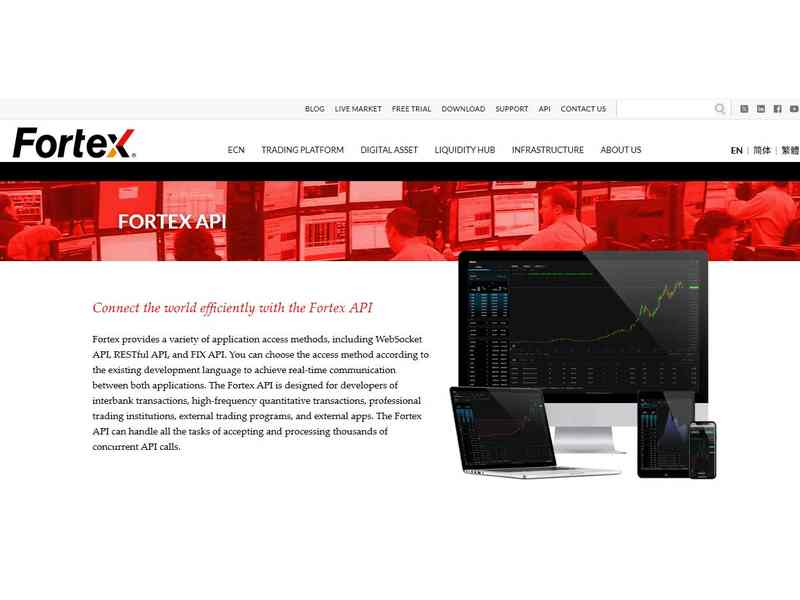
Source: Fortex official API page, captured 17 October 2026. Screens show vendor demonstrations; this is not an independent performance test.
The Fortex API offering includes FIX, WebSocket and RESTful interfaces. Its stated audience includes professional trading institutions, quantitative developers and external application builders. The API page also describes access to XForce features such as risk management, multiple liquidity-provider connections and custom liquidity.
These interfaces give an integration project several possible approaches, but the selected protocol must match the actual workflow. An existing institutional order connection may have different requirements from a browser application or an internal operations service. The implementation discussion should identify which interface supplies each required action and data field, together with authentication and account permissions.
Reconnection is a particularly useful test. After interrupting a test client, the broker should be able to explain how it establishes the authoritative order and position state and avoids duplicate actions. API documentation, sample messages and an agreed error-handling process are more informative for this purpose than a general assertion that integration is straightforward.
XCLOUD: hosting and operational support for trading systems
XCLOUD is presented as Fortex's infrastructure-as-a-service division, offering dedicated servers, virtual private servers and connectivity. Its hosting page specifically lists Equinix NY4 in New York, LD5 in London and HK3 in Hong Kong. These are the locations stated for the hosting offering; the location and topology of an individual deployment should be agreed separately.
The same page describes support for MetaTrader installation, existing-server migration, plug-ins and data feeds, backup and disaster-recovery servers, maintenance and monitoring. It also names stale-quote detection and alerts among the monitoring tasks. This makes the operating model relevant alongside the server specification: the broker needs to know who responds when infrastructure is running but a trading service is not behaving correctly.
A practical hosting review should follow the complete path from client connection through trading server, bridge and counterparty. Request a diagram identifying ownership of each connection and a recovery exercise with named responsibilities. Network proximity can inform deployment planning, but it is not a substitute for measuring the broker's actual order path.
Deployment scope, CRM integration and commercial terms
Fortex's October 2026 commentary focuses on the cost of coordinating trading, liquidity, execution, risk, CRM and hosting across multiple suppliers. Its proposition is that a more integrated arrangement can reduce repeated integration work and clarify operational ownership. For procurement teams, that is a useful hypothesis to test against their own systems and contracts.
Start with a scope document separating native Fortex functions, connected third-party applications and work retained by the broker. CRM integration deserves specific treatment: define the records exchanged, the system that owns each record and how failed updates are reconciled. A CRM connection should not leave two systems with competing versions of a client's status.
The public platform page describes volume-based charging for the MT4/5 WebTrader service. That product-specific statement should not be applied to Fortex 7, Bridge OMX, ECN services or XCLOUD as a single pricing rule. Request an itemized proposal covering the selected products, implementation, hosting, connectivity, support and any usage-related charges. No complete platform price is inferred here.
Where Fortex fits in a broker's vendor selection
Fortex is particularly relevant to three evaluation paths: brokers considering a Fortex 7 trading environment; MetaTrader operators assessing Bridge OMX; and firms reviewing XCLOUD hosting or API access for an existing architecture. Each path leads to different acceptance criteria, even when several components eventually form one deployment.
The strongest selection process follows a real workflow across the proposed products. Demonstrate client order entry, execution, exposure changes, reporting and incident handling, with commercial responsibilities attached to each stage. This allows a broker to assess Fortex as a connected technology offering while retaining a clear view of the integrations and operating work its own team will manage.
Sources and verification: Fortex's official trading platform, Bridge OMX, ECN, API and XCLOUD pages, its 14 October 2026 product commentary, and the Fazzaco company directory were reviewed on 17 October 2026. Product descriptions above reflect those published materials; deployment exercises and procurement questions are Fazzaco's editorial analysis.
 Subscribe Now