


FYNXT Forex CRM: Products, Integrations and Broker Use Cases
FYNXT is a Singapore-based financial technology provider whose modular software covers client management, introducing broker networks and brokerage operations. Its Forex CRM connects customer and account workflows with trading platforms, while separate products address partner commissions, digital onboarding and MT4/MT5 administration. For a brokerage evaluating FYNXT, the useful starting point is the operational process it needs to improve: onboarding clients, managing distribution partners or controlling trading-server tasks.
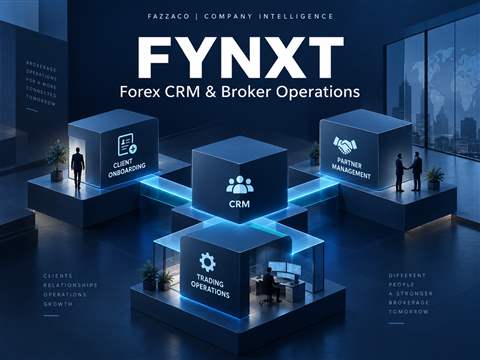
Fazzaco editorial illustration; not an official product screenshot.
FYNXT at a glance
| Dimension | Published offering |
|---|---|
| Company focus | Modular software for FX/CFD and multi-asset brokerage operations |
| Headquarters | Singapore, according to the company's website |
| Core areas | Forex CRM, Client Portal, IB Manager and Digital Onboarding |
| Additional products | TradeOps Control Center, PAMM, Copy Trading, Contest Manager and White Label Solution |
| CRM platform connections | MT4, MT5, cTrader, Sirix and DXtrade, as listed on the CRM product page |
| IB Manager platform connections | MT4, MT5 and cTrader, as listed on the IB Manager page |
| TradeOps scope | MT4/MT5 server operations |
Platform support differs by product. A CRM connection to a particular trading platform does not establish that every FYNXT module supports the same platform or data operations. Brokers should verify the connector, deployment requirements and supported actions for each module in their proposed configuration. Sources: FYNXT, Forex CRM and IB Manager.
What does FYNXT Forex CRM do?
FYNXT positions its Forex CRM around the brokerage client lifecycle. Its published functions include client profiles, multiple trading accounts, document-verification workflows, client risk profiling, automated communications and financial reporting. The product page also describes payment-gateway connections and synchronization of trading accounts and balances.
The operational connection between these functions matters more than the length of a feature list. A sales team may need to know whether a prospect has completed onboarding; operations may need to see which accounts belong to that client; finance may need to reconcile account activity against a payment record. A CRM deployment should let each team work from consistent identifiers and clearly defined statuses.
For example, a brokerage demonstration could follow one fictional client from lead creation through document review, account provisioning and a deposit-status notification. That exercise tests the hand-offs between departments. It is more informative than a tour of isolated dashboards, and it makes clear where a third-party identity or payment provider enters the process.
IB Manager: distribution relationships and commission rules
Introducing brokers bring clients to a brokerage under agreed referral or commission arrangements. FYNXT's IB Manager is designed to organize those relationships through multi-level partner structures, configurable commission rules, performance reporting and automated distributions. The company lists CPA, per-lot and hybrid models, alongside partner dashboards and campaign tools.
For a broker with several partner tiers, the central issue is whether the software reproduces its actual agreements. A calculation can depend on the referred account, instrument, eligible activity, partner level and effective date of the agreement. The procurement team should ask the supplier to demonstrate both a normal commission calculation and an exception, such as a correction to the underlying activity or a partner moving to a different scheme.
A useful acceptance record would identify the input data, applied rule, amount allocated to each eligible partner and reconciliation output. That gives finance and partnership teams something concrete to review before migration. FYNXT publishes support for configurable schemes and transaction records; the treatment of a broker's particular exceptions still needs to be established during implementation. See IB Manager.
TradeOps: a different layer from client relationship management
FYNXT describes TradeOps Control Center as a separate operations layer for MT4 and MT5. Its product page lists tools for server administration, bulk account updates, swaps, trading sessions, group settings and user permissions. It also describes approval workflows, activity logs and Dynamic Leverage as part of the product range.
This addresses a different problem from the CRM. CRM work concerns clients, relationships and service processes; TradeOps concerns actions taken against trading-server environments. Keeping that distinction explicit helps a broker assign ownership: sales and client operations may lead the CRM requirements, while platform operations and risk teams define the requirements for server administration.
Consider a scheduled change to trading sessions across several servers. A meaningful evaluation would check the target symbols, affected groups, proposed changes, approval record and resulting server state. The ability to export a log should be assessed alongside the actual content of that log. A bulk-action interface is only useful when the team can identify what it changed and resolve partial failures.
How the modules fit into a broker's workflow
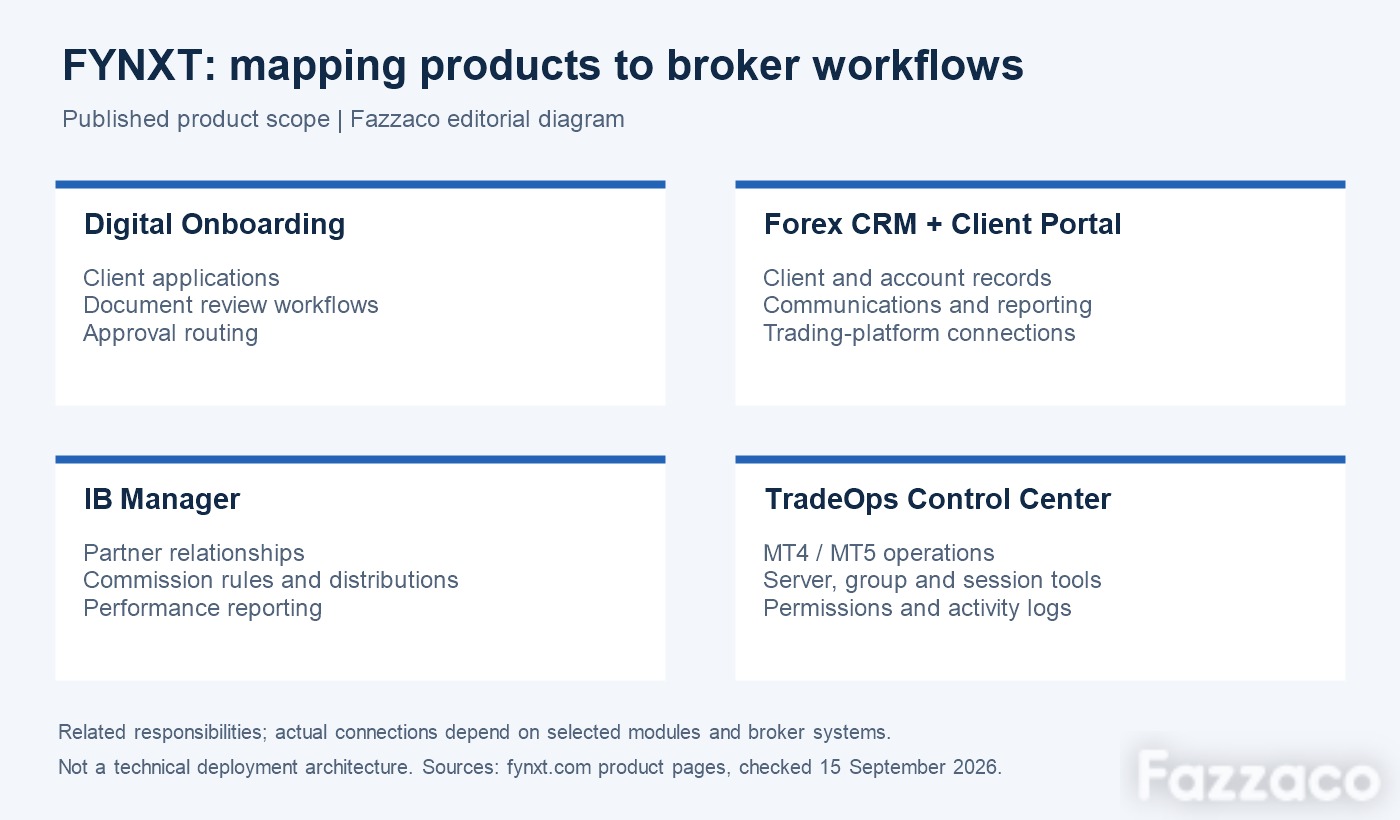
Editorial workflow map based on the published product scope. It is not a deployment architecture or a promise that all modules are included in one subscription.
The modules can be considered as related operational responsibilities. Digital onboarding handles the entry process; CRM and the client portal organize the ongoing relationship; IB Manager handles the distribution network; TradeOps addresses MT4/MT5 administration. The actual connections depend on the products selected and the broker's existing systems.
This makes a modular evaluation possible. A broker replacing spreadsheets for partner commissions may begin with IB requirements. A business replacing its customer back office may start with CRM, portal and onboarding requirements. A broker retaining its CRM but seeking more controlled MetaTrader operations would have a different scope again. These scenarios are an interpretation of the product range, not a recommendation that every broker needs the full suite.
Integration and implementation questions worth resolving
The following questions help turn a product demonstration into a usable procurement specification:
| Area | Question to resolve |
|---|---|
| Trading platform | Which platform version and connector support the selected module, and which read/write operations are available? |
| Data ownership | Which system holds the authoritative client, account, balance and partner records? |
| Migration | How will existing account IDs, documents, partner relationships and commission history be mapped and checked? |
| Payment connections | Which payment providers are included, and how are statuses and reconciliation records exchanged? |
| Access and approvals | Which roles can view, propose, approve and execute sensitive changes? |
| Support | What response times, escalation route and responsibilities are included in the contract? |
| Exit arrangements | In what format can records and logs be exported if the broker changes suppliers? |
These questions are not findings of deficiencies in FYNXT. They identify information that a public product page cannot settle for an individual brokerage. A working connector, for example, does not by itself determine migration effort or how the broker will handle an unavailable third-party system.
Pricing: distinguish the CRM from TradeOps
The CRM page directs prospects to a demonstration rather than displaying a complete subscription price schedule. A broker therefore needs a quote covering its selected modules, accounts, integrations, migration and support requirements.
TradeOps does publish indicative starting prices. On 15 September 2026, its page listed a Core Bundle from US$799 per month per server, with Dynamic Leverage and the Swap Free Tool each from US$499 per month per server. Those figures belong to TradeOps components; they are not the price of the entire FYNXT platform or Forex CRM. The final configuration, contract terms and current rates need confirmation with the provider. Source: TradeOps pricing.
Where FYNXT fits in a vendor shortlist
FYNXT's published scope is relevant to brokerages evaluating how to connect customer administration, partner distribution and trading operations. The potential value lies in the fit between those modules and the broker's existing operating model. That fit depends on verified integration coverage, migration requirements, staff permissions and the commercial package.
A productive next step is a module-specific demonstration using the broker's own requirements and anonymized sample data. Comparing the same scenarios across shortlisted suppliers makes the resulting decision more defensible than comparing marketing claims or the number of dashboard features.
Questions about FYNXT
Is FYNXT a forex broker?
FYNXT presents itself as a financial technology provider for brokers and financial institutions. The products covered here are business software for those organizations.
Does FYNXT support MT4 and MT5?
Its CRM and IB Manager pages list MT4 and MT5 connections, and TradeOps specifically covers MetaTrader operations. Support should be checked at module and connector level rather than assumed across the entire product range.
Are CRM, IB Manager and TradeOps the same product?
They are separately described products within FYNXT's modular offering. Their scopes overlap operationally, but they address different responsibilities. Inclusion in a subscription and the required integrations should be specified in the proposal.
 Subscribe Now