


How Global eSolutions Takes a Partial Fill from Order to Fund Statement
A fund manager orders 10,000 shares for two funds. Only 6,000 trade. By the time clients receive their statements, the broker needs to explain how many shares each fund bought, what each owes and which holdings qualify for a subsequent dividend. The order ticket alone answers none of those questions. Hong Kong software provider Global eSolutions (GES) addresses them through two systems. GES EX handles securities orders and allocations. Xentrix takes the resulting records into settlement, account administration and reporting.
GES packages those systems together with its Auton client terminal under the name GES EX 360°. Auton makes trading and market information available on desktop and mobile. A fund manager's allocation decision belongs in the broker's front office, while a stock movement or dividend entry belongs in its books. Following a single hypothetical order through those stages shows why a broker needs to preserve several quantities even when the security, price and trade date are the same.
Who receives the shares when only part of an order trades?
GES says a fund manager can place an order for several funds and distribute trades to their accounts using percentages set in advance. The daily trading report records the orders and the allocation method. Before an order reaches the market, the broker can monitor buying power, credit limits and margin. GES EX also offers an optional approval step for firms that require another person to authorise the release of an order.
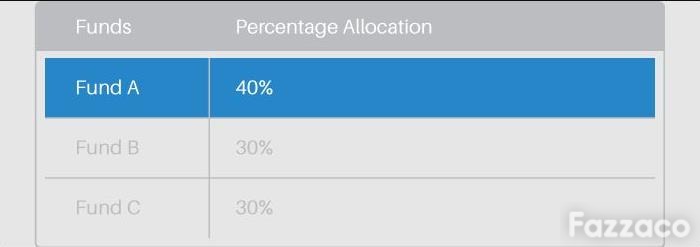
GES EX illustrates a three-fund allocation. The two-fund example below uses a 60/40 split.
Suppose the manager assigns 60% to Fund A and 40% to Fund B. The intended purchases are 6,000 and 4,000 shares respectively. If 6,000 shares execute at HK$12.50 and the percentages apply to that fill, A receives 3,600 shares and B receives 2,400. At that price their gross consideration is HK$45,000 and HK$30,000. The two positions add up to exactly what traded. The 4,000 shares still unfilled remain a question for the dealing desk until the order expires, is cancelled or trades again.
This example uses quantities that divide evenly and a single execution price. An allocation policy matters more when the final fill is too small to divide in the specified proportions, or when successive fills arrive at different prices. An operations team assessing GES EX can ask for the fund-level entries and daily report for one such order. Those records would reveal the rounding and price treatment actually configured for that broker. A percentage displayed on the original ticket cannot answer either question.
Where the front-office record meets the settlement file
GES describes real-time synchronisation between GES EX and Xentrix, as well as interfaces for firms that retain a third-party front or back office. In the example, the first check at that handover is straightforward. A single security, 6,000 executed shares and HK$75,000 in gross consideration must be traceable across the two fund accounts. Sending the 10,000-share order quantity as a completed purchase would create an extra 4,000 shares on the books, even if every message arrived immediately.
Xentrix supports file exchange with Hong Kong's Central Clearing and Settlement System (CCASS) and daily processing of account transfer instructions (ATIs) and settlement instructions (SIs). An ATI can move eligible securities between stock accounts of the same participant. That movement can change where shares are recorded while leaving the participant's overall holding unchanged. It therefore needs its own reference. Treating it as another purchase would inflate trading volume and create a cash entry for a trade that never occurred.
For a broker investigating a discrepancy, the useful comparison depends on what differs. A mismatch between an execution and its fund allocations calls for the order and fill records. A discrepancy between an internal holding and a clearing record calls for the stock accounts, instructions and their processing status. Exporting a file establishes that the broker prepared instructions. The corresponding clearing record is what helps operations establish how those instructions were processed.
Why the same trade appears differently on two statements
Xentrix lets a broker configure commission and fee formulas, including tiered charges. The HK$45,000 and HK$30,000 in the example are purchase amounts before charges. A client statement may therefore show a different total cash debit. To explain it, the broker needs both the fund's gross consideration and the charges applicable to that account. Even with a 60/40 share allocation, dividing a combined fee in the same proportions can give the wrong outcome if the two accounts have different fee schedules.
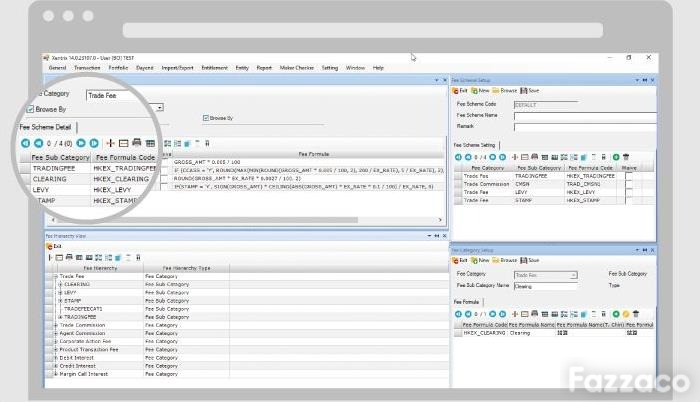
The Xentrix fee screen separates charge categories and their calculation rules.
A later corporate action poses a different question. Xentrix supports cash dividends, bonus shares, splits and rights exercises. Assume both funds still hold their allocated shares, every share qualifies on the relevant record date and the issuer declares HK$0.20 per share. Gross dividend entitlements would be HK$720 for A and HK$480 for B, before any deductions. Using the manager's original 10,000-share order would produce HK$2,000 instead of the HK$1,200 supported by the eligible holdings. A subsequent sale or transfer before the entitlement date would require checking the holdings again.
GES says Xentrix can schedule daily or monthly processing, send statements to clients and export reports to internal departments. For the two funds, the most revealing test is whether a statement query can be followed backwards. The dividend should tie to the eligible holding, the holding to the allocated trades and stock movements, and the purchase cost to the fills and fee entries. That chain gives the broker a concrete answer when a client asks why an order for 10,000 shares resulted in a dividend on 3,600.
 Subscribe Now