
Add Fazzaco to desktop

Add Fazzaco to desktop

Access Fazzaco from desktop next time

Add now
English

Global Forex Market Report in the First Half of 2020 IV (Global Forex Regulatory Framework: Africa, Middle East and Offshore Market)

Source: Fazzaco
2.10 Africa — Rapid growth but lack of regulation
Due to the growing momentum in fintech platforms, Africa’s online retail FX and CFDs transactions are on the rise.
It is estimated that there are about 1.3 million FX and CFD traders in Africa, which means one in one thousand people there trades FX online.
South Africa and Nigeria are the two major retail markets in Africa, with the highest daily trading volume and 390,000 FX traders.
According to statistics from BIS, the daily trading volume in OTC FX (including all currency pairs) amounted to $20.37 billion, including spot FX, FX options/futures, FX swaps & retail FX in 2019.
Across the continent, only South Africa has a Financial Sector Conduct Authority (FSCA) to provide regulation, while in most parts of Africa there is no clear standard as to whether the FX industry is legal or not. For example, Nigeria doesn’t have an FX regulatory body. The FX brokers doing business in Nigeria are subjected to the regulation of FSCA and FCA.
Most African countries don’t have local regulations or rules on FX and CFDs, leading to fund risks against new and regular investors and traders and slow development of its FX industry. Some veteran African investors are forced to resort to foreign brokers under the regulation beyond Africa to secure their investment.
2.11 Middle East — Rapid growth
Leading the way in the Middle East is the Cooperation Council for the Arab States of the Gulf, previously known as the Gulf Cooperation Council (GCC). As far as size is concerned, the top three countries in terms of FX markets in the GCC region is Saudi Arabia, the UAE, and Kuwait.
The Middle East region is famous for its oil-rich countries, Islamic culture and rich history. Although the region was a late adopter of FX as an asset class, it has certainly picked up speed and in recent years, welcomed forex with open arms.
This adoption is in large part thanks to a growing investment appetite and widespread Internet penetration.
The region’s strategic location between Asia and Europe makes it a hub for international Forex flows. It also benefits from the time zone, enabling its participators to catch trading hours for Europe as well as US and Asian hours all in the same day.
However, unharmonized regulation creates barriers for FX there. Some countries only have minimal regulations if any at all.
Partial list of brokers
ADSS
Noor Capital
2.12 Offshore regulation — Reform while moving forward
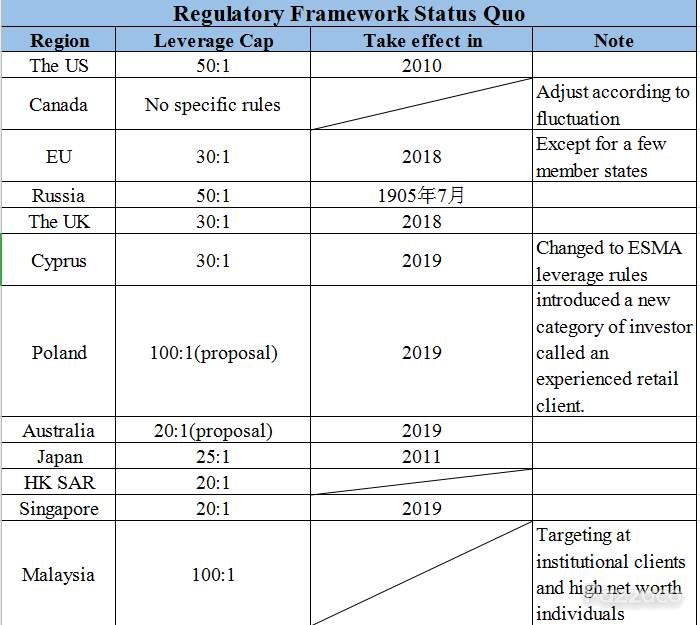
Since August 1, 2018 when the new ESMA rules took effect, FX market saw an upsurge of brokers in seeking offshore regulation.
Retail clients began to find new opportunities in offshore jurisdictions such as Vanuatu and Bahama. The same is true of brokers regulated by ASIC, CySEC, and FCA. The most common offshore regulatory bodies include International Finances Services Commission of Belize (IFSC), Seychelles Financial Services Authority (FSA), British Virgin Islands Financial Services Commission (BVIFSC), and Cayman Islands Monetary Authority (CIMA).
A lot of brokers have followed the trend by setting offshore entities to provide higher leverage for investors without violating the restrictions of ESMA. Compared with 2017 or 2018, brokers are more incentivized to resort to overseas regulation while ordinary investors favor brokers regulated by a variety of authorities.
Brokers prefer offshore regulation because of the following factors:
Loose regulation: Offshore regulation is relatively loose. Offshore license doesn’t require the applier to provide financial services within the jurisdiction, that is, the applier doesn’t necessarily need to set tangible office within the jurisdiction.
Time saving: Applying for offshore license requires less time, money, and documentation with less taxation.
High leverage: Loose regulation is highlighted by high leverage cap ranging from 200:1 to 500:1.
Notably, some brokers may attract more clients from different regions through their branches set in offshore jurisdictions which are independently operated. These branches may adopt a set of operating standards completely different from their parent companies and run illegally by taking advantage of the favorable conditions under offshore regulation.
This operating mode may easily misguide investors because a huge amount of brokers claiming to be regulated by mainstream regulators are under the disguise of offshore regulation. Therefore, the Ministry of Finance of Japan, and countries like Spain, Italy, and Ireland have blacklisted brokers holding license of Saint Vincent and the Grenadines and Marshall Islands.
But an improved regulatory framework is worth waiting for as offshore regulators are undergoing reform. In 2019, Vanuatu Financial Services Commission (VFSC) required that all the brokers operating within the country need to save 50,000 dollars as deposit and set offices in Vanuatu.
In spite of low operating cost, brokers seeking offshore regulation need to tolerate investors’ doubts on the brand capacity. Investors, on the other hand, need to face higher fund risks while enjoying higher leverage. Every coin has two sides. It is true both for investors and brokers.
Leverage restrictions in different regions

Create Company Page
