


Gold-i: MatrixNET, MetaTrader Tools and Broker Risk Technology
Gold-i supplies trading technology for brokers, liquidity providers, funds and proprietary trading firms. Its product range covers liquidity connectivity, MetaTrader operations, account allocation, risk analysis and hosting. MatrixNET connects the execution workflow to external trading venues; Visual Edge brings trading information into operational reporting; MAM Pro and specialist plugins address tasks within a MetaTrader brokerage.
For a brokerage building around several suppliers, the value of this portfolio is the ability to address distinct parts of its trading infrastructure. Gold-i supplies the software connecting and managing those workflows. The broker retains its commercial relationships with liquidity counterparties, while trading platforms and customer-management systems fit alongside the technology.
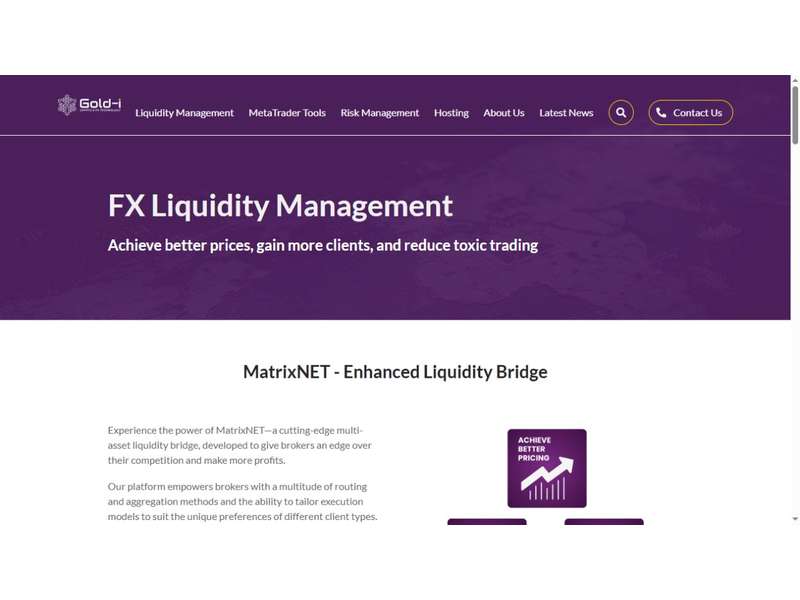
MatrixNET FX liquidity management product page. Source: Gold-i.
Where the products fit in a brokerage
A trading operation combines several different decisions: where prices originate, how an order is handled, how exposure is observed and how transactions are reflected across accounts. Treating these as separate functions makes the Gold-i range easier to understand. MatrixNET primarily serves the connection and execution layer. Visual Edge supports the teams interpreting trading activity. MAM Pro deals with allocation, while plugins automate narrower operational tasks.
This separation matters during expansion. A broker adding a trading platform may need shared liquidity access and consolidated reporting; a business introducing managed accounts has a different requirement around allocation. The relevant starting point is therefore the workflow being added, rather than the number of modules available.
| Product area | Main function | Brokerage application |
|---|---|---|
| MatrixNET | Aggregation, connectivity and execution management | Organise price sources and routing |
| Visual Edge | Risk data, reports and alerts | Monitor exposure across trading systems |
| MAM Pro | MetaTrader account allocation | Support managed-account operations |
| MetaTrader plugins | Targeted operational automation | Handle monitoring and daily administration |
| Hosting | Managed or client-hosted infrastructure | Place software within the operating environment |
MatrixNET: aggregation, distribution and execution
Gold-i describes MatrixNET as a multi-asset liquidity bridge with configurable aggregation and routing. The FX product page covers external order handling and internalisation, alongside settings for minimum spreads, markups and maximum spreads. A scheduling function lets operators prepare spread changes for planned events. These controls give the dealing team a way to translate its execution policy into system configuration.
Distribution is another part of the product. MatrixNET can create differentiated price feeds and provides FIX or WebSocket connectivity. Gold-i lists connections involving MT4, MT5, cTrader, TradeLocker, Match-Trader and DXT, and describes support for compatible order and execution management systems. Reporting includes an activity dashboard, order filters and a REST API for extracting information into another system.
For a multi-platform broker, a practical use is to organise upstream pricing and routing centrally while serving different customer interfaces. Keeping those rules explicit also gives operations and dealing teams a common reference when investigating an order.
For example, a business serving both retail and professional customers can define the intended pricing and execution treatment of each segment before mapping it into the bridge. The important connection is between the commercial offer and the configured flow: the customer interface, price stream and routing policy should describe the same service.
Liquidity connections and counterparty relationships
The MatrixNET network includes banks, non-bank market makers, ECNs and digital-asset venues. Its published connection list includes businesses such as Finalto, LMAX, CMC Markets and Integral. Gold-i says firms can configure pools around instruments, customer groups and other routing criteria, rather than connecting to every available provider. Its network also spans trading infrastructure in London, New York, Tokyo and Singapore.
Gold-i explicitly distinguishes its role from that of a liquidity supplier: it provides connectivity, aggregation and execution-management software. Brokers normally arrange their own commercial, legal and credit relationships with the counterparties they select. That distinction helps separate the technology deployment from counterparty onboarding.
A useful deployment decision is which source should serve which trading activity. A feed suitable for smaller orders may play a different role from a venue used to hedge larger exposure. Technical access creates options; matching those options to instruments and order sizes turns connectivity into an operating model.
Visual Edge: a shared view of trading risk
Visual Edge is Gold-i's reporting and risk-analysis product. Its documented integrations include MT4, MT5, DXtrade and other trading platforms. The product brings information into a combined view, with aggregation and drill-down by dimensions including customer, symbol, book, asset class, country and liquidity provider. Users can configure reports, receive automated alerts and schedule daily outputs.
Gold-i also lists CRM integration, mobile access and tools for analysing scalping or trading patterns that an operator wants to investigate. The web-based interface is positioned for several departments, including dealing, finance, compliance and marketing.
The operational significance is a shared data foundation with different levels of detail. A dealing desk may investigate a single symbol or customer, while management needs a broader exposure view. Agreed definitions for books, instruments and client identifiers help those views remain consistent when a brokerage operates more than one platform.
A useful reporting design distinguishes open exposure from realised trading results and cash movements. Those figures answer different business questions. Giving each report a clear purpose and recipient makes an alert or daily summary more useful than distributing the same dashboard to every department.
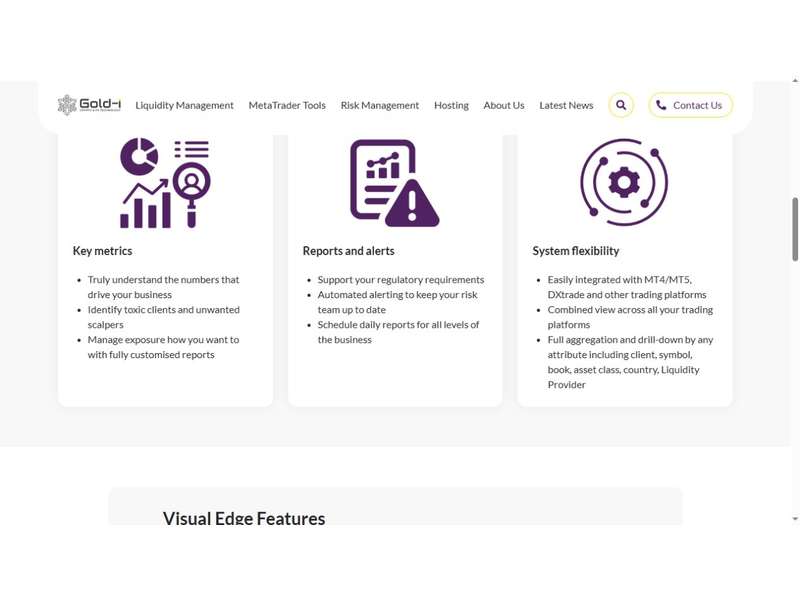
Visual Edge reporting and risk-analysis features. Source: Gold-i.
MAM Pro for managed-account allocation
MAM Pro supplies post-trade allocation for MT4 and MT5. Gold-i documents eight allocation methods, including approaches for PAMM, LAMM and MAM requirements. The product can temporarily exclude an account from allocation without changing its existing open positions, and apply an account-specific risk factor to adjust allocation.
Another feature separates synchronisation transactions into profit, commission and swaps. Gold-i also describes a branded graphical interface and a flat monthly licence structure, without publishing a numerical fee on the product page.
These functions address the administration behind a managed-account service. Different account balances and participation settings can create allocation complexity even when the underlying trade is the same. The brokerage's operating design should therefore connect allocation settings with account records and reconciliation. For a planned launch, a representative test includes an account entering or leaving participation while existing positions remain open.
Support teams also need to explain why accounts receive different allocations. Keeping the agreed allocation method, participation status and relevant account settings accessible to the appropriate staff helps answer that question. This links the trading tool to the service process customers experience when they query a transaction.
MetaTrader plugins for daily operations
Gold-i's plugin range targets specific jobs within a MetaTrader environment. Price Monitor alerts operators when quotes stop arriving; Swap Loader automates the upload of daily swap values; Balance Monitor emails the brokerage when a client balance becomes negative. The MT5 Cover Trade Plugin is described as supporting counterparty-risk reconciliation.
The catalogue also includes IB Profit Share and Margin Caller. The latter's published description covers notifications for stop-loss or take-profit closures and cash deposits or withdrawals. Its documented event coverage is therefore a better guide to use than assumptions based only on the product name.
Small automation components can be useful where a recurring manual step has a clear trigger and owner. A stopped-quote alert, for example, becomes actionable when the operations team has a defined escalation route. Daily swap uploads similarly benefit from a controlled input process and a check that the intended values reached the relevant symbols.
Technology for prop-trading environments
Gold-i applies MatrixNET to proprietary trading operations that need a simulated market environment. The prop product page describes configurable execution delays, replenishment of available liquidity, speed controls, aggregation from multiple price sources and synthetic symbols. These are controls for shaping the trading environment and its execution behaviour.
The documented replenishment function adjusts available liquidity so that traders compete for top-of-book prices within the simulation. Gold-i also lists market hedging and connections to multiple trading platforms. Its FAQ makes the product boundary clear: Gold-i does not supply the trading platform or CRM itself, although it works with suppliers of both.
For an operator, this places particular importance on consistency between configured execution conditions and the participant-facing service. A simulation policy should describe the environment the business intends to run, and its technical settings should implement that policy across the chosen instruments and platforms.
Hosting and deployment responsibilities
Gold-i offers managed hosting on its servers as well as deployment on a client's own instance with support. The hosting page describes cloud infrastructure, dedicated physical servers and in-house instances. It also explains that Gold-i works with data centres internationally to locate products near clients' existing infrastructure.
Those arrangements serve different operating preferences. Managed hosting places server administration with the supplier; an in-house instance lets the brokerage fit the software into its own infrastructure practices. The choice should align with who handles access, capacity planning, monitoring, backups and incidents. Location also needs to be considered alongside the actual path between platform, bridge and counterparties.
A practical rollout can start with a defined set of symbols, accounts and liquidity connections. Operations can then follow an order through execution, allocation where relevant, reporting and reconciliation. Expanding that tested configuration provides a clearer basis for growth than enabling every component at once. Gold-i's product range is most useful when each module has an identifiable job within that overall process.
 Subscribe Now

