


How ABN AMRO Clearing Sizes Up a Swap Portfolio Before the First Trade
A fund expects to put €60 million of new interest rate swaps through a clearing account next month. Its existing book is twice that size. Which number should it give a prospective clearing bank? ABN AMRO Clearing asks for both. Its application for over-the-counter clearing also asks how long the swaps run and how much initial margin the client expects to need. Each answer tells the bank something different about the business it would take on.
The bank clears derivatives for institutions including brokers, asset owners and market makers. For interest rate swaps, it lists euro, US dollar and sterling contracts, including overnight index swaps and swaps whose notional falls over time. A client choosing a clearing provider has two decisions to make even with a book in just one currency. Where will the next trade clear, and what should happen to the trades already on the books?
One month of trading, three different figures
Consider a hypothetical fund hedging for its own account. It starts the month with €120 million in gross swap notional and expects to enter 12 new euro swaps of €5 million each. That gives the clearing bank two figures for expected activity: 12 trades per month and €5 million per trade. Together they imply €60 million in new business. The opening portfolio is a separate €120 million figure with its own measurement date.
Now suppose €20 million of the opening book matures during the month. If nothing else changes, the fund will finish with €160 million outstanding: €120 million plus €60 million less €20 million. Quoting €160 million as monthly turnover would count contracts written in earlier months. Quoting €60 million as the portfolio would omit the €100 million of older contracts still outstanding. A dated inventory and an estimate of future trades resolve the ambiguity before the fund even requests a price.
There is still no margin number in that arithmetic. Two funds can have the same gross notional and very different exposure to a rate move. A book of short-dated swaps and one with years left to run give a clearing provider different risks to assess. The bank's form asks separately about the tenor of a typical new transaction, the tenor of the overall portfolio and expected initial margin. For the fund in this example, that last figure still requires a risk estimate.
What a clearing proposal has to cover
ABN AMRO Clearing identifies execution access, central counterparty clearing, collateral management and trade reporting as parts of its OTC service. Those functions have different owners at the client. A trader may arrange execution through a venue such as Tradeweb. Operations needs the right clearing account for the resulting trade. Treasury needs to know which collateral can reach that account when an intraday margin call arrives.
The bank's onboarding disclosure explains why a per-trade quote alone tells an incomplete story. Its written terms may cover setting up and maintaining an account, handling margin and bringing existing positions into clearing. The level of automation and the operational support a client needs can affect its terms. A desk that wants only new trades cleared can therefore ask for those terms separately from the cost of moving an existing book. That makes two proposals easier to compare even when both assume the same 12 new trades a month.
Two dates for going live
The bank's indicative onboarding chart gives new transactions and transfers of existing positions separate lines. It also distinguishes opening accounts at the bank from setting them up at the chosen central counterparties. Legal negotiations, due diligence and third-party account setup can overlap. Timing depends in part on when the client returns its documents and when the other participants are ready.
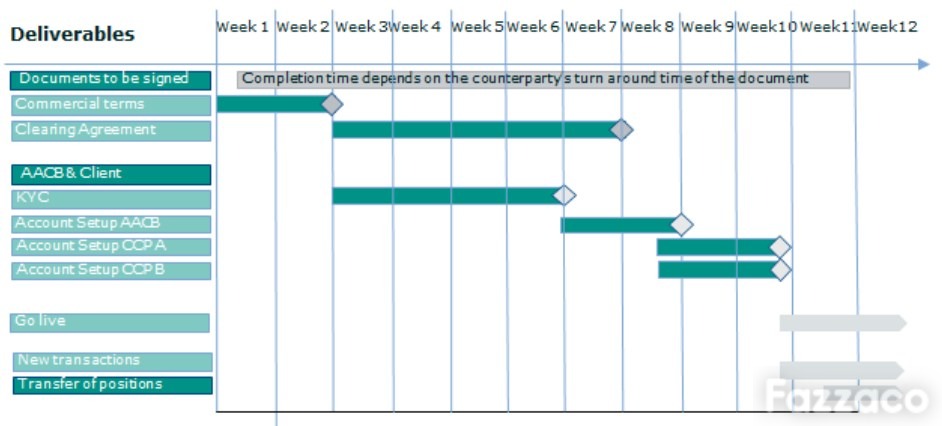
ABN AMRO Clearing’s indicative schedule separates account setup, the start of new trading and the transfer of open positions. Timing varies by client.
For the hypothetical fund, that changes the handover. On the first date, the desk can check where its next €5 million swap is booked. On the transfer date, operations can reconcile the older contracts individually against the outgoing and incoming records. If the €20 million has already matured, the opening inventory leaves €100 million of older swaps to account for. Keeping those two dates on the same handover sheet gives the fund a clear answer when someone asks who clears today's trade and who still holds yesterday's positions.
 Subscribe Now