


How Brokers Need to Report Transactions with Changing Regulations? TRAction’s Quinn Perrott Speaks
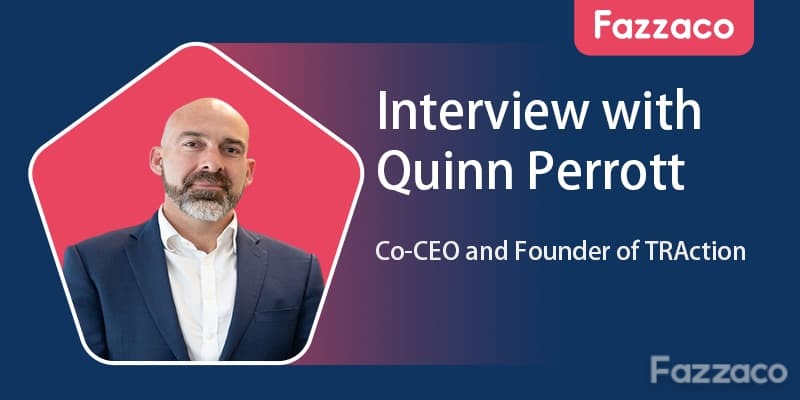
Quinn Perrott is co-CEO and founder of TRAction. With In-depth knowledge of regulation and compliance, Quinn focuses on assisting clients in Europe, Asia and Australia to meet their regulatory requirements with trade and transaction reporting solutions as well as development of the best execution platform.
Quinn joins Fazzaco today to discuss the transaction reporting process, advantages of self-reporting and delegated reporting, and how brokers to report transactions with changing regulations etc.
Fazzaco: Hello Quinn, happy to have you at Fazzaco. As a start, could you please give us an introduction about yourself and TRAction?
Quinn: I originally started my career in the IT industry and moved from there into finance, specifically as the IT manager for Green CFD (now City Index Australia).
After a few years, I got the great opportunity to be co-founder and General Manager of AxiTrader, That’s where I met my future business partner and friend Sophie Gerber who was our compliance consultant.
Working with Sophie helped me see that compliance is an often-overlooked component and without a clear understanding of compliance it’s like trying to play chess when you are not sure of the rules, an experience player will kick your ass.
Fazzaco: What motivated you to create TRAction and what need does the company aim to meet?
Quinn: We saw a huge void of understanding in the market between the stakeholders, in fact we have a name for it, “The triangle of pain”. Quite basic terms and concepts were seen vastly differently from the perspective of a Broker, the trade repository (DTCC) and the regulator (ASIC).
Due to Sophie’s and my combined experience and backgrounds we were able to see things from all the ‘corners’ of the triangle - IT, Legal and Trading.
That’s why we built TRAction - to bridge those gaps. To get the regulator the information they want and require by law, extracted from the brokers’ back office or platform and converted, stored and routed through to the trade repository.
Our services help our clients satisfy their regulatory reporting requirements. This also benefits the regulators as they can communicate more efficiently and effectively with just TRAction instead of multiple industry participants.
Fazzaco: Could you please tell us more about the process of transaction reporting, why need reporting, the general procedures.
Quinn: Essentially it is just sending data about trades, on a daily basis, in a set format, to the relevant financial regulator. Where things get tricky is that one regulation will cover a very broad set of financial products, all with the same fields.
For instance, a speculative crypto CFD trade may be reported into the same fields as an importer’s FX hedge of Euro movements against the British pound.
TRAction extracts the trade data in the native format from trading platforms and back-office systems of financial firms. We then enrich, verify and convert the data into the standardised format. We also resolve any breaks to provide quality assurance and ensure compliance before submitting it to the regulators (through an ARM or TR) on our clients’ behalf. Successful confirmations are provided to our clients upon submission.
Fazzaco: Compared with self-reporting by forex broker themselves, what are the benefits of using TRAction services?
Quinn: Probably the biggest advantage is our experience and knowledge. We actually learn a lot from our 100+ clients, so effectively each client of ours is benefiting from the experience of their peers.
Secondly, we really strive to understand our clients’ business models. DTCC is a great company but they might not know what you are talking about when you ask them “how to report a partial close-by on XAUUSD.”
Thirdly, due to our volume and economies of scale, we generally charge our clients about the same as going direct to the ARM or TR, but we provide the additional advice, data enrichment and support included in that price.
Fazzaco: Currently what’s the percentage of self-reporting and delegated reporting in forex market?
Quinn: I have seen surveys lately that show self-reporting at 40%, 12% delegated and 48% a combination of both, but that’s for the broader market and the survey was a likely somewhat skewed as it was performed by the trade repository itself. From our experience I would estimate it to be 85% delegated in the forex and CFD market.
Fazzaco: Different jurisdictions have different reporting obligations, especially with the regulatory change of ESMA and ASIC, which regulator has easier or stricter requirements?
Quinn: ESMA is stricter.
Firstly, they have 2 transaction reporting requirements. EMIR and MiFIR.
EMIR for derivatives and MiFIR for products Traded On a Trading Venue (or a derivative where the underlying is TOTV).
Currently ASIC is doing a consultation which will result in the ASIC rules mimicking EMIR, except for Exchanged Traded Derivatives which are reportable under EMIR but will remain not-reportable under ASIC.
Fazzaco: ESMA new regulations has been in force for about three years and ASIC’s is on the way, how have these regulatory changes affected your business? And How are you adapting your products or services?
Quinn: Leverage restrictions don’t affect our business directly, though they certainly do indirectly.
When leverage was restricted to a maximum of 30:1 in Europe we saw a drop of about 28% in transaction volumes, as some of our clients’ clients moved to less regulated entities (sometimes sister companies). This quickly recovered, probably due to general market growth.
Our products and services haven’t changed much though we are prepared for the likely outcome that positions will stay open a little longer due to lower leverage.
Fazzaco: What upcoming trends do you see emerging and making an impact on the forex industry as well as trade reporting in the future?
Quinn: I think we are at ‘peak island regulation'. I predict that G20 financial regulators and tax authorities will start to put unbearable pressure on small island governments to stop hosting forex and CFD brokers. This will result in the clients being ‘repatriated’ to more regulated jurisdictions like Australia or Europe and to a lesser degree Singapore and the USA.
 Subscribe Now