


How the Tension across Taiwan Strait Affects Financial Markets
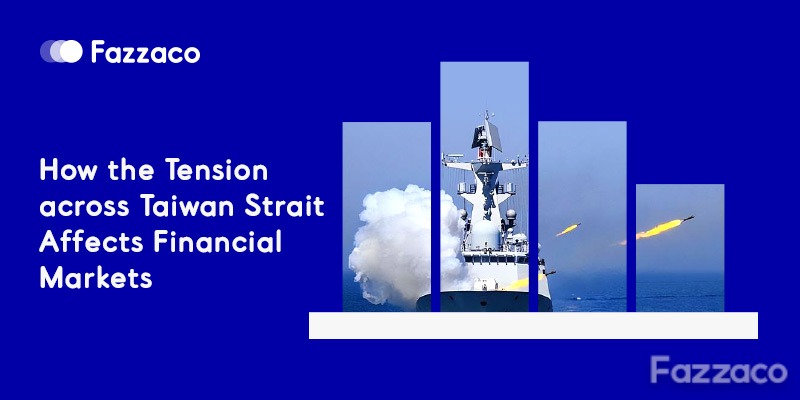
On August 8, the Eastern Theater Command of the People's Liberation Army of China announced that they would continue to conduct practical joint military exercises in the sea and airspace around Taiwan Island. As Nancy Pelosi, the Speaker of the U.S House of Representatives, departed the island on the 3rd and the Chinese Army initiated a three-day military drills around Taiwan started from the 4th and ended on the 7th, many are speculating that such "Over-the-Middle-Line" military drills would be a "new norm", achieving a de facto air-and-sea blockade of Taiwan.
Reactions from Financial Markets across the Strait to Pelosi's Visit to Taiwan
As an undisclosed part of the itinerary of her Asia trip in August, Nancy Pelosi, the Speaker of the U.S House of Representatives made a visit to Taiwan from August 2 to 3. Starting from the 4th to the 7th, the Chinese Army responded to her visit with a series of massive live-fire exercises around the island.
As important geopolitical bellwethers, the financial markets across the Taiwan Strait, reacted long before Pelosi's arrival. At first, several stocks of military-related enterprises in mainland China became popular among investors on August 1, including Addsino Co.,Ltd., Great Wall Military Co., Ltd., and Bestway Marine and Energy, all of which had seen an increase over 10%, with the highest topping 20%. Nearly 10 military-related stocks hit the daily limit until August 3. Correspondingly, Taiwan's stock market fell sharply as soon as it opened on August 2, and Shanghai Composite Index saw decline as well.
However, the Taiwan stock market began to stabilize and even showed an upward trend since August 5. Stocks of semiconductor manufacturers were the ones that performed particularly strong, with TSMC share price rising 3.20% and UMC share price rising 5.53% Markets elsewhere in Asia are, too, leveling off gradually. Besides, officials of Taiwan's central bank said on the 5th that they are not seeing any panic remittance of foreign exchange reserves from Taiwan in spite of PLA's military drills. In addition, both the stock market and forex market are stabilizing these days.
The geopolitical tensions in the Taiwan Strait are also pushing up the price of gold. The Gold / USD price once fell below $1,700 in mid-to-late July this year, yet it soared as the Chinese military drills commenced. As of the 9th, the gold price exceeded the $1,800 barrier.
How Will Normalized Military Drills around Taiwan Affect the Financial Markets in the Long Term?
The financial market, much like the semiconductor manufacturers, such as TSMC (export of semiconductors accounts for over 35% of Taiwan’s total exports), is an important pillar of Taiwan's economy as it involves large overseas / domestic capital movements. Therefore, Taiwan's financial systems might seek for establishing an overseas financial center for risk alleviation as a response.
Forex market: Brokers regulated by Taiwan's Financial Supervisory Commission (FSC), such as Yuanta Futures, Capital Futures, Far Eastern International Bank might be somewhat put under the geopolitical risks. However, forex trading is highly globalized OTC market and a large number of Taiwanese investors are trading at overseas forex platforms like Interactive Brokers, Oanda, eToro, so the risks faced by the island as a jurisdiction may not affect the operations of brokers regulated elsewhere. Similarly, forex trading in mainland China is limited to inter-bank trading while retail trading is banned. But Chinese investors are, too, trading forex at overseas platforms. But it is likely to create more opportunities for IBs in the forex market due to the tensions building up across the Strait.
Crypto market: Cryptocurrencies are risk-averse, and the market performance in recent years proved that it is not a sanctuary for inflation. Bitcoin is not looking like the digital gold as many believed before. Since August 1, the escalating Taiwan situation led to a slight bitcoin decline. Its price fell from $23,273.80 to $22,623.90 from the 1st to the 4th. As Pelosi landed safely in Taiwan, the market seemed to recovered a bit of confidence. As of the 9th, the bitcoin price jumped back to the level before the decline.
Conclusion
Although the tensions are showing signs of relief, the situation of Taiwan Strait is only getting better compared to how it was before Pelosi made her landing. In general, the overall risk of war in the region is still at a historically high level. But Fazzaco believes that the purpose behind the extended military drills conducted by the Chinese Army is still a way to facilitate the final "Reunification of China", and a "peaceful reunification" is still on the table. If we look at the long-standing preferential policies offered to Taiwan all these years, we can see that the destruction of Taiwan's economy - with lateral damages to the entire Asia Pacific - is never the purpose. On the other hand, once reunified, it is foreseeable that the Chinese government would prioritize the recovery of Taiwan's financial system.
Given that the mainland and Taiwan have very different attitudes towards non-banking, retail forex trading, cryptocurrencies and digital assets, so practitioners in Taiwan might become concerned about the future regulatory policies and legal status after the reunification.
 Subscribe Now