CRM is a relatively mature product in the market. The mainstream CRM products have existed for many years and kept pace with the trend of cloud computing and mobile technology. Many products are applicable to small and medium-sized enterprises, and some are suitable for niche market.
Similar to other IT technologies, CRM develops very fast. Therefore, the criteria to judge wheter a feature of a CRM system is mature or not is how early it has emerged on the market. When choosing an appropriate CRM system, please remember to find those features that can differentiate yourself from your competitors.
The core element in choosing CRM is to make sure it is adaptive to your own development (including service features, customer size, sales habits and preferences, etc).
I. User Experience
How do you feel when you use the CRM system? Is it really helpful in boosting your company’s sales performance? Is it automated and intelligent? Is is flawed or barely unsatisfactory? Is the user interface friendly enough? All these factors should be taken into consideration.
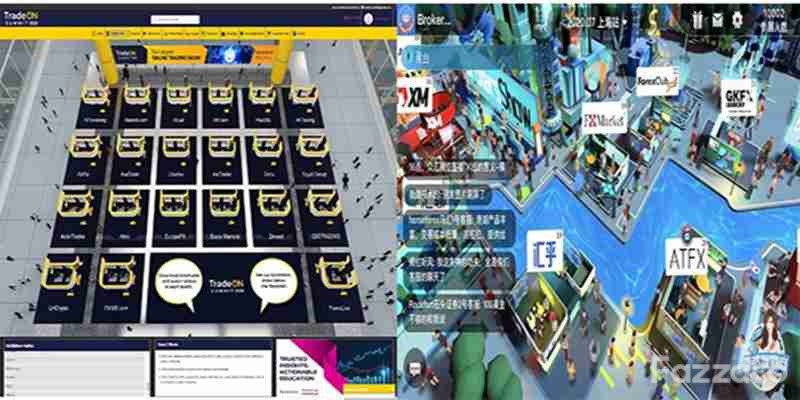
For instance, when it comes to online expo, the BrokersShow Virtual Expo App, developed by FX110, features a better user interface than Tradeon Summit as shown below. You can request a video of how the CRM software is running from the CRM vendor.
Other online exhibition(Left) and BrokersShow Virtual Expo (Right)II. Business Requirement
A huge potential lies in customers. CRM can be used to collect information of customers of various types who can produce different values for the company. You need to think in your business what’s your most urgent need? In what way do you want to use the data collected? How about your development and plan in the future?
III. Cloud-based or Not
Traditionally, deploying a CRM system for an enterprise is a big investment, followed by specialized venues, facilities, and equipment, including fire-proof and dust-free rooms and cooling systems, which may cost an arm and a leg. Moreover, the smooth running of the server requires specialized operators, thus increasing the cost of personnel.
However, SaaS CRM system is totally different. User can access it on the Internet after opening an account. You don’t need to buy your own servers.
Pros and cons of each type are obvious. If you have enough fund and want to have a stable CRM service, then on-premise CRM may be the right choice. Otherwise, you can choose an SaaS CRM at lower cost with more convenience.
IV. Mobile End
Apps installed on mobile ends become more common in this digital era, including CRM software. In some circumstances, it can enable sales persons and technicians to do more jobs and solve customers’ issues in a timely manner. It should be taken into consideration when you choose a CRM product.
V. Integration
A CRM system should be integrated with your existing platforms. You need to seek elsewhere if your intended CRM product cannot integrate with your email, communication, ERP, or OA systems because instead of improving your efficiency, it would only result in countless technical problems.
VI. Price
Most CRM providers charge as per subscriptions.
If you have sufficient fund, you can try to establish your own CRM. If not, you can have a trial test of CRM products free of charge to see to what extent such a product can enhance your sales performance.
If you resort to cloud CRM service, read the agreement carefully and make sure every penny worth it.



 Subscribe Now