


How to Deal with Payment Channels for Brokers before Entering Chinese Market?

Recently, many retail clients of mainland China-operated forex and contract for differences (CFD) brokers have suffered account freezing of payment card, which is another big event in payment industry of China following the abrupt halt of financial technology giant Ant Group's mega-IPO.
In fact, given the unique forex landscape in mainland China, one of the major challenges brokers facing when enter the market is how to deal with payment channels. In this article, Fazzaco will provide a detailed overview of payment channels with Chinese characteristics to help brokers start or grow brokerage business.
Many China-operated brokers suffered payment challenge
Many retail clients of FXTM and other brokers reported that their bank accounts were frozen after withdrawing fund from trading account.
One of the investors asked in Wechat group, “does anybody know the reason for payment card freezing? Upon withdrawing fund from my FXTM account, my bank card was frozen. I did not engage in other business except for daily consumption.”
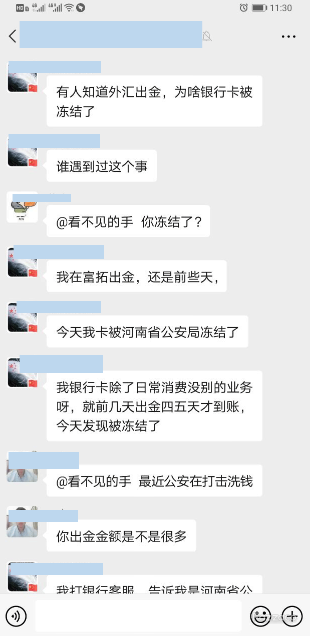
Actually, in August 2020, clients of IC Markets met the same case. Sources revealed that the payment channel of IC Markets was investigated, thus this impacted its withdrawals of client fund. Later IC Markets further explained in their official announcement that "we have deployed new payment channels and the deposits and withdrawals of fund are back to normal.”
China is Cracking Down on Illegal Use of Payment Cards
Usually, there are two types of bank card freezing: bank freezing and judicial freezing. The former one mainly refers to the behavior such as large fund transfer flow or frequent password error that triggered the bank's action while the later one involved in fraud, money laundering and other related factors.
This freezing was part of Chinese government efforts to crack down on illegal use of payment cards. As the illegal use of phone card and bank card becoming the hotbed of telecom fraud, the State Council of China has launched a nationwide cracking down on fraud tools on October 10, 2020 to eliminate the roots of crime.
Meanwhile, the People's Bank of China has tighten the rules against relevant criminals, including banning them from opening new accounts within five years and listing them as Dishonest Persons.
Payment Channels with Chinese Characteristic for Brokers
The above mentioned stricter management and control from government is rooted in its special forex policy where forex trading has not been fully opened up, and the government has strict rules on foreign exchange cap with maximum of 50,000 US dollars per person, which is not allowed to be used to buy overseas real estate, insurance, stocks, futures, forex and other financial derivatives.
Currently, most of the brokers that conduct brokerage business in mainland China are authorized by regulators from other juristictions, and one of the biggest challenges they encounter is they have no idea about payment issues between Chinese branch with its retail clients and parent companies.
Chinese branch and its retail clients
Generally speaking, the regulated brokers put all client funds into a segregated account in third party banks. But in light of the unique forex sistuation in mailand China, the following payment solutions are available for China-operated brokers to consider.
PSPs—UnionPay
For its convenience and efficiency, UnionPay had been the most popular solution to deposit in China. But in the past years, Chinese government downsized the number of certified PSPs like Ali-pay and Ten-cent from 300 to 100, and it involves a great deal of risk to conduct forex business and transfer large amount of fund under the supervision of government, so most brokers had given up such PSPs method. Even if some brokers claim to offer UnionPay options, they actually transfer funds through private account.
Private account transfers
After the PSPs UnionPay payment was banned, many platforms adopted private transfer, which has prominent drawback, that is, the movement of money not traceable since it is transferred to an unverifed private account.
IBs transfers
There are IBs transfers, that is to say, retail clients deposit their funds to trading account through IBs. By utilizing the IB security deposits or its clients deposits, the IBs create a fund pool to pay the withdrawals via its own private account. But this is actually a private transfers and lacking of deposits evidence, so it’s impossible to verify if the account suffers any problem.
Wire transfers
Compared with private account transfers, wire transfers involve the payment between bank accounts through electronic means, featured by safety and security. But bank wire transfers will take 3 to 7 days for cleared payment, which holds true for withdrawals. Another problem is that the cost of the transaction is significantly higher than other forms, which can be as much as 10% of the transaction amount or higher.
Crypto Deposits
With increasing popularity by a number of traders across the world, crypto is being accepted by some brokers as a method to deposit and withdrawal, opening the door to the age of crypto deposits.
Chinese branch and its parent company
In addition to its challenges with retail clients in deposits and withdrawals, the Chinese branches also have difficulties when transferring their operating earnings to parent companies.
The following are two alternative ways by some brokers to solve this problem:
foreign trade companies. Namely, they transfer earnings in the name of the foreign trade business to the parent company.
subsidiaries operating in Hong Kong. The funds are transferred from the mainland to Hong Kong firstly and then to the parent company.
In a word, payment is a challenging part of doing business in mainland China, and one of the keys to solve this is to find proper payment providers and build solid partnership. Fazzaco, as an industry-leading B2B forex portal, is always here to assist forex brokers in entering and succeeding in the Chiense market with our professional team and in-depth understanding of China's policy. If you plan to start a brokerage business in China and want to know more about Chinese payments channels, please visit Fazzaco.
 Subscribe Now