


Intercash: Card Programmes and Broker Payouts
Intercash offers card programme and payout technology for businesses, including foreign-exchange and CFD firms. Its offering brings programme management, branded cards, payment routes and integration into a single operating discussion. For a brokerage, the assessment starts with a practical question: how does an approved withdrawal move from a trading account to a customer, and who is responsible at each stage?
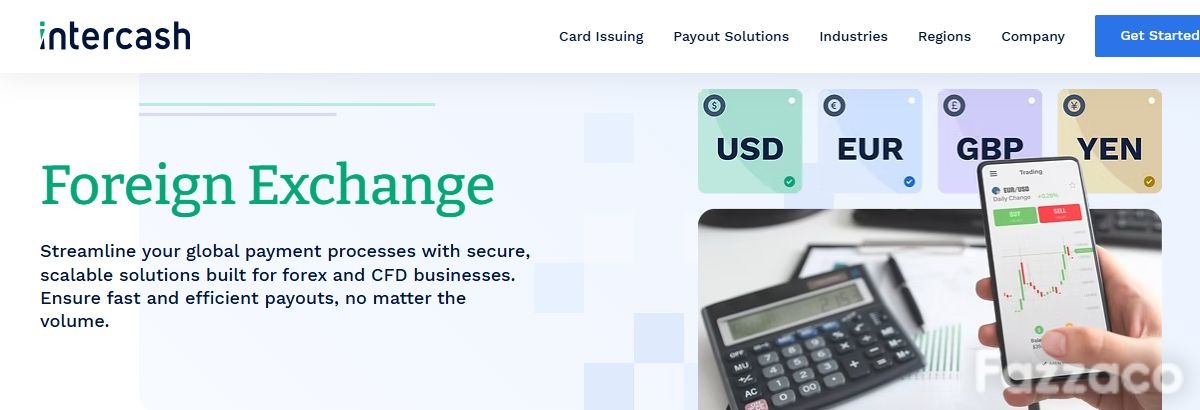
Image: Intercash.
Where card programmes fit in a brokerage
The company's current foreign-exchange page describes physical and virtual cards alongside bank transfers as potential payout methods. A card programme can give a recipient a payment instrument; a bank transfer delivers funds to an eligible account. Those routes involve different user journeys, operational dependencies and costs. Their availability depends on the issuing partner, customer location, currencies, product terms and regulatory assessment.
Adding a card does not change the brokerage's obligation to validate a withdrawal or automatically establish a right to spend in every market. The firm should determine whether the card belongs to the same verified customer, what activity is permitted, and how a customer accesses statements, disputes transactions or replaces a lost card.
Intercash presents the solution as configurable for forex and CFD businesses. Its materials describe branding and a centralised operating interface, but an individual firm's programme must be evaluated against the actual contract and approved configuration. Promotional claims about immediate execution should not be treated as a guaranteed settlement time.
The roles behind an issued card
Card programmes require several participants. An issuer is responsible for the payment instrument under the relevant arrangements; a network provides acceptance rules and connectivity; processors and programme managers support technology and operations. A brokerage sits alongside these participants as a business using the programme and remains responsible for its own customer relationship.
Intercash's website describes itself as a programme manager and BIN sponsor working with regulated issuers. Its footer says regulated payment services are provided by appropriately licensed electronic-money issuers or third-party providers, rather than directly by Intercash Limited. Buyers should identify the contracted legal entities and their responsibilities in each jurisdiction instead of assuming that a technology platform itself holds every required permission.
During procurement, ask who holds customer funds, who issues the instrument, who handles complaints, and which entity sends regulatory notices. Obtain current documentation for the relevant programme rather than relying on a generic description. Safeguarding arrangements, chargeback procedures and customer disclosures should be reviewed with the firm's own legal and compliance teams.
Physical and virtual cards
Intercash describes branded physical and virtual cards. A physical card requires manufacture and delivery, and creates workflows for activation, loss, replacement and expiry. A virtual card may suit online use without physical delivery, although its permitted use and issuance timeline depend on the programme. Neither format should be represented as universally available or risk-free.
Programme design is more than placing a logo on a card. The brokerage needs to agree whose name appears in the customer journey, what fees are shown, whether spending controls apply, and how limits or balances are communicated. Customer support must know when a question belongs with the brokerage and when it should be escalated to the issuer or programme operator.
For cross-border clients, the displayed card currency, transaction currency and settlement currency may differ. The contract should explain conversion rates, provider charges, ATM access where applicable, inactive-account rules and applicable restrictions. These details matter more to the end user than a broad claim of global acceptance.
From withdrawal request to payout
An effective payout process begins before a payment instruction is sent. The brokerage verifies the customer, checks the withdrawal against account and transaction controls, and approves or rejects the request. It then sends an instruction using the agreed interface and records the provider's response. A pending instruction should not be treated as a completed payout merely because it was submitted successfully.
Intercash also markets mass payments and bank-transfer capabilities. Batch processing may reduce repetitive manual work, but the operating team still needs visibility into individual failures. A useful test batch contains accepted, rejected and pending items, as well as a duplicated request. Staff should know which entries can safely be retried and which need investigation first.
Reconciliation connects the withdrawal request, client ledger, payment instruction and provider status. Agree a stable reference at each handoff and determine how adjustments, reversals and fees appear in reporting. If an API callback is delayed, the brokerage needs a documented way to check the authoritative status without creating a second payout.
Integration and operational controls
Intercash lists API integration, programme management and white-label programmes among its products. An API can support a more integrated customer journey, but the useful scope depends on the functions and permissions enabled for the specific programme. Request the current technical documentation and a test environment before defining the implementation schedule.
Engineers should test authentication, credential rotation, request identifiers, rate limits, event ordering and recovery from interrupted connections. Operations and finance should participate in testing as well: the records they use to answer a customer or reconcile a payout may differ from the messages seen by the integration team.
Access controls deserve separate attention. The person who can view a cardholder's status may not need authority to change a payout destination or release funds. Define approval thresholds, segregation of duties and an audit trail, then verify which controls are provided by the platform and which the brokerage must implement itself.
Compliance, support and commercial terms
The company describes compliance and security as parts of its programme process. These descriptions do not replace a firm's own due diligence. The brokerage should establish which partner performs identity checks, monitors payment activity and communicates with customers, and how exceptions move between organisations. Requirements vary by entity, jurisdiction, product and customer profile.
Customer support should cover declined transactions, lost cards, unauthorised use, delayed payouts and complaints. Agree service hours, escalation contacts, evidence requirements and expected response times in the contract. For a card dispute, identify the party responsible for intake and the separate party responsible for the network or issuer process.
A cost comparison should include programme setup, issuance, replacement, monthly charges, card transactions, payout fees and currency conversion where applicable. Ask about minimum commitments, available reporting and the cost of changes after launch. An advertised payment route is useful only if it is actually available to the firm's customers under its agreed terms.
| Assessment area | Questions to resolve |
|---|---|
| Programme structure | Issuer, licensed payment provider, customer terms and supported regions |
| Customer experience | Card format, currency, fees, delivery and support |
| Payout operations | Approval, transaction status, retries and reconciliation |
| Technology | API scope, authentication, access controls and testing |
| Governance | Due diligence, complaints, safeguarding and contractual responsibilities |
Evaluating Intercash in context
Intercash's combination of card programmes and payout infrastructure is relevant to a brokerage exploring how customers or partners receive funds across markets. The strongest evaluation follows a small set of representative transactions from approval through payment, customer notification, reconciliation and exception handling.
Before expanding a programme, the firm should confirm its eligible customer base, named provider responsibilities and actual service levels. This creates a clearer basis for comparing card and bank-transfer routes, and for deciding whether the proposed experience fits the brokerage's operational and compliance model.
 Subscribe Now