


Leverate: SiRiX, Broker CRM and MT4/MT5 Technology
Leverate supplies trading technology and operating tools for CFD brokers and proprietary trading firms. Its current offering connects the SiRiX white label trading platform with a client zone, CRM, Broker Portal, affiliate management and services around MetaTrader 4 and MetaTrader 5. For a business selecting a vendor, the useful question is how these components support its particular operating model: launching a branded platform, strengthening an existing MetaTrader operation, or administering trader challenges.
Fazzaco's Leverate company profile places the company in CRM, trading software, white label and risk management categories. Leverate's official website describes its role as a technology provider and states that it does not provide brokerage or investment services or hold client funds. This introduction focuses on that technology offering, using product information reviewed on 20 October 2026.
How Leverate's products fit a brokerage technology stack
A trading business needs several connected views of the same activity. Traders require an interface for orders and accounts; sales and support teams need client records; operations teams need account, transaction and exposure information. Leverate presents its platform and back office as an integrated environment serving those different users.
| Component | Published role | Business workflow |
|---|---|---|
| SiRiX | Branded trading platform with charts, order tools and social trading | Client order entry, position management and account access |
| Client Zone | Client account functions and connected services | Onboarding, funding requests and trader communication |
| CRM and Broker Portal | Client management, reporting, trading rules and operational oversight | Sales follow-up, support, risk review and administration |
| Prop CRM | Challenge configuration, trader tracking and retry workflows | Managing the evaluation and trader relationship lifecycle |
| MT4/MT5 ecosystem | Setup, hosting, integrations and ongoing administration | Operating infrastructure around the broker's MetaTrader license |
This separation helps define a project. A front-end replacement involves client experience and migration; a back-office project concentrates on records and operational responsibilities. A proposal should identify the selected modules and the systems that remain with the broker, even when the supplier describes the overall arrangement as turnkey.
SiRiX: a branded trading interface with TradingView charts
The SiRiX product page describes a white label platform for brokers and prop firms, with mobile, web and desktop access. Its published trading tools include TradingView chart integration, trading from charts, one-click order entry, price alerts and support for netting and hedging account approaches. Branding is part of the proposition, allowing a firm to present the platform under its own identity.
These features connect platform choice to the client journey. Chart-based trading and account presentation should be consistent with the instruments and trading conditions the business actually offers. A platform demonstration can follow one instrument from its chart through order submission, position changes and account history, so dealing and client-service teams see the same sequence.
Social trading is also described within SiRiX. The published material discusses following or copying trades and viewing strategy information. An implementation brief should specify the chosen allocation model, client permissions and reporting. A social interface is a distribution feature; its presence does not establish the performance of any strategy offered through it.
Client Zone and CRM: linking the trader experience to operations
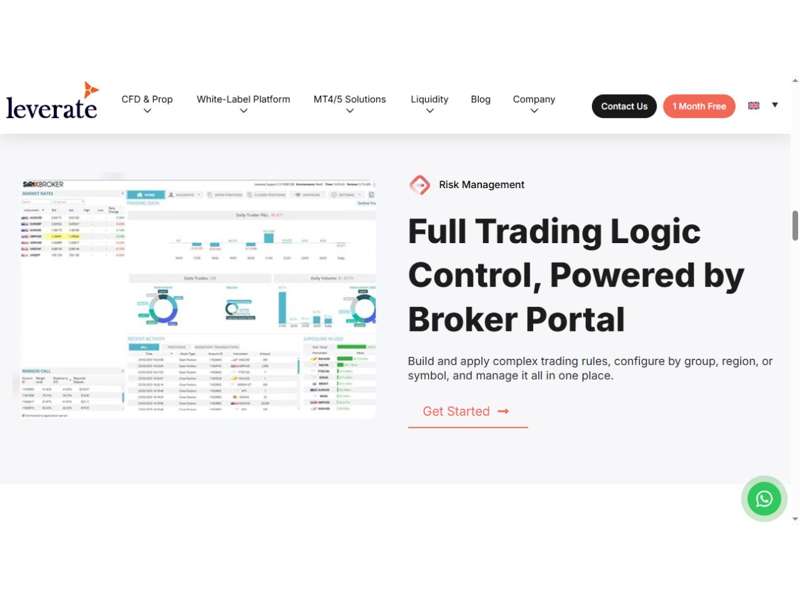
Leverate’s official Broker Portal demonstration, captured on 20 October 2026. The interface contains demonstration data and is not an independent performance test.
Leverate's back-office page describes native trading-platform integration, client histories, lead and activity tracking, communication tools, dashboards and reports. Sales, service and marketing teams have different needs, but all depend on accurate account and client information. The CRM is therefore relevant to the ongoing operating model as well as the initial launch.
The Client Zone is the trader-facing part of this relationship. Leverate describes account functions, onboarding and connections to verification and payment services. Its MetaTrader service page separately lists registration, KYC document upload, deposits and withdrawals, and account creation synchronized with MT4/MT5. The exact workflow depends on the selected platform and configured integrations.
For example, a funding request involves more than a button in the client area. The payment provider's transaction state, the back-office approval and the trading-account balance must be reconciled. Defining which system owns each record helps the broker manage pending requests, failed updates and customer enquiries without relying on parallel manual records.
Broker Portal, risk controls and partner management
The Broker Portal is presented as the operational control layer. Leverate describes trading-rule configuration by group, region or symbol, alongside reporting, real-time oversight and a virtual dealing desk. In its MetaTrader offering, the vendor also lists exposure breakdowns, net open position limits, group segmentation, routing choices and hedging triggers.
Those capabilities become useful through a consistent configuration process. A broker can map a client group to its trading conditions, execution route and exposure limits, then reconcile a test trade against the resulting report. Changes to a rule should have a clear owner and an agreed procedure for checking their effect on existing accounts.
Partner operations form another part of the back office. Leverate publishes a customizable, multi-tier IB and affiliate system with tracking, commission management, reporting and payout automation. The commercial agreement still needs precise definitions: which activity earns remuneration, when it becomes payable, and how corrections or disputed transactions affect the partner statement.
Prop CRM: managing challenges and trader lifecycle records
The Prop CRM page focuses on the requirements of firms running trader evaluations. It describes onboarding and KYC integrations, trader segmentation, behavior tracking, affiliate and referral flows, and synchronization of challenge plans with the Broker Portal. Its FAQ says challenge parameters, retry pricing, rules and payouts can be configured through that portal.
The same product page identifies Challenge Keeper status, retry behavior, purchase history, eligibility triggers and notifications for retry workflows. These are specific lifecycle records: a trader may purchase an evaluation, attempt it, become eligible for a retry and move into a different operating stage. A conventional sales pipeline alone does not describe all of those transitions.
A useful acceptance exercise follows one challenge through its defined stages and checks the records visible to support, risk and finance teams. The firm should establish which environment is simulated or live and how payout eligibility is determined. Software support for a workflow does not itself decide the firm's contractual obligations to participants.
MT4 and MT5 services: infrastructure around the broker's license
Leverate's MT4/MT5 ecosystem page explicitly describes a bring-your-own-license arrangement. The broker supplies its MetaTrader license, while Leverate provides the surrounding technology and operational environment. The page also offers MT5 license guidance as a separate service. Guidance and infrastructure support should therefore be distinguished from the actual granting of a platform license.
The published service scope includes primary, backup and access servers; symbol, routing and gateway configuration; hosting, monitoring and maintenance; CRM and client-portal integration; and payment connections. It also names staff training and support from platform administrators. This is relevant to a broker that wishes to retain MetaTrader while consolidating technical administration.
Migration planning should cover account identifiers, group settings, instrument definitions, historical records and the handover between internal and supplier teams. A controlled trial with a defined rollback procedure is more informative than a general launch-time promise. The target configuration, support responsibilities and service commitments belong in the implementation agreement.
Liquidity and payment connections within the operating model
The MetaTrader service page lists aggregated liquidity, FIX API or MT4/MT5 Gateway connectivity, and A-Book, B-Book or hybrid routing configurations. Leverate's wider product material also presents liquidity and data-feed connections as part of the platform ecosystem. This gives brokers several related technical components to evaluate, while keeping the commercial counterparty arrangement distinct from the software connection.
A complete deployment diagram should identify where pricing enters the system, how orders are routed and where exposure is recorded. Teams can then test a quote interruption, a rejected order and a connection recovery using the proposed configuration. These are practical evaluation scenarios, not a claim that this article has independently measured execution quality.
Payment integrations require similar clarity. The vendor describes connections to multiple payment providers, transaction processing, currency support and balance updates. The broker still needs to agree supported business models, settlement arrangements and exception handling with the relevant providers. Integration availability should be checked for the actual entity, market and service selected.
Public pricing: platform plans and the CRM add-on
On 20 October 2026, the monthly pricing view on Leverate's homepage and SiRiX page displayed Start-up Brokers at €1,690 per month and Professional Brokers at €2,990 per month, with a custom Premium tier. The displayed allocations were 1,000 real accounts and 250 active traders for Start-up, and 2,500 real accounts and 625 active traders for Professional.
The same comparison displayed CRM & Client Portal as an additional €2,390 per month for those two tiers. This distinction matters when comparing a platform quote with an operating-suite budget. The annual billing option and promotional messaging are separate from the monthly view cited here; buyers should confirm billing periods, included modules and applicable conditions in writing.
The proposal should also define what counts as a real account or active trader, the treatment of additional usage, and any integration or third-party charges. A menu item or feature label is not a substitute for a contracted scope. These public figures are a dated comparison point, not an all-inclusive quotation for every Leverate or MetaTrader deployment.
Where Leverate fits in B2B vendor selection
Leverate is relevant to businesses evaluating three connected paths: a SiRiX branded trading environment, an integrated CRM and Broker Portal, or managed infrastructure around an existing MetaTrader license. Prop firms have an additional reason to examine the challenge and retry lifecycle within Prop CRM. Selecting between these paths clarifies which features need detailed validation.
The strongest demonstration follows one complete business process: client registration, account creation, a funding event or challenge purchase, trading activity, an operational exception and the final report. Have the teams responsible for clients, dealing, risk and finance review the same records. That connects product capabilities with the work the business will perform each day.
Sources and verification: Leverate's official homepage, SiRiX, back-office, Prop CRM and MT4/MT5 ecosystem pages, together with the Fazzaco company directory, were reviewed on 20 October 2026. Product and pricing descriptions reflect those published materials. Deployment examples and acceptance questions are Fazzaco's editorial analysis.
 Subscribe Now

