


Listen to the Article: Estonia Is More FinTech-Savvy Than You Ever Know
People always have stereotypes about other countries they know little of. Financial industries , on the other hand, often defy such stereotypes because they are less influenced by national characteristics. Take Estonia, for example. When people think of this European country, they usually picture snowy places, a slow-paced life, saunas, and beautiful women.
However, what many might not realize is that Estonia is one of the most digitally advanced countries in the European Union. According to the digitalization data from Statista back in 2022, Estonia was in fact more digital than traditional European powerhouses like Germany, the UK, and France. For instance, global tech giants such as Skype and Wise were actually founded in Estonia.
Facts About Estonia You Might Not Know of
With only a population of 1.3 million, Estonia has produced more than a dozen global unicorn companies. Besides Skype (founded in 2005) and Wise (founded in 2015), other major companies originating from this country include Playtech (2007), Bolt (2018), Pipedrive (2020), Zego / ID.me / Gelato (2021), and Veriff and Glia (2022). This results in an impressive 7.7 unicorns per capita, compared to only 1.6 in the UK, a traditional fintech powerhouse.
Furthermore, according to "The State of European Tech 2022," Estonia had 1,452 startups by the end of that year. Although this number isn't high in absolute terms, for a country of their size, it occupies a significant niche within the EU's tech ecosystem. Per capita, Estonia has four times the average number of startups in Europe, earning it the title of Europe's startup capital.
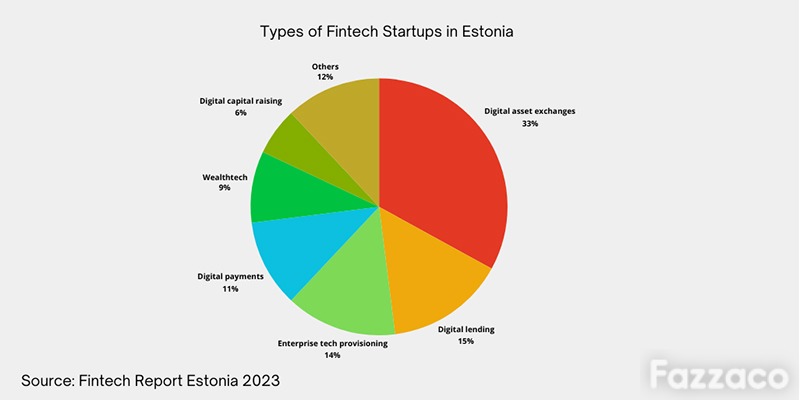
In the fintech sector specifically, data from the "Fintech Report Estonia 2023" shows that the country has 264 fintech startups, with the largest segment being digital asset exchanges, totaling 86 companies or 33% of the sector.
How Did Estonia Become the Capital for Startups and a Financial Hub?
First, looking at infrastructure, Estonia has a fully functional e-government, truly transforming Estonia into E-stonia. This allows startups, fintechs, and tech giants to easily handle business registration, compliance reporting, and tax matters with government officials.
As their society becomes increasingly digital, every citizen has an electronic ID and access to electronic signatures. This greatly facilitates the KYC process for financial institutions, reducing associated risks.
Historically, since becoming independent from the Soviet Union in the early 1990s, Estonia strengthened ties with Nordic countries like Sweden, Norway, and Finland. With Nordic support, the country successfully initiated economic transformation. Since the 1990s, all new banks were equipped with the latest fintech, enabling Estonia to shed the planned economy burdens of the Soviet era and start afresh, with a rejuvenated economy and financial sector.
Estonia's Influence on Forex Brokers
Estonia permits forex brokers to provide trading services, with licenses issued by the Estonian Financial Supervisory Authority (EFSA). Notable brokers operating in the country include Saxo, Fusion Markets, Pepperstone, Tickmill, and VT Markets.
According to current EFSA licensing requirements, the wait time after submitting the necessary application materials is typically around four months. Once brokers obtain an EFSA license, they are essentially granted a passport to operate throughout the EU. For large brokers like Interactive Brokers, many might not know that their core technology development center has been in Estonia for nearly 20 years, further underscoring Estonia's maturity in core financial infrastructure and platform development.
 Subscribe Now