


Low-Fee Trading Wave Hits Forex Brokerage - A Struggle for Survival or Win-Win Strategy?

Last October, Switzerland based retail FX brokerage group Dukascopy lowered its volume commission rates. That's only been two months since its Japan subsidiary reduced the transaction fee for MT4 trading accounts.
This April, FxPro made significant enhancements to their trading conditions, with spreads on all FX majors lowered by up to 20%.
In July, Admirals informed their clients of reducing spreads and minimum trading volumes, while expanding trading hours; and FXCM reduced spreads by as much as 54% on major currency pairs.
Key metrics show signs of sluggish growth for these brokerages
Last year, Dukascopy reported an annual income of CFH 21.1 million for trading activities, representing a 46.7% decrease compared to the CFH 39.6 million for 2020, even lower than the CFH 27.3 million for 2019 when the COVID-19 pandemic, which later caused great volatility in the currency market, had not broke out.
For the fiscal year 2021 FxPro reported a significant slowdown in its UK business. FxPro UK Limited generated a revenue of £900,365 for the period, which is down by 48% from more than £1.7 million generated in the previous fiscal.
Admirals' report on the first half of 2022 shows the group's number of trades went down 2% to 28.7 million comparing to the 29.2 million for the same period of 2021. For the first 6 months of 2020, the figure was 32.4 million. Additionally, number of active clients in the Group went down 17% to 33,493 clients compared to the first half of 2021.
Instead of seeking profit growth, FXCM is still trying to stop loss. In the first and second quarter of 2022, Global Brokerage Inc., the owner of FXCM, recorded a net loss of $12 million and $5.12 million respectively.
Obviously, the aforementioned brokers aren't and won't be the only forex brokerage players stuck between a need for growth and slowing sales, for although the forex market is immense, growing a successful business in it is never easy.
The market is growing, so is the number of players in it
The global forex trading market, estimated to be worth $2.409 quadrillion and with a daily average trading volume of $7.5 trillion, up from $6.6 trillion in 2019, is the largest and most liquid market on earth. However, retail forex trading only accounts for a mere 5.5% of the entire forex market globally, which means volume of trading that is done by individuals on a daily basis comes in at only $412.5 billion. The vast majority of the market share tend to be in the hands of financial institutions such as central and commercial banks, hedge funds, and money managers.
So how many forex brokers are out there sharing the small $412.5 billion pie? A report in 2016 recorded a total number of 1,231. This number only included the brokers who offer MetaTrader 4, and their sites were indexed by major search engines and can be retrieved using English key words. The real number, therefore, should be much higher.
As brokers open up shop almost on a daily basis - 20 were found via just a simple keyword search on Google for forex brokers founded in 2017, we believe it's not an overestimation to say the total number of forex brokers to date has grown to at least 1,500+.
A few big brokers enjoy a majority share of the market
Clearly, the $412.5 billion retail market will by no means be equally shared by all brokers. Just like in any other industry, a few large established brokerage firms swallow the most part while a large amount of their small competitors struggle to grab just a small slice of the market.
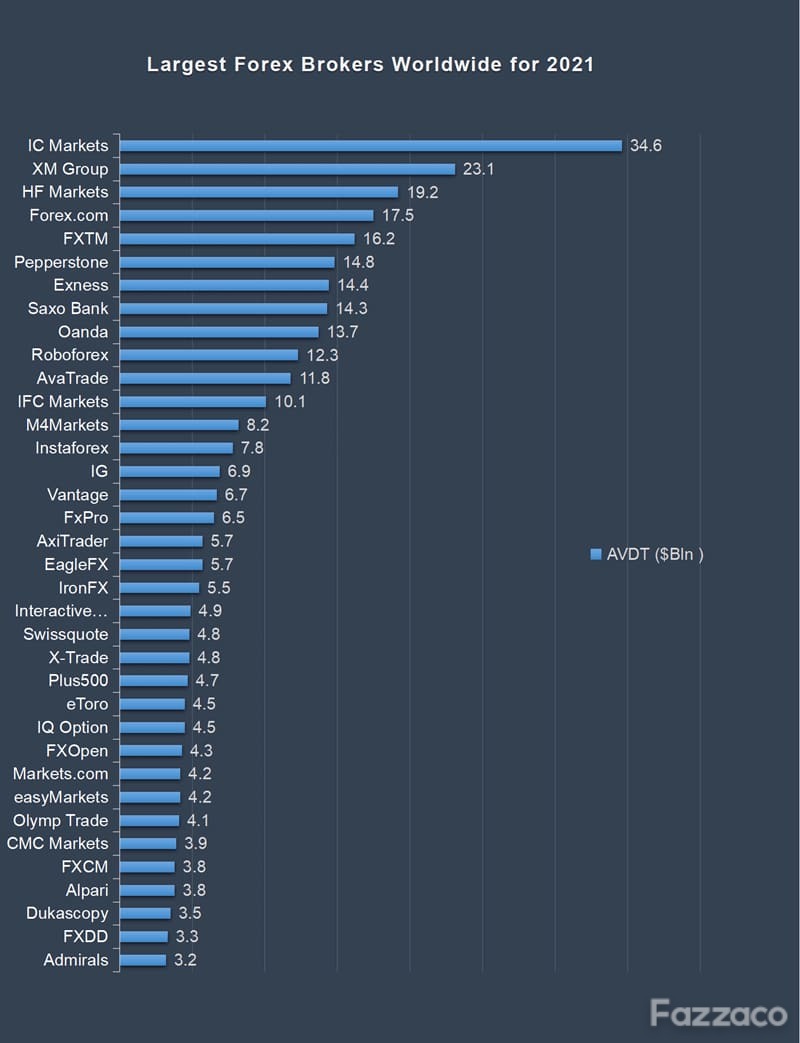
More specifically, the statistics released by Wealth & Value show that the 36 largest forex brokers in the world registered an average volume of daily transactions (AVDT) of $321.5 billion in total in 2021, representing 77.9% of the retail forex market.
Australian Broker IC Markets led the list with an AVDT of $34.6 billion, followed by XM Group and HF Markets with $23.1 billion and 19.2 billion respectively. Below is the ranking of the 36 biggest brokers by volume.
Is commission cut a struggle for survival or win-win strategy?
Does dropping trading commission means brokers are adopting a so called "small profits but quick turnover" business model to get themselves out of the current situation? Not exactly.
Actually, the Revenue streams for many brokers come from a variety of sources, among which brokerage fee possibly accounts for only a tiny part, while interest on clients' cash balances, on the contrary, constitute a large percentage.
New clients drawn by the incentive of paying lower commissions would bring some cash along, on which brokers will earn interest.
Take Interactive Brokers, which is known for low fees such as 0.08% commission per trade or as low as $0, as an example. Despite headwinds from a push to no-fee trading, the US electronic broker reported an adjusted revenue of $847 million in the third quarter of 2022, representing a 30% jump year-over-year. The upbeat results were driven by a strong interest revenue of $473 million, which is around 56% of the company's total adjusted revenue for the quarter.
Moreover, very significantly, Interactive Brokers has won 25,000 new accounts in September, with its active accounts increasing to 2.01 million, which is 31% above the previous year's figure of 1.49 million.
So the point is how many clients brokers can acquire/activate by cutting commissions and other fees for trading. As brokerages get a large number of additional trades by doing so, their revenues and profits will very possibly see a decent growth.
Subscribe to Fazzaco's newsletter now to get real-time access to latest news and in-depth analysis and opinion from Fazzaco. If you'd like to offer your unique opinions, sharing your industry insights with the mass audience of Fazzaco, please feel free to contact service@fazzaco.com.
 Subscribe Now