


Malaysia's November IB Rules Could Shake Up Brokers
Starting from November 1 2025, the Securities Commission Malaysia (SC) will bring into force a revised set of advertising guidelines for capital market products. The change is not mere housekeeping: it recasts responsibility for online promotion, treating independent social-media promoters—commonly known as "finfluencers"—as advertisers, and tightens licensed firms' accountability for third-party promotions. That places brokers who have long relied on IB networks and social distribution in a new regulatory squeeze.
Why IBs Sit at the Centre of This Storm?
On paper the new Guidelines reaffirm familiar principles—truthful, balanced and non-misleading advertising—but their bite comes from reworked definitions and shifted liability. "Voluntary advertisers" who promote capital market products on their own accord are now advertizers under the rules, and penalties for breaching the regime can be severe. This is not regulatory window-dressing; it brings social channels into a legally enforceable accountability framework.
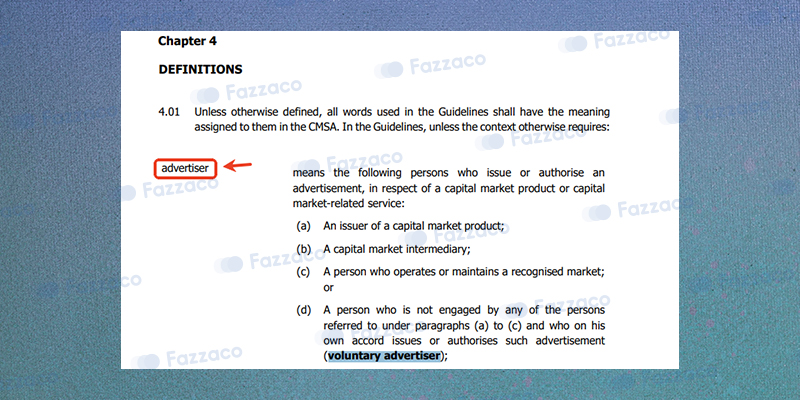
Chapter 4 "Definitions" of the SC's Guidelines
The IB model is fundamentally about distribution and customer acquisition; many IBs act as semi-autonomous conduits rather than tightly controlled marketing arms. By linking "who publishes" to "who is accountable," the new regime can make licensed firms answerable for the promotional conduct of IBs—even when those IBs are not formal agents. For brokers who outsourced client acquisition to local networks, the legal peril becomes systemic rather than isolated, forcing a rethink of contracts and oversight.
The Tug-of-War Between Enforcement and Market Reality
Statutes can look tougher than enforcement realities. The anonymous, multi-lingual and private-channel nature of many promotions—Telegram groups, Discord channels, voice notes—complicates detection and prosecution.
While the SC has strengthened the toolkit on paper, policing dispersed online promotion is operationally hard; the regulator appears to know this, offering stakeholder engagement and transition periods even as it tightens rules.
The Paradox: Will Higher Standards Mature the Market?
In the near term expect contraction: IBs pause, brokers tighten acceptance of local clients, and partnerships are re-negotiated. Promotional strategies will migrate toward educational, platform-demo framing and private channels to avoid overt calls to action. Over time the market may polarize:
Well-capitalized players that internalize compliance and client acquisition will consolidate;
while small operators dependent on opaque local networks will see their margin for manoeuvre shrink.
How enforcement plays out in the first test cases will shape the longer trajectory.
The immediate regulatory aim is investor protection, but the consequence is higher compliance costs and a raised bar for market entry. That need not be solely negative: over time, clearer accountability for promotions and tougher standards could wean the market off sensationalist, high-churn marketing and nudge players toward product quality and client education. The outcome depends on the balance between enforceability and engagement—rules need teeth, but also operational pragmatism.
Conclusion
The revision is a live test of how regulatory frameworks adapt to social distribution and influencer-driven finance. For brokers it is immediate pain and potential strategic gain: treat compliance as cost and you risk fines and reputational damage; embed it into distribution and product strategy and you may gain a durable competitive edge. The coming months—and the first enforcement cases—will tell whether this is a regulatory hiccup or the start of a structural shift.
 Subscribe Now