


Match-Trade Technologies: Match-Trader, CRM and Broker Infrastructure
Match-Trade Technologies builds the Match-Trader trading platform and a surrounding set of tools for brokerage and proprietary trading operations. Its offering connects the trading interface with account administration, CRM, partner management and execution infrastructure. For a brokerage choosing a new platform, the central question is how much of that operating environment it wants to source together and which existing systems it intends to retain.
The portfolio accommodates several starting points: a branded Match-Trader White Label, a server licence with broader administrative control, a proprietary front end using Match-Trader back-end technology, or selected services for an existing MetaTrader operation. Understanding those deployment paths makes the individual product capabilities easier to assess.
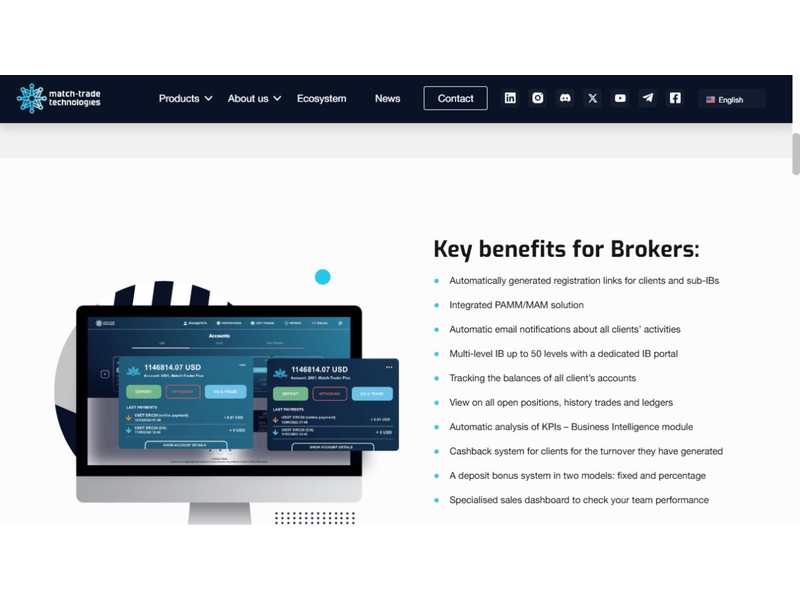
Client Office interface and brokerage account-management features. Source: Match-Trade Technologies.
How the Match-Trade product portfolio fits together
The company presents Match-Trader as its core trading technology, with surrounding applications serving distinct operational roles. A trading platform handles the trader's interaction with the market; the CRM organises the customer relationship; and a bridge manages connections and routing between a platform and liquidity providers. The following map separates those responsibilities.
| Product area | Primary role | Relevant business requirement |
|---|---|---|
| Match-Trader White Label | Branded trading application with connected client services | Launching a consistent client-facing brand experience |
| Match-Trader Server Licence | Platform administration, configuration and API access | Managing a more customised trading environment |
| Standalone back-end technology | Trading infrastructure behind a custom interface | Developing a differentiated client application |
| Forex CRM and Client Office | Customer, account, payment and IB workflows | Connecting sales, client service and operations |
| Prop Trading CRM | Challenges, evaluation rules and trader progression | Operating a structured prop programme |
| Social Trading application | Signal-provider discovery and trade copying | Adding managed copying workflows to the client journey |
| MT4/MT5 Bridge and hosting | Liquidity connectivity and platform infrastructure services | Supporting an existing MetaTrader environment |
These are possible components of a solution. The commercial proposal should specify the chosen modules, integrations and responsibilities so that the operating model is clear from the outset.
White Label and server licences serve different operating models
The Match-Trader White Label page describes an application branded with the broker's name and logo, connected to Client Office and CRM through single sign-on. It also describes configurable instruments, markups, commissions and leverage. For a new business, the practical attraction is the ability to shape a customer experience around an established platform rather than coordinate the development of each interface separately.
The Server Licence offers a deeper administrative layer. Match-Trade lists an Admin application for configuring instruments, managers, data feeds and liquidity-provider connections, alongside Manager functions for account activity and reporting. The company also describes control over the client database and a hybrid arrangement for forex and prop operations on one server.
The choice therefore concerns operational ownership as well as branding. A brokerage with a dedicated platform team may need direct configuration and integration capabilities. A smaller operation may prefer a deployment with more setup work handled alongside the provider. In either case, administrators, dealing staff and client support should work from an agreed permissions structure before the first client account is activated.
The trader experience spans charts, devices and account access
Match-Trader uses a web-based interface designed to adapt to different screen sizes. The White Label materials describe synchronised settings across devices and distribution through a broker's website or app stores. This gives a broker multiple ways to deliver its branded application while maintaining a recognisable account experience.
The current platform page lists built-in TradingView charts alongside its own charts, a multi-chart workspace, chart-based adjustment of stop-loss and take-profit levels, and a calculator showing position nominal value in the account currency. Guest mode lets a visitor explore the interface before opening an account. The page also describes Google sign-in and an in-platform live-chat system with ticketing.
For product teams, these features connect acquisition with everyday use. A useful demonstration follows a prospective client from the initial platform preview to account creation, chart analysis, order management and a support enquiry. That sequence reveals how the interface supports a complete relationship, including the moments when the customer needs help or changes device.
Forex CRM connects the client journey with internal teams
Match-Trade's Client Office and Forex CRM bring lead management, onboarding, accounts and introducing-broker activity into the same operational environment. Traders can open accounts, request withdrawals and transfer funds between their accounts, while broker staff can inspect balances, transactions and open positions. The vendor lists integration with Match-Trader, MT4 and MT5.
The current CRM page adds role and permission management, KPI dashboards, cash-flow analysis and a multilevel IB structure. Its dedicated partner environment supports referral tracking and commission administration. These functions are relevant when a brokerage needs sales, finance and partner teams to work with connected records while retaining different access rights.
Payment connectivity is another part of the client journey. The product materials identify Match2Pay integration and connections to payment providers. The useful operational question is how a payment event becomes a correctly attributed account transaction and how an exception reaches the responsible employee. A demonstration should show the customer request, internal action, resulting balance and reporting entry together.
This makes the CRM particularly relevant to brokers coordinating several acquisition channels. A referral, a lead and a trading account represent different stages of the same relationship; connecting them supports clearer ownership of follow-up work and a more coherent view of partner performance.
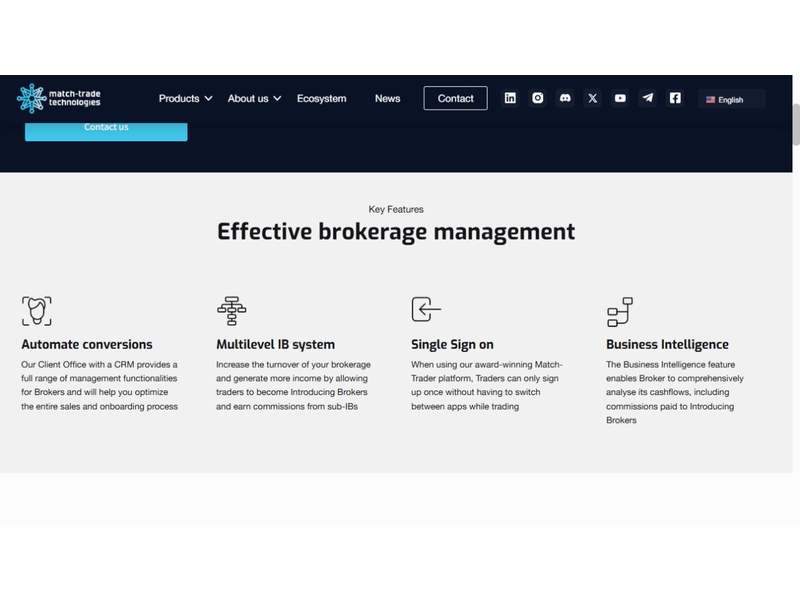
CRM features for onboarding, IB management, single sign-on and business intelligence. Source: Match-Trade Technologies.
Prop Trading CRM organises challenges and progression
The dedicated Prop Trading CRM addresses a different workflow from conventional brokerage sales. Its published functions cover challenge creation, evaluation rules, trader progression, competitions, referral programmes and payouts. Match-Trade describes a unified operational environment supporting Match-Trader, MetaTrader 5 or a combination of both.
Challenge status dashboards and configurable trading restrictions give the operator tools for following participants through successive stages. The product page also specifies phase-level withdrawal eligibility for funded accounts. That distinction matters because completing an evaluation, moving to another phase and becoming eligible for a payout are separate operational events.
A prop firm's implementation should translate its programme design into explicit account states. For example, the team can demonstrate a participant entering a challenge, progressing under the configured rules, receiving an updated dashboard and reaching the relevant payout workflow. The objective is consistent handling across the trader interface and the administration team.
The broader prop platform offering includes account monitoring, transaction-history reporting and branded web and mobile access. Together, the platform and CRM support both the trading environment and the business processes surrounding participation.
Social Trading adds copying within the platform journey
Match-Trade's Social Trading application is integrated with Match-Trader and Client Office. The company describes a leaderboard with signal-provider statistics, settings for the amount allocated to following a provider, and position identification that distinguishes copied activity from a client's own trades. Its administration application supports management and incentive fees.
The published controls also include a maximum-loss setting intended to trigger position closure. For an operator, these capabilities place discovery, allocation and account monitoring close to the trading interface. A customer can review a provider's statistics and manage a copying relationship without repeatedly moving between unrelated applications.
The implementation detail is the lifecycle of that relationship: starting to follow, changing an allocation, stopping a subscription and identifying the resulting positions. Demonstrating those transitions gives client-service staff a concrete basis for explaining the product. Performance displays and copying controls should be presented as tools for managing activity, without turning historical results into promises about future outcomes.
Bridge and hosting services support MetaTrader operations
Match-Trade also supplies an MT4/MT5 Bridge with a risk-management system. Its product description covers aggregation of multiple price streams, configurable account- and group-level risk settings, and a hedge monitor comparing exposure with liquidity-provider accounts. The web-based Bridge Manager includes controls for groups, clients and data feeds.
The bridge's reporting module records processed trades, giving dealing teams another view of routing and execution activity. This is a separate layer from the trading screen: its relevance lies in how the brokerage connects its chosen liquidity relationships to its platform configuration.
For infrastructure, the MT4/MT5 hosting service includes server installation, instrument and group configuration, performance monitoring and notifications. The company also lists failover servers in separate data centres and DDoS protection among the available infrastructure capabilities.
These services give an established MetaTrader operator a way to engage Match-Trade without making a new trading interface the centre of the project. The operating agreement should identify who manages platform configuration, connectivity changes and incident escalation. A clear division of responsibilities helps the brokerage coordinate its own staff with the technology and liquidity providers involved.
APIs and back-end technology enable a tailored architecture
The Server Licence materials list Manager, Admin, Backoffice, platform, Candle, WebSocket and FIX APIs. Those interfaces serve different purposes, from administrative integration to market-data access and trading connectivity. A brokerage can therefore scope integration around the information and actions its existing systems require.
Match-Trader is also offered as standalone back-end technology for brokers and prop firms developing their own front end. This creates a further deployment path: the customer-facing application can reflect the firm's own design while connecting to the vendor's trading infrastructure. The back-end product page also describes integration with the TradingView interface.
For a business with an established CRM or proprietary customer portal, this architecture makes interface planning central to the project. Account identifiers, authentication, transaction events and reporting data need consistent treatment across applications. An integration plan should assign a system of record for each data type and define how updates reach the other systems.
Turning the product selection into an operating platform
Match-Trade's relevance to a broker or prop firm depends on the combination it needs. A new brokerage may prioritise the branded platform and connected Client Office. An established operator may concentrate on server administration and external-system integration. A prop firm may begin with challenge management and participant progression, while a MetaTrader business may focus on bridge connectivity and hosting.
A useful implementation plan follows one complete business journey before expanding the scope. It should connect account creation, platform access, the relevant payment or challenge event, trading activity and the resulting operational report. The same sample records should be visible to the teams that will service them after launch.
That approach turns a broad product catalogue into a defined operating environment. Match-Trader supplies the central platform, while the selected CRM, copying, connectivity and infrastructure components determine how the firm's people and systems work around it.
 Subscribe Now