


Mobile Technology — the Key to White Label Success in a Mobile Era
The mobile application market is booming drastically these years. The number of smartphone users has exceeded 3.2 billion across the world, and as early as 2019, downloads of apps from Google Play have surpassed 21.3 billion, according to the statistics of Statista. In the forex industry, the mobile trend has started to thrive as well.
Today, a lot more investors show a preference for mobile trading, which brings much convenience and flexibility, as they will not be confined to a traditional trading terminal sitting on a chair for a long time. This has driven on-demand legacy brokers to switch to the mobile terminal. And naturally, the white label providers, who would always focus on brokers' needs, also begin to develop mobile capabilities.
Fazzaco has conducted a survey on 9 eminent forex White Label providers to see on which terminals they offer services based on the information released in their websites.
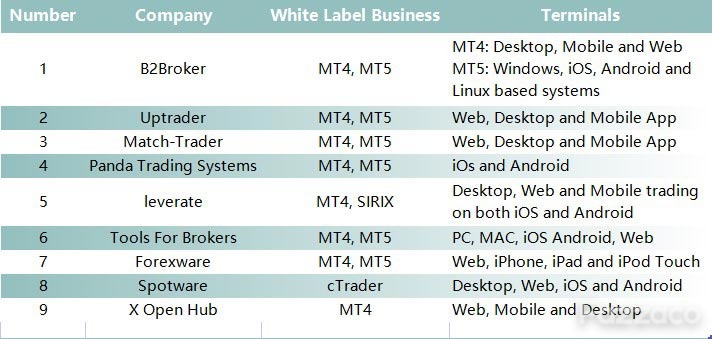
As seen in the chart, all the 9 vendors provide White Label services on mobile devices.
Take B2Broker, the leader in offering liquidity and technology solutions for the FX industry, as an example, its MT4 White Label solutions are available on desktop, mobile and web terminals, and the MT5 White Label services are provided on Windows, iOS, Android and Linux based systems.
As for X Open Hub, which delivers superior, open trading technology to financial institutions and retail brokerage firms around the world, it only offers MT4 White Label, and the solutions are provided on Web, mobile and desktop.
Spotware's cTrader, one of the most popular trading platforms favored by both brokers and traders, second only to MT4 and MT5, is also available on desktop, Web, iOS and Android.
People are getting increasingly used to mobile devices featuring safety, cost-efficiency and convenience with the development of mobile technology.
Let’s take a deep look at the fast-growing mobile industry in Southeast Asia. The region is at the forefront of fintech revolution. In Q1 2021 alone, smartphone shipments surged by 12% YoY in Indonesia, Thailand, Vietnam, and the Philippines, according to Counterpoint Technology Market Research. In Malaysia, 48% of people prefer to explore smarter technologies like e-wallets to make payments and billing much easier, and that number is 45% in Singapore, 40% in Indonesia, and 39% in Thailand, the global E-wallet service provider STICPAY reported.
In terms of offering e-wallet services, the technology firms are disrupting the traditional banks, S&P Global Market Intelligence, a data report and global research platform, commented. In Indonesia, banks have been overwhelmed by nonbanks (financial institutions that are not considered full-scale banks because they do not offer both lending and depositing services), which have become the major payment service providers. Also, the trend is arising in the Philippines. And earlier in 2019 in Thiland, nonbanks have already accounted for 72% of e-money payments value.
Last year, Visa has conducted a survey in Singapore, disclosing that 66% of consumers were forming a cashless habit, preferring to pay via mobile apps over cash. 78% said they intended to stick with digital payment methods instead of reverting back to cash even when the pandemic faded away.
In the 21st century, digitalization is reshaping the whole world and human activities in all aspects.
The wide penetration of mobile devices indicates that clients are getting more accustomed to a digital life. Thus, in the White Label sector, offering mobile trading service is an inevitable trend. More and more brokers are seeking to select fintechs to assist them with building a mobile terminal to meet the needs, which in return forces fintechs to switch to develop mobile technologies.
Mobile technology springs up to facilitate people’s life, which in the meantime creates massive opportunities for businesses to grow. And forex White Label vendors, which provide out-of-box solutions with the start-ups to enable them to start brokerage business much faster and strategically, share the same concept of bringing convenience for others.
Moreover, it is likely that mobile may soon be the dominant way for brokers to communicate with their customers to maintain better relationshiops. Retaining customers to win a place in the fierce forex industry is a tough thing, both White Label providers and fintechs must adopt the change, take mobile transformation into account, and implement the strategy as soon as possible, to avoid the risks of lagging behind.
Various companies have been phased out by unpredictable and unstable situations. Only those that are keeping up with the trend and innovations are able to live through challenges and even become stronger.
 Subscribe Now