


How payabl. Merchants Reconcile Card Sales to a Bank Credit
A merchant records €10,000 in card payments and finds a €9,255 credit on its bank statement. Where did the other €745 go? The answer matters to a finance team because a refund, a processing fee and money held in reserve have different consequences. payabl., a payments provider that offers merchant acquiring, gives its customers several ways to follow the money. Its payabl.one platform brings payments and business account activity into one workspace. Its reporting tools let merchants examine the individual transactions behind a settlement.
The two amounts above come from a hypothetical settlement. Following it from the original card charge to the bank credit shows what each record can establish and where a finance team still needs its own ledger or merchant agreement.
Start with the amount the merchant captured
Suppose a customer sees a €200 hold on a card. In the two-step flow described by payabl., pre-authorisation reserves that amount against the customer's available funds. The merchant then requests capture to complete the charge. A merchant using the provider's combined authorisation operation handles both steps in one request. The distinction matters when an order is cancelled between the two steps. An eligible reversal releases an uncaptured hold, so the merchant has no €200 sale to include in its settlement calculation.
For a finance team, the most useful question about that €200 is what happened to the original payment. The gateway assigns a transaction ID, and the merchant can supply its own order reference. Keeping both gives customer support a way to start with an order and finance a way to locate the corresponding gateway record. If a customer retries a failed payment, one order can generate more than one attempt. Counting every attempt against that order would overstate the amount collected.
Two currency filters answer different questions
Consider a merchant that charges one customer in pounds and another in euros, and receives both settlements in euros. To investigate what the first customer paid, the natural starting point is the original sterling transaction. To reconcile the bank's euro credit, the starting point is the group of payments settled in euros. A report filtered only for transactions originally in euros would omit the sterling sale even though it contributed to the same euro balance.
payabl.'s transaction-level settlement export supports both choices. Its currency filter selects the transaction currency and settlement_currency selects the settlement currency. A finance analyst can narrow the reporting period to the settlement under review and use the financial merchant ID (MID) or merchant account name to isolate the relevant business. The documentation also calls for an entity selection when a reporting user has access to more than one entity.
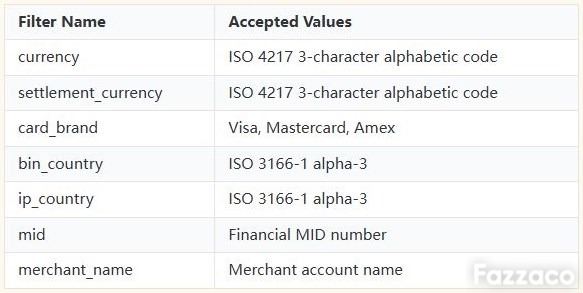
The payabl. reporting guide lists transaction currency and settlement currency as separate filters.
That scope belongs with the figures. If two shops share a brand but receive settlements under different merchant IDs, matching a single bank credit against both shops' sales can produce a discrepancy even when every payment was processed correctly. For a cross-currency sale, the merchant also needs the converted amount used for that settlement. Applying the exchange rate visible on the day someone investigates can introduce a second difference.
How €10,000 becomes a €9,255 bank credit
Assume that €10,000 of captured sales falls into one euro settlement. In this illustration the same settlement includes €400 in refunds and €125 in fees. A further €300 moves into a merchant reserve, while €80 held from an earlier period is released. With no other entries, the expected credit is €9,255. These amounts illustrate the arithmetic. Each merchant's agreement and statement determine which items apply.
Calling the €745 difference a processing cost would give the business a misleading view of its margins. The fee in this example is €125. The refunds return €400 to customers. The two reserve movements increase the amount still held by €220. That last figure belongs in the reserve reconciliation too. If the reserve opened at €1,000, the merchant should be able to trace a closing balance of €1,220 under the same assumptions.
payabl. describes this distinction in its services for travel merchants, whose customers can pay well before a trip takes place. Its reporting lets those merchants review daily settlements, outstanding settlement amounts and reserves. A date on a daily report tells the reader which settlement to examine. The bank's booking date establishes when the receiving account recorded the credit. A reporting feature alone establishes neither a universal payout timetable nor the reserve conditions a particular merchant has agreed.
Choose the report that can explain the difference
payabl. documents two downloads for finance teams. One returns a ZIP archive of PDF statements for a period of up to one month per request. That gives a controller a dated set of records to retain for the close. The other returns settlement detail as a CSV at transaction level. An analyst investigating one missing sterling payment can use the narrower export to check the merchant and currency filters before searching a month's worth of activity.
A sensible final check runs in both directions. From the bank credit, identify the merchant, currency and settlement period, then trace the components that produce the net amount. From a disputed order, follow its reference to the gateway transaction and check whether it was captured, refunded or left as an uncaptured hold. In the €9,255 example, the reconciliation is complete when the bank credit, the €125 fee and the €1,220 closing reserve can each be explained from the records that support them.
 Subscribe Now