


PLUGIT: YOONIT CRM, Dynamic Margin and Broker Operations Software
PLUGIT develops brokerage operations software around YOONIT, a modular suite spanning Forex CRM, Dynamic Margin, IB and affiliate management, MAM/PAMM, Bonus Automation and Copy Trade. Its proposition connects the administrative work behind a trading business: acquiring clients, opening accounts, managing partner compensation, applying trading conditions and administering money-manager relationships.
For a broker, these functions meet in the same client lifecycle. A referred client may enter through an IB campaign, complete onboarding, receive a promotional credit and trade under a particular margin profile. YOONIT brings tools for these connected processes into one ecosystem, while allowing firms to license selected modules. That makes PLUGIT relevant both to businesses assembling an operating stack and to established brokers adding a specific capability.
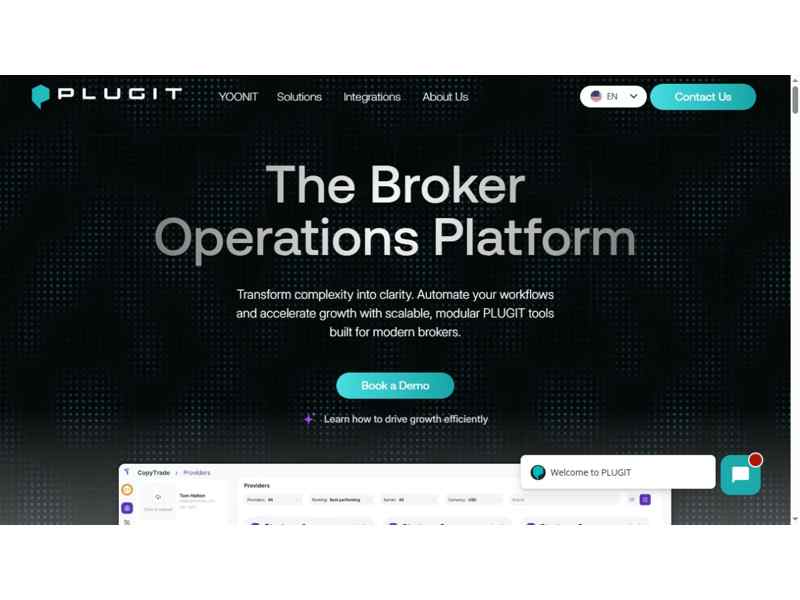
PLUGIT official website: the broker operations platform.
YOONIT connects brokerage workflows through modular software
PLUGIT presents YOONIT as a broker-specific operations platform, rather than a general-purpose CRM adapted to financial services. The suite combines a centralized operational view with individual products for client administration, trading-related controls and commercial programs. Its homepage also describes cloud hosting on Microsoft Azure and connections to external verification, payment and communication services.
The modular approach gives procurement teams a practical way to define scope. A broker replacing its CRM can evaluate the wider suite as part of that project; a firm retaining an existing client-management system can focus discussion on a particular module and its integration requirements. These are different implementation paths. Licensing, data migration, responsibilities and the connection to existing systems should therefore be established for the actual deployment.
| Module | Published capabilities | Operational connection |
|---|---|---|
| Forex CRM | Lead tracking, onboarding, documents, workflows and branded client portal | Sales, support and client administration |
| Dynamic Margin | Margin tiers, account and instrument rules, scheduled session profiles | Dealing and risk policy implementation |
| IB & Affiliate Management | Partner hierarchies, commission models, reporting and payouts | Referral activity and partner accounting |
| MAM/PAMM | Strategy allocation, manager portal, fee calculation and reports | Money-manager and investor-account administration |
| Bonus Automation | Campaign eligibility, priorities, reward triggers and reversals | Promotions and account-credit administration |
| Copy Trade | Strategy replication within the suite | A separate product discussion for copying workflows |
Forex CRM organizes onboarding and ongoing client service
YOONIT CRM covers the progression from a lead to a funded account and ongoing client activity. PLUGIT describes real-time lead tracking, automated follow-ups, notifications and assignments. Teams can configure access and workflows around their organizational structure, making ownership of an application or support task more explicit across departments and time zones.
Onboarding capabilities include integrated KYC, document management, approval workflows and audit trails. The branded web portal lets clients manage accounts, documents, deposits, withdrawals and trading activity. This connects the staff-facing administration layer with the interface through which clients submit information and requests. KYC tooling supports a broker's process; the applicable checks and approval decisions remain part of that broker's operating responsibilities.
PLUGIT also describes dashboards and reporting across sales, support and marketing, together with an open API framework and connections to the other YOONIT modules. In an implementation, a useful demonstration follows one client through registration, document review, account creation and a funding request. It should show both the client's view and the staff records, including which team can approve, amend or escalate each step.
Dynamic Margin translates dealing policies into configurable rules
Dynamic Margin addresses how leverage and margin requirements are applied across accounts, instruments and trading periods. The product supports tiering by notional value, lots or account equity, with customized profiles per symbol, account or both. Its feature list also includes mapping by account, symbol, group and country, alongside cross-server visibility and a dashboard for multiple servers and white labels.
Scheduled session profiles are a particularly concrete part of the offer. A dealing team can define a period with different margin rules and arrange a return to the normal profile afterward. The product page describes changes without server restarts and coverage across FX, CFDs, indices, futures and other asset classes. These are vendor-described capabilities; they do not establish a measured performance result for every broker configuration.
The operational detail is the interaction between rules. A broker may need an equity-based tier for one client group, an instrument-specific condition and a temporary event profile at the same time. A demonstration should expose which rule takes priority and what the resulting requirement looks like on the trading account. Clear rules and a controlled change process help the dealing desk connect its policy to the conditions clients actually receive.
IB and affiliate management links referrals to compensation
The partner-management module combines multi-level IB structures with configurable commission schemes. PLUGIT describes payouts based on trade volume or action-based logic, with conditions that can be assigned to selected assets or instruments. A dedicated partner portal provides performance information, while reporting and portfolio analysis give the broker a view of referral activity across its network.
Published tools include automated payouts, an open API for data synchronization, marketing campaigns and loyalty incentives. The module connects with YOONIT CRM to track referred leads and with Bonus Automation for incentives. PLUGIT also describes time-stamped activity logs and commission reports. These records matter when a partner asks how an amount was calculated or why a client belongs to a particular referral chain.
For a business with several partner tiers, configuration should start with an actual compensation example: a client referred through a sub-IB, an eligible trade and the amounts assigned to each level. Following that example into reporting and payment creates a clearer implementation specification than a general request for multi-tier support. It also separates commercial agreement terms from the software rules used to administer them.
MAM/PAMM supports strategy and money-manager administration
PLUGIT's MAM/PAMM solution centers on managing money managers, strategies, allocations and related fees. Brokers can establish manager profiles, define permissions and provide a dedicated portal. Each strategy has a master trading account and an allocation method; the published options include lot size, equity ratio and custom percentage. Reports cover trade allocations, performance-related earnings and financial transactions.
The product describes configurable fee schedules, automated performance-fee calculations and payment, plus registration and management fee structures. It also provides rules for investor withdrawals and account closures. These details place the module beyond the act of distributing an order: it also administers the relationship between a strategy, participating accounts and the money manager's compensation.
A representative test should include an investor joining, trading activity, a fee calculation and a withdrawal or closure. Timing matters because account participation and strategy results can change within a fee period. The product's public FAQ lists cTrader, MetaQuotes MT4 and MT5 as integrated platforms; the exact module and server combination should form part of the deployment scope. Software allocation and reporting do not by themselves determine investment suitability or a manager's authorization.
Bonus Automation manages campaign conditions and account events
Bonus Automation provides rules for promotions rather than requiring staff to apply every reward manually. Published campaign types include welcome and recurring bonuses, credit bonuses and cashback. Eligibility can be segmented by account type, country of residence, referral source and trading group, with triggers such as a deposit or executed trade.
The interaction between campaigns receives specific attention. PLUGIT describes campaign ranking and priority, together with an option to mark offers as exclusive. Its reversal logic can adjust a bonus after expiry, a withdrawal or another change in eligibility, including a proportional revocation based on withdrawal value. The product also lets brokers define the portion of a credit bonus usable against trading profit and loss on open positions.
These controls connect marketing promises to account administration. A promotion needs a defined audience, an activation event and a clear treatment of later account changes. For brokers considering the module, those conditions should be tested together with CRM records and client communication. Availability of a software feature does not make a particular promotion permissible in every market; the broker must determine which campaigns it can offer.
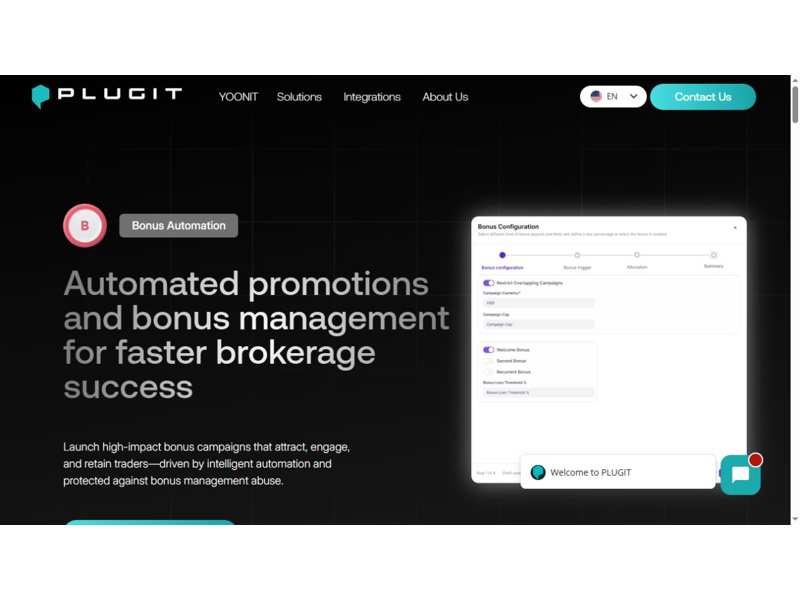
PLUGIT official website: Bonus Automation product page.
Integrations determine how the suite fits an existing stack
PLUGIT groups its integrations into payment service providers, trading platforms, market data, KYC and live chat. Its CRM materials describe an open API framework, while the homepage refers to verification and communication tools alongside payments. This reflects an operating environment in which the broker's client records must interact with several specialist systems.
A connection list is the starting point for technical scoping. The useful questions concern which data moves, which event triggers a change and which application owns the definitive record. A funding request, for example, involves more than a portal screen: the broker needs a reliable relationship between the payment outcome, account record and the team's reconciliation process. Likewise, partner commissions depend on the agreed trading data and calculation rules.
For a phased rollout, the first scope can be one complete workflow rather than every module at once. Agreeing access roles, data mapping, exception handling and support ownership for that workflow makes later additions more manageable. PLUGIT's value to a B2B buyer lies in how its connected modules administer the firm's actual operations, with CRM, partner economics, trading controls and managed-account processes configured to work together.
 Subscribe Now

