


PrimeXM XCore: Liquidity Aggregation and Broker Infrastructure
PrimeXM supplies the software and infrastructure that financial institutions use to connect trading platforms, organize liquidity and manage order flow. Its central product, XCore, combines aggregation, execution routing, exposure controls, monitoring and reporting. The wider offering adds hosting and network services, allowing a broker to consider the trading engine and the environment in which it runs as parts of the same operating design.
For a B2B buyer, the important questions are specific: how does a price reach a client, which rules route an order, where is exposure measured, and what evidence explains an execution? This profile examines those questions using PrimeXM's official product and pricing pages, checked on September 23, 2026. Product descriptions are attributed to the supplier; the workflow examples and evaluation framework are Fazzaco's editorial analysis.

What is PrimeXM?
PrimeXM's company page states that the business was established in 2010 and develops trading technology and hosting solutions for financial institutions. The Fazzaco company directory lists PrimeXM under Forex Bridge Provider, Forex Network Solution and Forex White Label Provider. This article focuses on its role as a technology supplier to institutions.
The product portfolio is best understood through three connected layers. XCore handles trading connectivity and order management. Hosting supplies the computing environment for the engine and related applications. Network services connect that environment to counterparties, platforms and other infrastructure. Institutions can evaluate the combination around an existing business rather than assuming that every component must be replaced at once.
PrimeXM's technology stack at a glance
| Component | Published function | Business relevance |
|---|---|---|
| XCore | Liquidity aggregation, routing, risk controls and reporting | Central organization of pricing and trade flow |
| MT4 Bridge and MT5 Gateway | Connect MetaTrader servers to XCore | Retain a trading front end while connecting execution and reporting |
| Web Trader | Trading interface with market depth and position views | Provide a configurable interface for professional and institutional users |
| MT Analytics | Trade reports, positions, exposure and client analysis | Review activity across MetaTrader groups and accounts |
| Hosting | Bare metal and enterprise cloud services | Place trading applications in a defined infrastructure environment |
| Network services | Connectivity between infrastructure and trading participants | Plan communication paths and operational continuity |
These components serve different responsibilities. An execution engine determines how an order proceeds; an analytics view helps explain the resulting activity; hosting determines where the applications run. Procurement becomes more precise when each requirement is assigned to the relevant layer and a named owner within the institution.
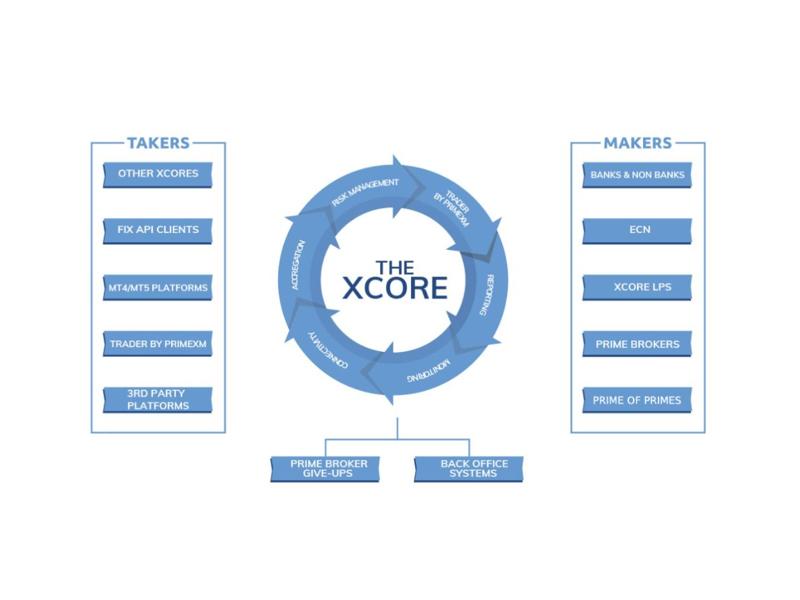
XCore liquidity aggregation: from price streams to liquidity pools
XCore supports multiple asset classes and interfaces including FIX API, MT4/MT5 and PrimeXM's Web Trading UI. The official aggregation documentation describes multi-tier best bid/offer aggregation, consolidated market depth and configurable liquidity pools by symbol and time frame. It also describes sweeping available liquidity across the book.
Aggregation gives a broker a common place to organize incoming prices. A pool can represent a particular instrument offering or client service, with the relevant liquidity sources and configuration attached to it. Different pools can then support different business requirements without forcing every client group into one undifferentiated stream.
For example, a broker serving smaller retail orders and larger institutional orders may want different liquidity arrangements for the same symbol. The implementation discussion can examine the depth available to each group, how symbols map between providers, and which pool feeds each downstream connection. This is an illustrative operating scenario, not a statement about a particular PrimeXM client's configuration.
Connectivity and liquidity access also have separate commercial meanings. A supported technical interface establishes a route to a provider; the institution still needs the applicable counterparty relationship and trading terms. A useful vendor discussion therefore maps both the technical connection and the business agreement that makes that connection usable.
Smart order routing and configurable pricing
PrimeXM describes XCore routing rules that can vary by client, symbol, order type, trade size and target liquidity provider. Its published functionality also includes markup profiles configured by symbol and time frame. These controls allow the institution to connect its service design with the execution paths and price presentation used for different flows.
A routing rule is most useful when the dealing and technology teams can explain its trigger and result. An evaluation can follow a small order and a larger order through the same instrument, showing which rule is selected and where each order is sent. A second case can examine partial fills and the handling of the remaining quantity. Those cases connect the configuration screen with observable execution records.
The same discipline applies to pricing. A team should be able to distinguish an upstream quote, an aggregated price and a downstream price after the relevant markup. Recording the symbol, timestamp and profile used at each stage makes the eventual client price easier to explain. The result is a clearer operational model for reviewing pricing changes and investigating individual trades.
Risk controls: internalization, exposure and overflow
On its solutions page, PrimeXM describes support for A-book, B-book and custom execution models, with changes applied in real time. Published controls include global, symbol, currency and time-frame exposure limits, client-flow netting, manual risk offsets and automatic overflow of risk volume to external liquidity providers. The interface also tracks volume sent out through that overflow process.
These functions relate to how an institution manages the exposure associated with client flow. A broker can define which flow is routed externally, which exposure is retained within its operating model, and when a configured limit changes the treatment. The business policy should identify the relevant accounts, instruments and thresholds before those choices are translated into software settings.
For a demonstration, a firm could define a test book with an agreed exposure limit, add orders until that limit is reached, and inspect the subsequent routing and records. The useful output is a traceable explanation of the transition: which limit applied, what quantity was affected and where the resulting order went. This provides a concrete basis for discussing operational controls with the vendor.
Risk monitoring and configuration governance belong together. XCore's product page lists an administrator audit log and customizable portal permissions. These capabilities are relevant when one team proposes a routing change, another authorizes it and operations needs to review the configuration history afterward.
MT4 Bridge, MT5 Gateway and MT Analytics
PrimeXM's MT4 Bridge and MT5 Gateway are server-side components connecting MetaTrader platforms with XCore's order-management and reporting engine. The supplier describes synchronization between the systems, parallel processing, partial fills and order-routing rules configurable at account, symbol and order-type level without restarting the server.
For an established broker, this architecture creates a route to change the execution environment while retaining a familiar platform for clients. The migration scope can focus on the bridge or gateway, symbol mappings, account groups and downstream counterparties. Client-facing continuity depends on how the institution plans and validates those changes across the connected systems.
MT Analytics has a related but distinct purpose. PrimeXM describes interval-based order and trade reports, real-time open-position and currency-exposure monitoring, Value at Risk views and client profiling based on historical trading activity. It can analyze activity for combinations of MetaTrader groups and accounts, giving operations another way to organize the book.
The distinction between order and trade reports matters during reconciliation. The official description says a closed trade can appear as two side-specific entries in an orders report and one combined entry in a trades report. Reporting teams should therefore agree which representation is used for each metric before comparing counts between systems.
Monitoring, reporting and execution investigation
XCore's monitoring functionality covers connector and provider status, pricing, trades and configuration activity. PrimeXM lists dashboards, log viewers, automated email notifications and historical access to logs. The reporting module supports filtered and exported data, individual-order drill-down and management summaries, including analysis of slippage, execution time, rejections and positions.
These capabilities connect day-to-day supervision with later investigation. A live connectivity alert helps operations respond to an event. Historical records then help the team understand what happened to prices and orders around that event. Both views are useful, but they answer different questions and should share consistent identifiers and time conventions.
Consider a client query about an execution. An organized review follows the order identifier through its request, selected route, fills and final state, then checks the corresponding pricing and connection records. The purpose is to assemble an explanation supported by the recorded workflow. The institution can use the same method to define the fields it needs in exports and internal reporting.
Web Trader and system integration
PrimeXM's Web Trader is described as an interface for professional and institutional clients. Published features include customizable layouts, market watch with depth, real-time positions, margin and running profit-and-loss views, historical reporting, multiple order types, and request options such as time to live and price deviation.
That interface can be evaluated around the user's working sequence: choose an instrument, inspect available depth, submit an order and review the resulting position. A product team can compare the information available before submission with the records visible after execution. This links interface design to the order-management process rather than evaluating the screen only by appearance.
XCore also lists a configuration API, permission controls and customized reporting. Integration planning can assign responsibilities between the vendor portal and the institution's own systems. For example, the institution may need a clear process for configuring symbols, managing user access and transferring execution data to its back office. The exact interface scope should be specified for the proposed deployment.
Hosting and the four infrastructure hubs
PrimeXM's infrastructure page identifies Equinix LD4 in London, NY4 in New York, TY3 in Tokyo and SG1 in Singapore as its hubs. It describes dedicated fiber links and cross-connects to trading participants, redundant internet connectivity, paired networking equipment and redundant storage. These are supplier descriptions of the infrastructure design.
The location question starts with the communication paths that matter to the business. A broker may place its execution environment near a chosen liquidity relationship, while clients connect from multiple regions. The path from a client to the trading platform and the path from the platform to a liquidity provider are separate segments. Mapping them helps avoid treating a data-center location as a complete answer to end-to-end performance.
PrimeXM's bare-metal offering includes dedicated hardware resources and a Dedicated XCore option. The published explanation emphasizes control over scheduled updates and rollbacks, resource allocation and monitoring. It also describes shared bare-metal XCore infrastructure for smaller and medium setups. The appropriate choice depends on the application's resource profile and the institution's operational requirements.
For a larger deployment, the evaluation can address CPU, memory and storage needs alongside change windows, recovery procedures and monitoring ownership. Those considerations connect capacity planning with daily service management. A hardware specification is one part of that discussion; the process for maintaining the service is another.
How to interpret XCore's published pricing
The official pricing page, checked on September 23, 2026, describes a maximum-based model for each live XCore: its monthly fee is the highest of the applicable instance, connectivity, volume and transaction fee groups. The total monthly XCore charge is then the sum of the charges for the individual XCore deployments. The four groups should therefore not simply be added together for one XCore.
The page describes a further rule within connectivity: give-up fees are added to the higher of the maker and taker fee totals. Volume calculations distinguish asset type and execution treatment, and the published discount mechanism can use grouped reference volume for up to three XCore instances. Transaction charges are defined by orders with a non-zero fill size, with an exception stated for dedicated hosting of both XCore and the trade database.
An illustrative calculation makes the first rule easier to understand. If one XCore's calculated fee groups were $2,000, $2,400, $3,100 and $500, the maximum-based XCore fee would be $3,100. These are hypothetical inputs demonstrating the formula, not a quotation for a broker. Hosting, counterparty arrangements and the precise contracted scope should be identified separately when building a total project budget.
Three broker deployment scenarios
| Scenario | Relevant PrimeXM components | What to validate |
|---|---|---|
| Existing MetaTrader broker adding liquidity relationships | MT4 Bridge or MT5 Gateway, XCore aggregation and routing | Account groups, symbol mapping, liquidity pools and execution records |
| Institution building a professional trading service | XCore, FIX connectivity and Web Trader | Order workflow, depth presentation, permissions and reporting exports |
| Broker scaling infrastructure and operational oversight | Dedicated XCore, hosting, monitoring and analytics | Resource profile, update windows, exposure views and incident procedures |
Each scenario starts with a business requirement, then identifies the relevant software and infrastructure. This keeps the scope concrete. It also allows an institution to retain components that already serve its needs while specifying the integration work around the new deployment.
Frequently asked questions
Is PrimeXM a broker or a technology provider?
PrimeXM presents itself as a trading technology and hosting supplier for financial institutions. This profile covers that B2B role and its XCore software, connectivity and infrastructure services.
What does XCore do?
XCore brings together liquidity connections, price aggregation, order routing, exposure controls, monitoring and reporting. It supports interfaces including FIX API and MetaTrader connections, alongside PrimeXM's trading interface.
Can a broker use XCore with MT4 and MT5?
PrimeXM documents an MT4 Bridge and an MT5 Gateway connecting the platforms to XCore. Deployment planning should define account groups, instrument mappings, synchronization and execution rules for the broker's environment.
Where are PrimeXM's infrastructure hubs?
The infrastructure page identifies London LD4, New York NY4, Tokyo TY3 and Singapore SG1. The chosen location should reflect the institution's trading connections and wider network design.
Are all four XCore fee groups added together?
The published model uses the highest applicable group for each live XCore, then adds the resulting fees across XCore deployments. Detailed connectivity, volume and transaction rules still need to be applied to the intended setup.
PrimeXM in a B2B vendor shortlist
PrimeXM's relevance is the connection between an execution engine, its operational data and the infrastructure supporting it. XCore organizes liquidity and orders; bridge and gateway components connect existing platforms; monitoring and analytics support review; hosting and network services define the deployment environment. A buyer can assess the combination against specific workflows and a documented operating model.
Company context: PrimeXM on Fazzaco. Primary references: company background, XCore, XCore solutions, infrastructure, bare-metal hosting and pricing. Information checked September 23, 2026.
 Subscribe Now